Mass Decomposition
Checking whether a mass difference between two spectrometry peaks corresponds to a chemically real neutral loss — not a general chemistry library, just this one question.
A mass spectrometer reports peaks, not atoms. Given a precursor's molecular
formula and a mass difference observed between two of its peaks, the real
question is: does any combination of the precursor's own atoms add up to
that mass difference, and is that combination a chemically valid fragment
(not just an arithmetic coincidence)? mass_decomposition answers both
parts: an exact search for reachable masses, and a chemical-validity filter
on top of it.
Step 1. Parse a formula and check its validity
from dense_evolution.utils.mass_decomposition import parse_formula, rdbe

formula = parse_formula("C6H12O6")
formula, rdbe(formula)
parse_formula turns a formula string into {element: count}. rdbe
(Ring-plus-Double-Bond-Equivalent, the standard organic-chemistry degree of
unsaturation) checks whether that atom count could belong to a real,
closed-shell molecule: RDBE = 1 + sum(count_i * (valence_i - 2)) / 2, and
a real molecule always has RDBE >= 0. Glucose's RDBE = 1.0 is real and
valid; benzene (C6H6) comes out to 4.0 (three double bonds plus one
ring), and water (H2O) to 0.0 — both real, independently known values.
Step 2. Find whether a specific mass loss is reachable
from dense_evolution.utils.mass_decomposition import build_reachable_masses, nearest_reachable_mass

reach = build_reachable_masses(formula, max_mass=50.0)
water_loss = 18.0106
len(reach), nearest_reachable_mass(water_loss, reach)
build_reachable_masses enumerates every sub-formula mass reachable by
using between 0 and the full count of each element — an exact, bounded
integer subset-sum, solved via iterative Minkowski sums rather than a
continuous approximation. nearest_reachable_mass then answers the actual
question: glucose's own atoms can reach 18.010565, matching a water-loss
neutral fragment (H2O = 18.0106) to within microscopic error, using only
atoms glucose actually has.
Step 3. The same landscape via FFT, for larger formulas
from dense_evolution.utils.mass_decomposition import build_reachable_density_fft, density_at_mass

mass_grid, density = build_reachable_density_fft(formula, max_mass=50.0)
density_at_mass(mass_grid, density, water_loss)
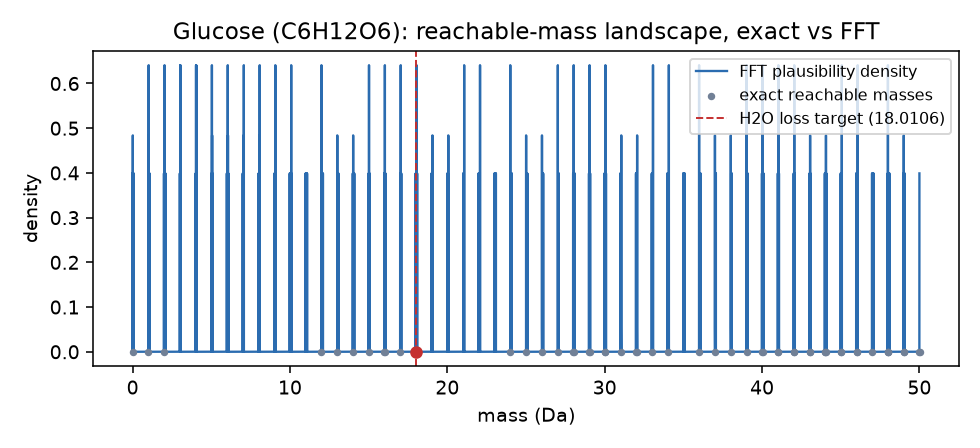
build_reachable_masses truncates once the number of distinct reachable
states passes max_states (150,000 by default) — fine for small formulas,
a real limitation for large ones. build_reachable_density_fft builds the
same landscape a different way: each element's own reachable masses are a
spike train, and the combined landscape across every element is their
convolution — which the convolution theorem turns into a plain pointwise
product of FFTs, and one inverse FFT back. The result is a plausibility
density, not a 0/1 reachability array: 0.3362 at the water-loss mass
means real, well-supported combinations land there, not that a fragment is
present with 34% probability.
Details
Where this came from
Promoted from Dense-Evolution-Discovery's CASMI26 spectral-identification experiments (real MS/MS data, the OTRF/Enveda CASMI26 Kaggle dataset). Six different formula-scoring methods were tried there for true-vs-wrong-formula discrimination on real spectra; RDBE-filtered exact subset-sum was the best of the six.
Why the RDBE filter matters
Checked directly on real CASMI26 data (n=1952 real spectra): without the
RDBE filter, an unrelated, wrong candidate formula "explains" a real
peak-pair mass difference by pure arithmetic coincidence 58.5% of the time
(mean). Filtering by RDBE >= 0 does not close that gap by itself, but it
does remove chemically impossible matches from both the right and wrong
candidates — so any downstream threshold built on build_reachable_masses
is scoring real, buildable neutral losses, not arithmetic accidents.
The FFT construction
build_reachable_density_fft uses the same technique Rockwood & Van Orden
use to compute isotope distributions (Ultrahigh-Speed Calculation of
Isotope Distributions, Anal. Chem. 1996): a 0..count_i spike train per
element instead of an isotope-abundance distribution, combined by FFT
multiplication instead of direct convolution. A single Gaussian broadening
(relative_tolerance, ppm-level) is applied once, after combining every
element, matching how real mass-measurement uncertainty scales with the
final observed mass rather than with each element's own contribution.
test_mass_decomposition.py verifies this FFT route agrees with both
brute-force convolution and build_reachable_masses's own exact
enumeration on the same formula.
Bounded, not unbounded, search
Both build_reachable_masses and build_reachable_density_fft cap each
element's usable count at 60 and take an explicit max_mass — real
molecules in this use case (CASMI26 precursors) are small enough that the
reachable-state space stays enumerable, and max_mass (usually the
precursor's own observed mass) keeps the search from exploring atom counts
no real fragment of that precursor could ever reach.
mass_decomposition 
Exact bounded mass-decomposition scoring: given a target mass difference and a molecular formula's atom budget, find the closest achievable sub-formula mass and its RDBE (degree-of-unsaturation) validity.
Promoted from Dense-Evolution-Discovery's CASMI26 spectral-identification experiments (real MS/MS mass-spectrometry data, OTRF/Enveda CASMI26 Kaggle dataset). Real, verified need: testing whether a peak-to-peak mass difference in a spectrum corresponds to a chemically real neutral loss requires knowing whether SOME integer combination of the precursor's own atoms reaches that mass -- a bounded integer subset-sum problem, solved here exactly via iterative Minkowski sums (not a continuous relaxation: the element-count space is small enough, typically under 10^5 states, to enumerate directly).
A candidate decomposition is chemically valid only if its Ring-plus- Double-Bond-Equivalent (degree of unsaturation) is non-negative:
RDBE = 1 + sum_i( count_i * (valence_i - 2) ) / 2
(standard organic chemistry -- the same closed-shell constraint already used in this package's own isodesmic bond-scission work). Verified on real CASMI26 data: without this filter, an unrelated (wrong) molecule's formula "explains" 58.5% of real peak-pair differences by coincidence alone (mean, n=1952 real spectra) -- RDBE-filtering doesn't remove that gap, but does remove chemically impossible matches from both sides, so any downstream feature/threshold built on this function is scoring real, buildable neutral losses only, not arithmetic coincidences.
build_reachable_density_fft below builds the same reachable-mass landscape a second way, via the convolution theorem (an FFT instead of direct enumeration) with a physically motivated ppm-level Gaussian tolerance instead of a fixed absolute one -- same physics, a different (and for large state spaces, cheaper) construction.
parse_formula 
Parse a molecular formula string (e.g. "C20H15N3O2") into {element: count}. Repeated elements in the string are summed, matching how real formula strings from different sources occasionally repeat a symbol instead of merging it. Elements not in ATOMIC_MASS/VALENCE are kept in the returned dict (parsing doesn't know or care which elements downstream functions recognize) -- rdbe()/build_reachable_masses()/build_reachable_density_fft() each skip an unrecognized element explicitly, not this function.
Source code in dense_evolution/utils/mass_decomposition.py
rdbe 
Ring-plus-Double-Bond-Equivalent (degree of unsaturation) of a formula: RDBE = 1 + sum(count_i * (valence_i - 2)) / 2. A real, non-negative closed-shell molecule/fragment always has RDBE >= 0; negative RDBE means the atom counts cannot form any valid closed- shell structure (too many univalent atoms for the given carbon/ nitrogen skeleton) -- unrecognized elements are ignored, not counted as an error, since a formula may legitimately include an element this module has no valence table entry for.
Source code in dense_evolution/utils/mass_decomposition.py
build_reachable_masses 
build_reachable_masses(
    formula_counts: Dict[str, int],
    max_mass: float,
    resolution: float = 0.0005,
    require_rdbe_valid: bool = True,
    max_states: int = 150000,
) -> np.ndarray
All sub-formula masses reachable by using 0..count_i atoms of each element in formula_counts (0 <= f <= formula_counts, component-wise), sorted ascending. Exact bounded subset-sum via iterative Minkowski sums over each element in turn -- correct because element counts here are small enough (real molecules, typically under a few hundred atoms total) that the reachable set never needs more than max_states entries after resolution-binning.
require_rdbe_valid=True (default) keeps, for each mass bin, only whether ANY chemically valid (RDBE >= 0) combination reaches it -- the physically meaningful question for neutral-loss matching. Pass False to get the pure arithmetic reachable set instead (e.g. for a sanity check against a hand-verified subset-sum test case).
max_mass bounds the search (usually the precursor's own observed mass) so element counts far beyond what's physically possible for that precursor are never explored.
Source code in dense_evolution/utils/mass_decomposition.py
nearest_reachable_mass 
The single closest value in a (sorted, ascending) reachable-mass
array to target, or None if the array is empty/trivial (only the
zero-formula placeholder). O(log n) via binary search.
Source code in dense_evolution/utils/mass_decomposition.py
build_reachable_density_fft 
build_reachable_density_fft(
    formula_counts: Dict[str, int],
    max_mass: float,
    grid_resolution: float = 0.001,
    relative_tolerance: float = 2e-05,
) -> Tuple[np.ndarray, np.ndarray]
Plausibility density over achievable sub-formula masses, via the convolution theorem instead of the exact Minkowski-sum enumeration in build_reachable_masses.
Real precedent, not a novel trick: this is the same FFT technique Rockwood & Van Orden use to compute isotope distributions (Anal. Chem. 1996, "Ultrahigh-Speed Calculation of Isotope Distributions") -- using 0..count_i copies of element i as a spike train instead of an isotope-abundance distribution, but the same convolution-theorem trick applies identically: the reachable-mass landscape of "any combination of atoms up to the formula's budget" is the CONVOLUTION of each element's own spike train, and convolution in mass-space is a plain pointwise PRODUCT in frequency space -- so combining K element types costs K FFTs and one inverse FFT, not an enumeration over the (potentially huge) product of per-element choices that build_reachable_masses must truncate (max_states) for.
A single Gaussian broadening is applied ONCE, after combining every
element -- not per-element -- because real mass-measurement
uncertainty (ppm-level, relative_tolerance) is a property of the
FINAL observed mass difference, not of each element's contribution
individually. This replaces build_reachable_masses's arbitrary fixed
absolute tolerance with a physically motivated relative (ppm) one.
Returns (mass_grid, density). density is a plausibility landscape, not a normalized probability distribution: many sub-formulas can coincide near the same mass and add constructively, so its peak height reflects how many/how well-supported combinations reach that mass, not a probability that sums to 1.
See test_mass_decomposition.py for a direct verification that this FFT-based construction agrees with brute-force convolution and with build_reachable_masses's own exact enumeration on the same formula.
Source code in dense_evolution/utils/mass_decomposition.py
density_at_mass 
Linearly-interpolated plausibility density at an arbitrary target mass (need not land exactly on the grid).