Spectral (exp(-iHt), and other functions of a matrix)
A quantum system with Hamiltonian H, left alone for a time t, evolves
into the state exp(-iHt). Any other smooth function of H -- sqrt(H),
log(H), a step function -- works the same way: diagonalize H, apply the
function to each energy, rotate back. dense_evolution.physics.spectral
does that, with one specific fix.
The fix matters because of a trap you can fall into without noticing. The
gradient of exp(-iHt) with respect to H -- the thing you need if you
want to learn or optimize H -- is computed wrongly by the standard
method when two of H's energies are exactly equal. Nothing crashes. The
number just comes back silently wrong.
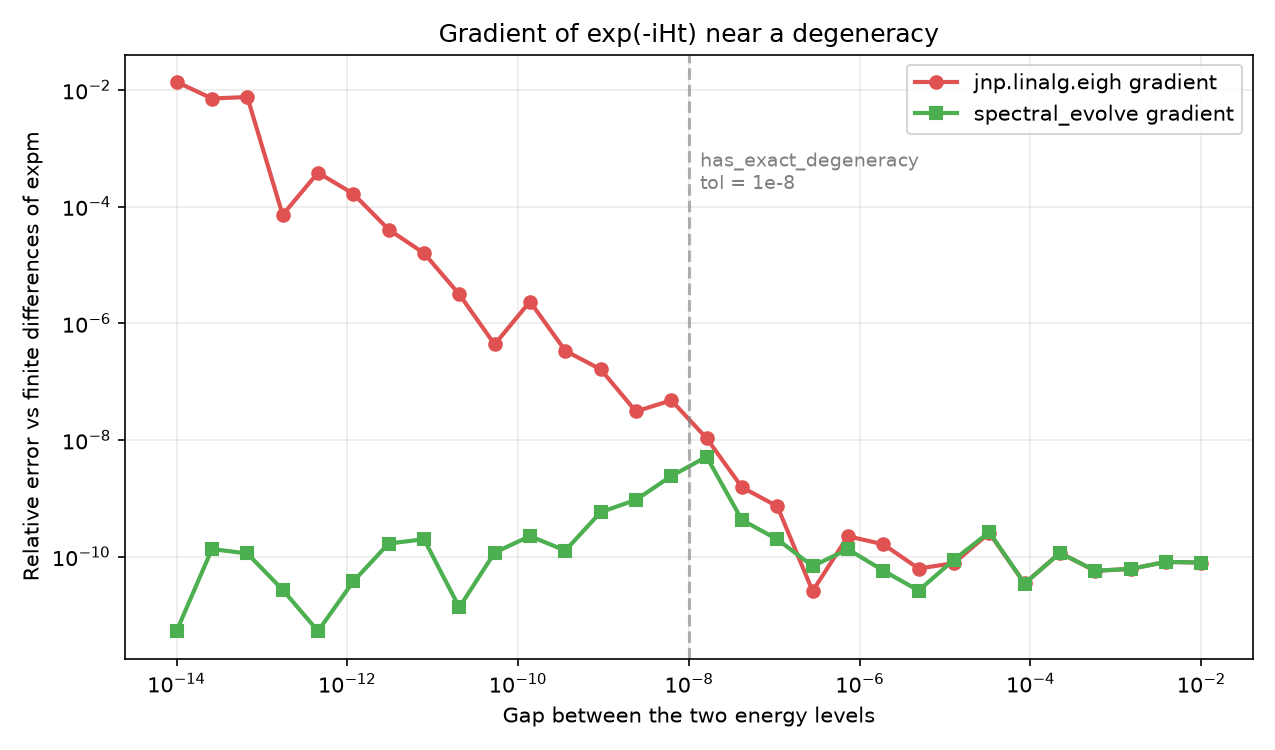
The x-axis is the gap between two energies of a random 4×4 Hamiltonian:
1e-14 on the left means they are almost identical, 1e-2 on the right
means they are well separated. Each curve is the relative error of a
gradient of exp(-iHt) against central finite differences of
jax.scipy.linalg.expm. Red is the standard jnp.linalg.eigh gradient,
green is spectral_evolve. Well separated, both sit at the 1e-10 level
of the finite-difference reference. As the gap closes the red error climbs
to 1e-2; the green one stays below 1e-8 everywhere.
Step 1. Recognize when you have a degenerate Hamiltonian
Two energies are degenerate when they are exactly equal -- two different states of the system happen to share the same energy. That is not a pathology: it happens in every symmetric molecule and every lattice model. Here is how to check for it:
import jax.numpy as jnp
from dense_evolution.physics import has_exact_degeneracy

H_deg = jnp.diag(jnp.array([1.0, 1.0, 2.0, 2.0]))
H_gap = jnp.diag(jnp.array([1.0, 1.001, 2.0, 2.001]))

has_exact_degeneracy(H_deg), has_exact_degeneracy(H_gap)
has_exact_degeneracy(H) answers a single question: are any two of H's
eigenvalues closer together than 1e-8? H_deg has two pairs of exactly
equal energies, so it returns True. H_gap looks identical on paper, but
its smallest gap is 0.001 -- far above the threshold -- so it returns
False.
This is a check, not a fix. Run it once before you decide which method to use for the gradient.
Step 2. Evolve a system forward in time
Now the actual evolution. spectral_evolve(H, t) gives you exp(-iHt) as
a matrix, and it is safe to differentiate at any gap:
import jax
import jax.numpy as jnp
from dense_evolution.physics import spectral_evolve

H = jnp.diag(jnp.array([1.0, 1.0, 2.0, 2.0], dtype=jnp.complex128))

def loss(H_):
    return jnp.real(jnp.sum(spectral_evolve(H_, t=1.0)))

jax.grad(loss)(H)
[[-0.841-0.540j -0.841-0.540j -0.956-0.068j -0.956-0.068j]
 [-0.841-0.540j -0.841-0.540j -0.956-0.068j -0.956-0.068j]
 [-0.956-0.068j -0.956-0.068j -0.909+0.416j -0.909+0.416j]
 [-0.956-0.068j -0.956-0.068j -0.909+0.416j -0.909+0.416j]]
Forward, spectral_evolve(H, t) is the same matrix you would get from
v @ diag(exp(-1j*w*t)) @ v.conj().T -- identical to machine precision.
The difference is entirely on the backward pass, where the gradient with
respect to H is built with a formula that stays correct at exact
degeneracy (Step 4 shows which).
loss(H_) reduces exp(-iHt) to a single real number, so jax.grad can
differentiate it. The result is a complex matrix of the same shape as H.
The output has a visible block structure -- rows and columns 0, 1 share
one value, and so do 2, 3 -- because those are the pairs of exactly
equal energies. The gradient respects the degeneracy: it does not try to
pick one basis state over the other inside a degenerate pair.
Step 3. Any function of H, not just the exponential
If the function you need is not exp(-iHt), use matrix_function_eigh
directly. It takes H, plus the function f you want to apply to the
eigenvalues, plus its derivative f_prime:
import jax.numpy as jnp
from dense_evolution.physics import matrix_function_eigh

H = jnp.diag(jnp.array([1.0, 1.0, 4.0, 4.0], dtype=jnp.complex128))

U = matrix_function_eigh(
    H,
    f       = lambda w: jnp.sqrt(w),
    f_prime = lambda w: 0.5 / jnp.sqrt(w),
)
U
[[1.+0.j 0.+0.j 0.+0.j 0.+0.j]
 [0.+0.j 1.+0.j 0.+0.j 0.+0.j]
 [0.+0.j 0.+0.j 2.+0.j 0.+0.j]
 [0.+0.j 0.+0.j 0.+0.j 2.+0.j]]
H has eigenvalues [1, 1, 4, 4]. f is sqrt, so the output is the
diagonal matrix with sqrt applied to each energy: [1, 1, 2, 2].
f_prime is only consulted where two eigenvalues are exactly equal, as the
limit of the divided difference in Step 4 -- away from a tie, the
non-degenerate entries use the divided difference, not f_prime's value.
Both callables must return complex values if H is complex. Neither should
be a closure over a JAX array: they are treated as static by JAX, so a
captured array will not be traced through.
spectral_evolve from Step 2 is a one-line wrapper around this function,
with f and f_prime filled in for the exponential.
Step 4. The formula behind the gradient
The gradient rule is the classical divided-difference formula for a matrix
function's derivative (Kato 1995, Ch. II.5.6). For a perturbation dH of
H:
with F the matrix of divided differences of the exponential:
F[i,j] = (exp(-i lambda_i t) - exp(-i lambda_j t)) / (lambda_i - lambda_j)   if lambda_i != lambda_j
F[i,j] = -i t exp(-i lambda_i t)                                              if lambda_i == lambda_j
The key detail is what is not in that formula: the eigenvectors V are
consumed only through the projected matrix V^dagger dH V, never carried
through as a differentiable output. At exact degeneracy the eigenvectors
are not unique -- any orthonormal basis of the degenerate subspace works
equally well, and jnp.linalg.eigh picks one arbitrarily. Differentiating
through that choice is what makes the standard method wrong. By not
depending on it, this formula stays correct.
Details
The actual failure mode. jnp.linalg.eigh's reverse-mode rule divides
by lambda_i - lambda_j for every eigenvector pair. At an exact tie that
is 0/0; JAX does not raise, it returns a finite but wrong number.
Measured on a Kaggle CPU kernel (Dense-Evolution-Discovery, PR #173):
standard eigh gradient error 0.98 versus Kato 4e-10 on an H with
four exact doubly-degenerate eigenvalues -- several orders of magnitude,
not a rounding difference. The plot at the top of this page measures the same
effect across the gap range (random 4×4 Hamiltonian, seed 0, gaps 1e-14
to 1e-2, finite-difference step 1e-6).
When to use which method.
| Situation | Method |
|---|---|
H has an exact degeneracy (gap below 1e-8) |
spectral_evolve / matrix_function_eigh |
H has only near-degeneracy (smallest gap above 1e-8) |
plain jnp.linalg.eigh |
| Forward value only, no gradient needed | plain jnp.linalg.eigh |
Above the threshold, spectral_evolve never hurts -- it just does not
help. The check from Step 1 is what makes the decision cheap.
References. Kato, T., Perturbation Theory for Linear Operators, Springer (1995), Ch. II.5.6 -- the classical divided-difference formula for matrix-function derivatives, which predates the modern quantum-chemistry literature by decades. Kasim, M. F., arXiv:2011.04366 (2020) -- the same formula stated specifically for degenerate Hermitian matrices, in a form more directly applicable to this code. Both were checked against the actual paper text, not trusted from a citation string alone.
Why custom_jvp rather than custom_vjp. The formula needs only
(H, dH, w, v) at the primal point, with no compatibility condition on
the perturbation direction. A VJP built on top of eigh's own eigenvector
output would need one (Kasim's Eq. 4.72, confirmed present in the actual
paper text). This is a structural property of the formula, not an
implementation preference.
Hermitian only. The module uses eigh, not eig. f and f_prime
must return complex values when f is complex. f_prime is only ever
consulted at lambda_i == lambda_j; the non-degenerate entries use the
divided difference, not its value, so it does not need to be accurate
away from the diagonal.
Standalone precision. Both matrix_function_eigh and
has_exact_degeneracy call dense_evolution.config.ensure_x64() on
entry, so a fresh process that reaches for them first does not stay at
JAX's float32 default.
Regression test. tests/unit/test_spectral.py includes a guard test,
test_std_eigh_fails_at_degeneracy, that asserts the standard eigh
gradient is wrong at degeneracy. If a future JAX release fixes this
upstream, that test fails loudly -- the signal to retire spectral_evolve,
not a silent pass.
spectral 
Gauge-safe gradients for spectral functions of a Hermitian matrix (V f(Lambda) V^dagger, e.g. time evolution exp(-iHt)) at exact eigenvalue degeneracy.
jnp.linalg.eigh's reverse-mode gradient divides by lambda_i - lambda_j
for every eigenvector pair. When two eigenvalues are exactly degenerate,
this does not raise and does not always produce NaN -- it can silently
return a finite, WRONG gradient, because the eigenvectors spanning a
degenerate eigenspace are not themselves uniquely defined (any orthonormal
basis of that subspace is an equally valid eigh output). Measured on a
real Kaggle CPU kernel (Dense-Evolution-Discovery, PR #173): std eigh
gradient error 0.98 vs Kato 4e-10 on an H with four exact doubly-degenerate
eigenvalues -- several orders of magnitude, not a rounding difference.
REFERENCES (verified against the actual paper text, not trusted at face value from a citation string alone): Kasim, M. F., "Derivatives of partial eigendecomposition of a real symmetric matrix for degenerate cases", arXiv:2011.04366 (2020). Kato, T., "Perturbation Theory for Linear Operators", Springer (1995), Ch. II.5.6 (the classical divided-difference formula for matrix function derivatives, predating Kasim by decades).
matrix_function_eigh uses a jax.custom_jvp based on Kato's
divided-difference formula for matrix functions:
d/deps [ V(eps) f(Lambda(eps)) V(eps)^dagger ] = V (F o (V^dagger dH V)) V^dagger
with F the matrix of divided differences of f:
F[i,j] = (f(lambda_i) - f(lambda_j)) / (lambda_i - lambda_j)   if lambda_i != lambda_j
F[i,j] = f'(lambda_i)                                          if lambda_i == lambda_j (incl. i == j)
This formula does not pass through eigenvectors as an intermediate OUTPUT,
so it is gauge-invariant: the contribution from a degenerate block uses
f'(lambda) directly, and there is no gauge choice to make -- unlike a
custom_vjp built directly on top of eigh's own eigenvector output,
which needs a compatibility condition on the perturbation direction
(Kasim's Eq. 4.72, confirmed present in the actual paper text) that this
formula does not.
WHEN TO USE THIS: - H has (or might have) exactly degenerate eigenvalues, AND - the function L(H) you differentiate depends on H through eigh, AND - the function is not trivially constant on degenerate blocks.
For a Hamiltonian with only near-degeneracy (e.g. min_gap ~1e-5, no exact
tie), plain jnp.linalg.eigh is correct and faster -- use
has_exact_degeneracy to check before reaching for spectral_evolve.
has_exact_degeneracy 
True if H has at least one pair of eigenvalues closer than tol.
Diagnostic only -- call this before choosing spectral_evolve (Kato) over plain jnp.linalg.eigh (std). The threshold is the same one the JVP rule below uses internally, so this is the exact condition under which the two methods disagree.
Source code in dense_evolution/physics/spectral.py
matrix_function_eigh 
V f(Lambda) V^dagger with a gauge-safe gradient at exact degeneracy.
Parameters:
| Name | Type | Description | Default |
|---|---|---|---|
H
|
(n, n) Hermitian matrix.
|
|
required |
f
|
callable, lambda (array) -> array. Applied elementwise to the
|
eigenvalues. |
required |
f_prime
|
callable, lambda (array) -> array. Analytic derivative of f,
|
used only in the JVP rule for degenerate blocks. Passed via nondiff_argnums since a Python closure is not a valid JAX type to trace. |
required |
Returns:
| Type | Description |
|---|---|
(n, n) complex128 matrix.
|
|
Example
import jax.numpy as jnp H = jnp.diag(jnp.array([1.0, 1.0, 2.0, 2.0], dtype=jnp.complex128)) U = matrix_function_eigh(H, lambda w: jnp.exp(-1j * w), lambda w: -1j * jnp.exp(-1j * w))
Source code in dense_evolution/physics/spectral.py
spectral_evolve 
exp(-i H t) with a gauge-safe gradient at exact degeneracy.
Equivalent forward to V @ diag(exp(-1j*w*t)) @ V.conj().T where
(w, V) is jnp.linalg.eigh(H). Backward uses Kato's divided-difference
rule (see module docstring) instead of eigh's own reverse-mode rule.
Source code in dense_evolution/physics/spectral.py
See also: Autodiff -- the differentiable-VQE pipeline
where an H with exact degeneracy would otherwise produce a silently
wrong parameter update. Observables -- the Pauli-sum
Hamiltonian format an H on this page would typically be built from.
```