Kullback-Leibler Divergence: the Real Thing Behind healing.py's Log-Ratio
In plain terms: Kullback-Leibler (KL) divergence is a standard way to measure how different two probability distributions are from each other. The healing pipeline's own code already uses something similar but not the real thing -- this page builds the actual, textbook-correct KL divergence and checks whether it behaves as a genuinely different, useful signal, or is just a rescaled copy of what was already there.
dense_evolution/mitigation/healing.py's own module docstring already flags an honest gap: calculate_vettore_dinamico's core term, log(E_B/E_A), is a log-likelihood ratio -- "the same elementary quantity Kullback-Leibler divergence is built from" -- but explicitly not a full KL divergence. It is one un-weighted log-ratio between two scalars, not a probability-weighted sum over a distribution: D_KL(p‖q) = Σₓ p(x)·log(p(x)/q(x)) (Kullback, S. & Leibler, R.A., "On Information and Sufficiency", Annals of Mathematical Statistics, 22(1), 79-86, 1951).
A real terminological nuance, checked directly against the paper's own text (Section 2, eq. 2.2-2.3) rather than assumed from the textbook formula alone: what this experiment implements is what Kullback & Leibler call I(1:2), "the mean information for discrimination between H₁ and H₂" -- what the broader literature later popularized as "the KL divergence". Their own word "divergence", J(1,2) = I(1:2) + I(2:1) (eq. 2.9), names the symmetrized sum of both directions instead. This experiment builds the real asymmetric I(1:2) quantity -- the one everyone today calls "KL divergence" -- and checks the concrete question a healing-pipeline maintainer would actually ask before adding it as a diagnostic: is it genuinely a different signal, or just a rescaling of what's already there?
Validation against an independent reference
kl_divergence(p, q) matches scipy.stats.entropy(p, q) (converted from nats to bits) to 1e-9 across 20 random trials on distributions of 2-8 outcomes -- an independent implementation, not just a self-consistency check.
Gibbs' inequality, asymmetry, support violation
- Non-negativity (Gibbs' inequality):
D_KL(p‖q) ≥ 0always, confirmed across 200 random distribution pairs (min observed:1.13e-03, never negative). - Asymmetry:
D_KL(p‖q) ≠ D_KL(q‖p)in general -- caught one accidental counterexample first (q=pwith indices reversed makes the two equal by construction, an index-permutation coincidence, not a property of KL divergence itself) before landing on a genuinely asymmetric pair (0.7188vs.0.8440bits). - Support violation: when
phas mass whereqis exactly zero,D_KL(p‖q) = +∞-- the mathematically correct value, not a numerical artifact to clamp away (the same lesson already learned the hard way forsandwiched_renyi_divergence'sα>1case). The reverse case --phas zero mass exactly whereqdoesn't -- stays finite, confirming the violation check doesn't fire spuriously.
Applied to real measurement-outcome distributions, and compared against healing.py's scalar
Using a 3-qubit |000⟩ state's measurement distribution as the reference, mixed with an increasing fraction of uniform noise: D_KL(ideal‖noisy) grows from 0 to 0.62 bits as noise goes from 0 to 40% -- monotonic by construction, confirming the divergence responds to genuine distributional drift.
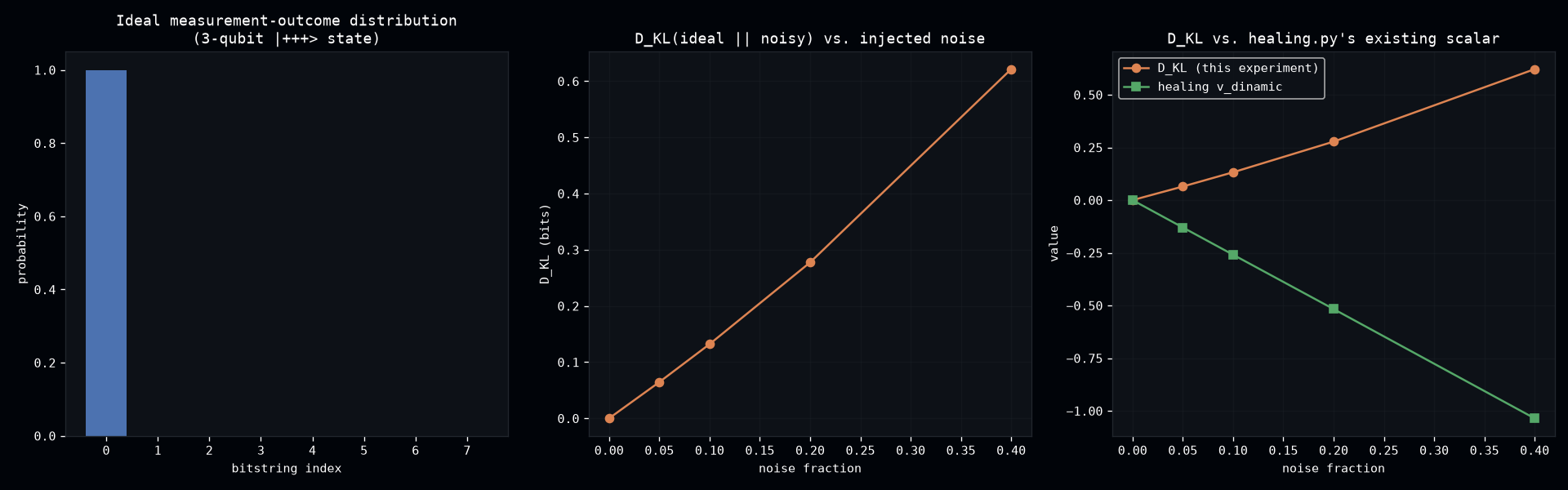
Run side by side against healing.py's existing calculate_vettore_dinamico on the same states: the two signals are not a trivial rescaling of each other -- D_KL stays positive and grows smoothly with noise, while v_dinamic goes negative over the same sweep (-1.04 at 40% noise). Confirms in a concrete, checkable way what the module docstring already claimed from the formulas alone: these are genuinely different quantities, not the same thing under two names.
Status
Validated in scripts/diagnostics_healing/kullback_leibler_divergence.py and tests/diagnostics_healing/test_kullback_leibler_divergence.py (7/7 passing). Promoted to dense_evolution.mitigation.kl_divergence/kl_divergence_jit as an additive diagnostic, alongside sandwiched_renyi_divergence -- not a replacement for healing.py's existing (already-validated) scalar signal.