Quantum Ruzsa Key Unitary -> Magic Entropy as a Noise Diagnostic
In plain terms: "magic" is a technical measure of how much a quantum state resists being simulated efficiently on a classical computer -- more magic means harder to fake classically. A paper proposed a new way to measure it, but this page finds that the proposed formula doesn't actually exist for qubits as originally described -- and builds the real object from a companion paper instead, which does work as a genuine, usable diagnostic.
A "Quantum Ruzsa Divergence" for dense_evolution was proposed as a pairwise convolution rho \boxtimes sigma parametrized by s,t with s^2+t^2 = 1 mod d, following Bu, Gu, Jaffe (arXiv:2401.14385). That equation has no solution for qubits (d=2 -- confirmed by reading the paper directly). The companion paper (arXiv:2306.09292, "Stabilizer testing and magic entropy") does not patch this gap with a qubit-specific pairwise formula; it replaces the pairwise convolution with a structurally different object entirely.
What the paper actually defines (Def. 7-8, p.6)
The "Key Unitary" needs K quantum registers with K odd, K >= 3 -- there is no K=2 case. Two layers of CNOTs across the registers:
- Fan register 1's value into every other register:
CNOT(1->i)fori=2..K. - XOR every register back into register 1:
CNOT(j->1)forj=2..K.
On computational basis states this gives (Lemma 9, verified against our implementation basis-state by basis-state): V|x1 x2 x3> = |x1+x2+x3> (x) |x2+x1> (x) |x3+x1> (mod 2). The convolution is boxtimes_K(rho_1,...,rho_K) = Tr_{2..K}[V(rho_1 (x) ... (x) rho_K)V^dagger], keeping only register 1.
For qubits the smallest valid K is 3, and there is no pairwise rho boxtimes sigma -- only a minimum 3-fold self-convolution boxtimes_3(psi,psi,psi) of one state with itself. The paper calls the entropy of that reduced output register "magic entropy": zero for stabilizer states, positive for non-stabilizer ("magic") states.
So "a Ruzsa divergence between two qubit states" is not implementable correctly, because no correct definition of it exists in either source paper. The real, well-defined qubit object is different: a single-state magic monotone, not a two-state divergence.
What we built instead
KEY_UNITARY_K3: the real 8x8 unitary for K=3, n=1-qubit registers, built directly from the CNOT circuit in Definition 7 (not a shortcut formula) and verified basis-state by basis-state against the paper's own Lemma 9 identity.magic_entropy(rho): von Neumann entropy of the reduced output register after 3-fold self-convolution.
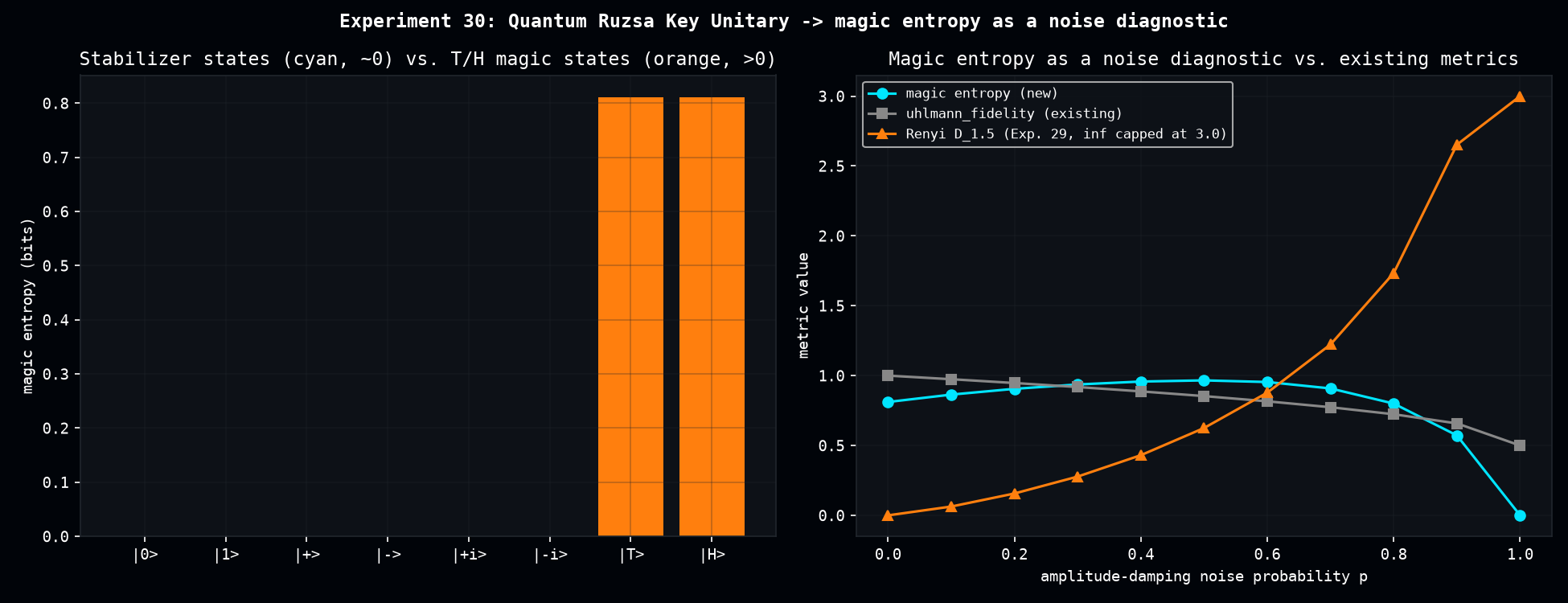
Validated against the paper's own claim: all six single-qubit stabilizer states (|0>, |1>, |+>, |->, |+i>, |-i>) give magic entropy ~0 (max 4e-11, floating-point noise); the two standard single-qubit magic states, |T> and |H>, both give 0.811 bits.
Using it as a noise diagnostic (and a wrong first guess, corrected)
The first hypothesis was that magic entropy should decay to 0 under any noise channel, since noise "washes out" quantum resources. Testing on a |T> state under depolarizing noise proved that wrong: at full depolarization (p=1) the state is I/2, which is maximally mixed but not a pure stabilizer state -- and magic_entropy(I/2) = 1 (its own intrinsic entropy), not 0. Verified directly: depolarizing drives magic entropy monotonically up to 1 and it stays there.
Amplitude damping tells a different, more informative story. Its p=1 fixed point is the pure state |0>, which is a stabilizer state -- so magic entropy rises to a peak around p=0.5-0.6 and then falls all the way back to exactly 0 by p=1. Compared side by side with the two diagnostics this repo already has, on the same |T>-state amplitude-damping sweep:
uhlmann_fidelity(existing) decreases smoothly and monotonically toward its own floor.- Sandwiched Renyi divergence (Experiment 29, alpha=1.5) increases monotonically and diverges to
+infatp=1-- a genuine support-mismatch case, exactly the behavior Experiment 29's fix was built to produce correctly. - Magic entropy (this experiment) is the only one of the three that is non-monotonic: it rises then returns to exactly 0.
None of these three curves is a simple rescaling of another -- they capture genuinely different information about how the state degrades.
Status
magic_entropy is implemented and validated in scripts/diagnostics_healing/quantum_ruzsa_magic_entropy.py, not yet promoted to dense_evolution. Two things worth resolving before promotion: (a) whether the non-monotonic amplitude-damping shape is a generally useful early-warning signal (e.g. distinguishing "still recoverable" from "past the point of no return") or just a curiosity of this one channel, and (b) the connection to Classical Shadows raised separately (shadow-based magic estimation) is still open.
Reproduce
Produces data/quantum_ruzsa_magic_entropy_states.csv, data/quantum_ruzsa_magic_entropy_noise_sweep.csv.