Leaky-Switch Differentiable Healing
In plain terms: to use the data-correction ("healing") step inside a training loop that needs gradients, someone proposed a smoothed, differentiable rewrite of it. This page checks two separate things: does it actually produce usable gradients (yes), and does it correct data as well as the version already shipped (no -- clearly worse).
The same proposal line behind Stratonovich-Projection Vector Healing and the Healing Trigger False-Positive Audit also suggested a JAX/XLA rewrite of the healing filter using jax.lax.scan and a sigmoid "soft trigger" (blending the raw and healed values continuously) instead of a hard if/else branch, plus a small "leaky" floor (trigger_activation * (1 - 1e-4)) specifically meant to prevent the sigmoid from fully saturating and killing the gradient -- intended for use cases where healing sits inside a differentiable training loop (e.g. a VQE loss). The original validation was a single 4x8 toy gradient check on one seed, and never checked healing quality at all, only that a gradient existed.
This page asks two separate questions.
1. Differentiability -- real, as claimed
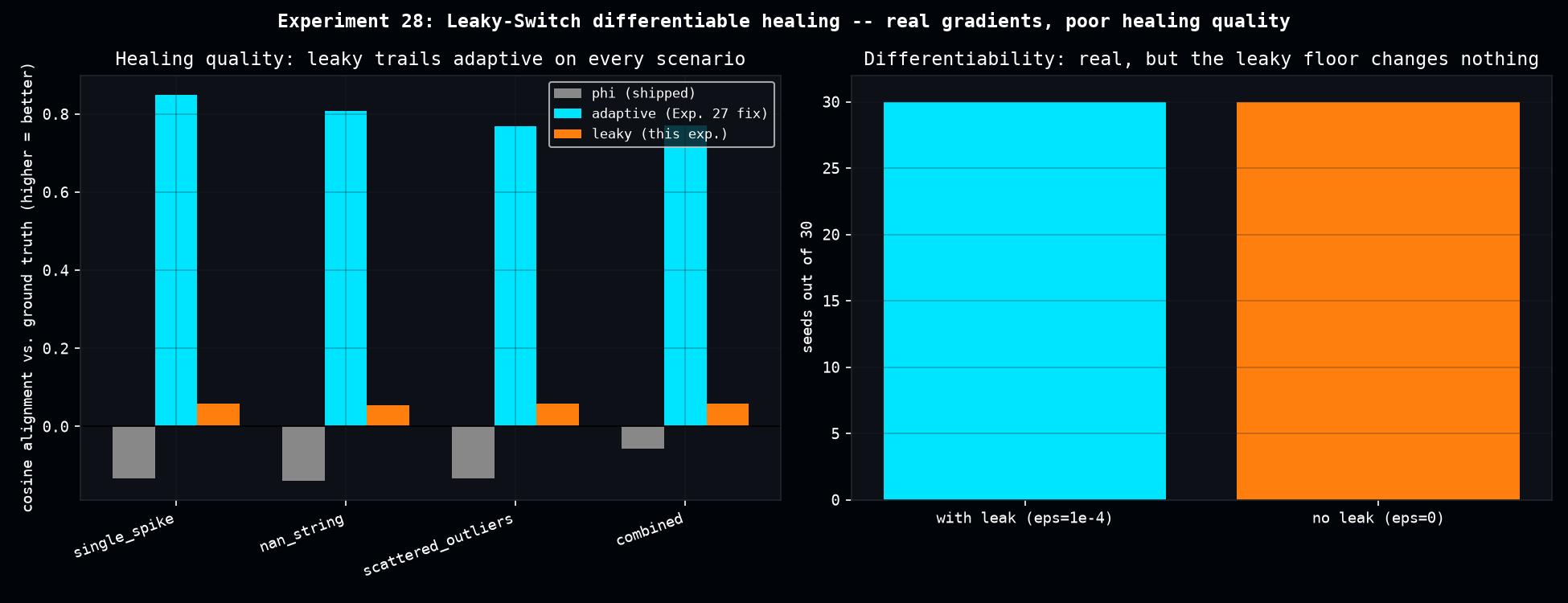
30/30 seeds give finite, non-zero jax.grad on a sum(healed**2) loss (gradient norm 48.7-71.0). But the "leaky" 1e-4 floor turned out to be unnecessary insurance for every case tested: an ablation removing it entirely (epsilon=0) also gave 30/30 finite non-zero gradients, with gradient norms within 0.1% of the leaky version -- the plain jax.nn.sigmoid never saturated hard enough in these trials to need the floor.
2. Healing quality -- clearly worse than what's already shipped
Compared against the MAD-adaptive trigger on the same 4 corruption scenarios x 40 seeds, this design's cosine alignment with the ground truth sits at ~0.055-0.058 (barely above chance) versus ~0.77-0.85 for the adaptive trigger -- a 0-10% win rate for the leaky design, every comparison significant at p<0.0001. L2 error is also suspiciously near-constant (~56.7-56.8) across every corruption type, the signature of a filter that smooths indiscriminately rather than correcting the actual anomalies.
Three concrete structural reasons stand out:
- a fixed 0.25 sigmoid threshold, not the MAD-adaptive one
- zero-imputation of NaN/Inf instead of column-mean imputation
jax.lax.scancascading each correction into the next window's statistics (the shippedenhanced_dense_healing_hybriddeliberately does not cascade)
On the arXiv:1510.05279 citation
Re-reading the actual Hu & Šverák paper again, specifically looking for anything that could improve this design, turns up nothing applicable. The paper's Euler-Arnold bracket requires a known finite-dimensional Lie algebra structure that arbitrary hidden-state vectors don't have. More directly: this design has no stochastic noise term at all (healed = state_A + drift_step * 0.5 is fully deterministic), so the paper's central Itô-vs-Stratonovich concern -- the entire point of citing this specific paper -- doesn't even arise here.
Verdict
Sound differentiability engineering, not promoted to dense-evolution. Healing quality would need the same MAD-adaptive threshold and NaN-handling fixes documented in the trigger audit, rewritten differentiably (a non-trivial task, since median/MAD have no useful gradient as-is and would need a soft approximation), before being competitive. Documented here as an honest negative result rather than left unrecorded.
Reproduce
Produces data/leaky_differentiable_healing.csv.