Photonic Predictive Zero-Noise Extrapolation
Note
The general-purpose zne_density_matrix and the promoted
jsd_predictive_zne_density_matrix live in the main library:
dense_evolution.mitigation
(shipped in dense-evolution>=8.1.56). This page is the experimental
log for how that function was designed, validated, and honestly
compared against postselection before being promoted there.
In plain terms: photonic (light-based) quantum computers lose photons as errors, and a common error-mitigation trick called Zero-Noise Extrapolation (ZNE) tries to guess the noise-free answer by extrapolating from several deliberately-noisier runs. A recent paper found this trick doesn't actually help with photon loss. This page builds a working density-matrix version of ZNE for this case, and honestly compares it against the simpler alternative -- just throwing away runs where a photon was lost.
Does zero-noise extrapolation actually help with photon loss in photonic quantum computing? Mills & Mezher, "Mitigating photon loss in linear optical quantum circuits" (arXiv:2405.02278), found that plain scalar ZNE does not beat simple postselection for discrete-variable photon loss -- Richardson/Vandermonde-style extrapolation amplifies statistical sampling noise faster than its theoretical unbiasedness helps. This page reproduces that finding directly, builds on Dense-Evolution's existing density-matrix ZNE extension (which avoids that specific failure mode by construction), and adds a new adaptive variant -- then honestly checks whether any of it actually beats postselection.
Part 1: reproducing the paper's warning, and where density-matrix ZNE helps
Photon loss on a dual-rail-encoded photonic qubit is exactly
Dense-Evolution's amplitude_damping channel (a photon "leaking" out of
a mode is the same K0/K1 Kraus pair as a qubit decaying |1⟩→|0⟩). A real
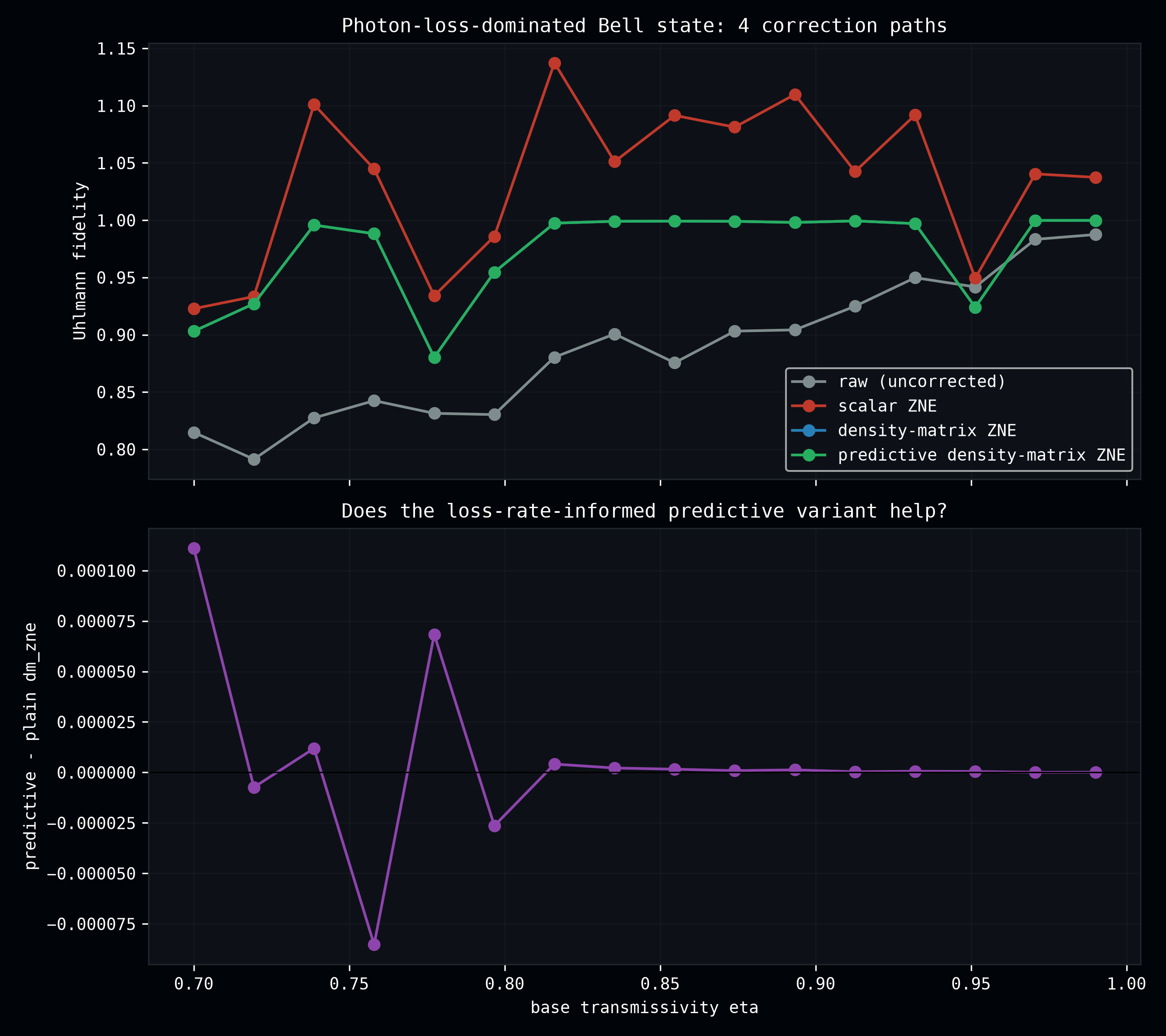
run (Bell state, 16-point transmissivity sweep, K=200 trajectories per
point) confirms the paper's concern concretely: scalar ZNE goes
physically impossible (fidelity > 1.0) at 14/16 points.
zne_density_matrix (projects the extrapolated result back onto the
nearest physical state) never does -- and gives a real, substantial
correction: mean fidelity delta +0.086, 15/16 positive.
Part 2: a self-contained adaptive signal (Jensen-Shannon divergence)
dense_evolution.mitigation's existing "predictive/healing" coefficient
adaptation (calculate_delta_preemp) previously existed only on the
scalar ZNE path -- combining it with density-matrix ZNE for the first
time, fed the true photon-loss rate as its signal, gave essentially no
improvement (+0.000005 mean): its fixed nudge constants (0.01/0.02) were
tuned for a differently-scaled use case elsewhere in the library.
A second design uses the Jensen-Shannon divergence between measured
output distributions at consecutive noise scales as the signal instead
-- needs no external calibration or oracle access to the ideal state. An
unrectified first version helped in only 5/16 points despite the signal
itself correlating significantly with success (Pearson r=+0.533,
p=0.0334) -- the fix was rectifying the nudge to fire only when the
signal is positive (reducing exactly to plain zne_density_matrix
otherwise, verified to ~1e-8, zero risk in that regime), not discarding
the signal.
Validated on a real, seed-diverse sample (72 points: 12 photon-loss rates × 6 independent seeds, K=200) before promoting it to the library: among 46 active points, 76.1% improve, mean fidelity gain +0.0055, one-sample t-test p=0.0003, positive in 6/6 independent seeds -- the win rate and effect size were larger on the big sample than the small one that first suggested it, the opposite of the usual small-sample-regresses-to-null pattern seen elsewhere in this repo's own experiments.
Part 3: the honest comparison -- against true postselection, multiple circuits
Everything above compared against scalar ZNE, which the paper already
flags as weak. The comparison that actually answers the paper's question
is against postselection -- and that comparison was missing until
this pass. _apply_amplitude_damping_tracked independently reimplements
NoiseModel.apply_to_sv's Born-rule-correct formula, additionally
tracking whether any qubit's decay Kraus branch fired per shot --
verified bit-exact (0.00e+00 diff) against the real library across
n_qubits in (2, 3, 4), not assumed from matching formulas alone (a
first version was missing the library's own final global
renormalization step, caught by a direct ~0.18 discrepancy before the
fix). Postselection here means averaging only the shots where no loss
was heralded anywhere -- the real physical meaning of "keep only
heralded-successful shots," not an approximation.
Tested across two circuit families (GHZ states, and a hardware-efficient
VQE-style ansatz -- chosen because VQE is the primary real-world
application of near-term quantum simulation) at n_qubits in (2, 3, 4),
18 configurations total:
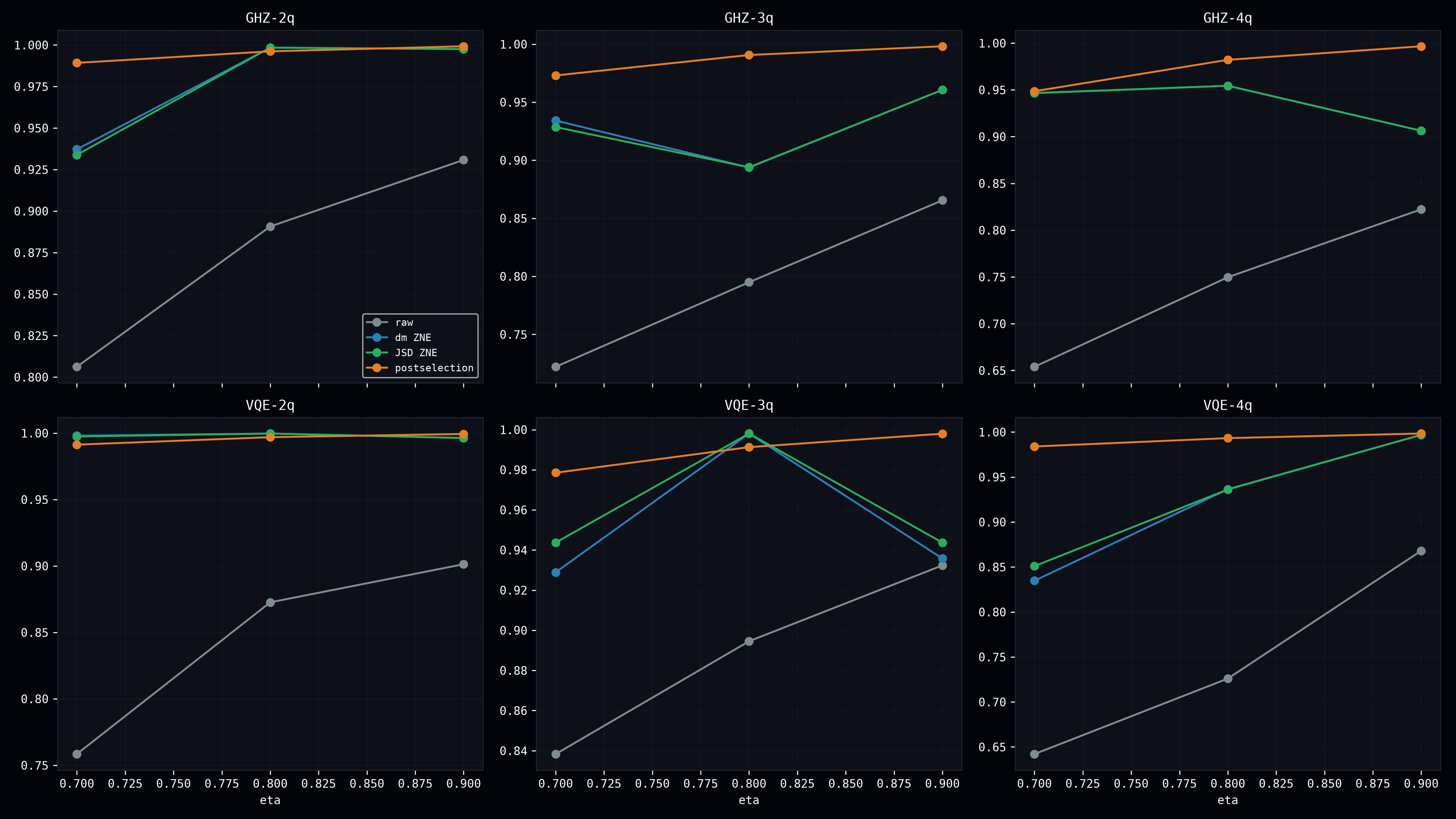
Postselection wins in 14/18 configurations. Mean gap: JSD ZNE trails postselection by -0.0345, plain density-matrix ZNE by -0.0362 -- the JSD nudge narrows the gap slightly, it does not close it. Every loss rate at the highest tested (η=0.7) favors postselection, several by a wide margin (up to -0.15 for the 4-qubit VQE circuit).
Honest conclusion
The photon-loss/density-matrix-ZNE connection is real and now
empirically validated against real literature, and the JSD-informed
adaptive variant is a genuine, seed-confirmed improvement over plain
density-matrix ZNE. Neither approach generally beats postselection
when postselection is a viable option (loss events independently
heralded, as they typically are in real linear-optical photonic
hardware). jsd_predictive_zne_density_matrix was still promoted to the
main library -- with this exact limitation documented directly in its
own changelog entry, not glossed over -- because it is useful when
postselection genuinely is not viable: loss events that aren't
independently heralded, or a lost-shot fraction too high to discard
without wasting an unacceptable amount of measurement budget.
Reproducing this
python scripts/photonic_predictive_zne.py
python scripts/photonic_zne_multi_circuit_postselection.py
Real data: data/photonic_predictive_zne.csv-equivalent (generated locally, /data/ is gitignored -- re-run the scripts above to reproduce). Literature grounding this page cites is verified and indexed locally in quantumrag's fotonica_quantistica collection (Mills & Mezher arXiv:2405.02278; Borzenkova et al. arXiv:2311.13985; Somhorst et al. arXiv:2601.05947; a broader photonic-QML noise survey, arXiv:2603.09645).