Cosmic-Ray Error Bursts: Validating the Dissipative Counterpart to Trotter Pulses
In plain terms: a stray cosmic ray hitting a quantum chip can knock out many qubits at once for a brief window, then recovery happens gradually over milliseconds -- a real, measured effect on Google's own hardware. This experiment reproduces that measured error-burst shape inside Dense-Evolution's simulator, to validate a new tool for modeling this kind of time-varying, non-constant noise.
arXiv:2104.05219 (McEwen et al., published in Nature Physics) directly measures what happens when a cosmic-ray/gamma-ray impact hits a 26-qubit Google Sycamore chip: a burst of quasiparticles transiently collapses the chip's effective T1, pushing simultaneous decay errors from a baseline ~4/26 qubits to ~10/26 within ~10us, further to ~15/26 over ~1ms, then back down exponentially with a time constant tightly grouped in the 25-30ms range (fitted across 415 real events). This experiment reproduces that measured shape with dense_evolution.continuous_dissipative_evolve, promoted straight out of the discussion that followed germanium_iswap_validation.py -- its first real-data validation.
Scope note: this validates continuous_dissipative_evolve (Dense-Evolution PR #122) and an amplitude-damping channel matching this paper's own reported error asymmetry. It does not reproduce the paper's matched-filter event-detection algorithm, the spatial hotspot dynamics across the real 26-qubit array, or the T-RReCS multi-timescale measurement protocol -- this is a single representative qubit, not a 26-qubit simulation.
Why this needed a new utility, not the one already promoted
continuous_pulse_evolve (Dense-Evolution PR #121), promoted from germanium_iswap_validation.py's exact_final_state, evolves a pure state under a time-dependent Hamiltonian -- correct for a coherent control pulse, wrong for this paper's mechanism. The paper's own asymmetry finding (decay errors only, no excess excitation errors in their control RReCS run) confirms this is quasiparticle-poisoning dissipation, not a coherent drive: a rising and falling decay rate, which cannot be written as a Hermitian Hamiltonian coefficient. continuous_dissipative_evolve scans a density matrix through a time-dependent CPTP channel instead -- the same jax.lax.scan pattern, applied to the physics that actually needs it.
Two honest approximations, kept separate from what's paper-exact
- The rise shape is ours, the decay is the paper's own fit. The paper states two descriptive rise timescales (~10us, ~1ms) with precise error counts at each, but publishes no closed-form rise fit -- modeled here as two sequential saturating exponentials (
tau1=3us,tau2=300us) chosen only to pass through those two points. The decay, in contrast, uses the paper's own directly fitted single-exponential time constant (25ms, the central value of their reported 25-30ms range). - The baseline T1 is an assumption, the event's scaling is not. The paper's raw baseline count ("~4/26") mixes true T1 decay with finite readout infidelity by its own admission, so reading it directly as a single-qubit decay probability implies an unrealistically short T1 (~6us). Instead, the model fixes a representative baseline T1 (
T1_BASELINE_ASSUMED_US = 20, a plausible value for this hardware generation, isolated to one named constant) and scales the instantaneous decay probability by the paper's own real, dimensionless ratios -- peak/baseline = 15/4 = 3.75x, intermediate/baseline = 10/4 = 2.5x.
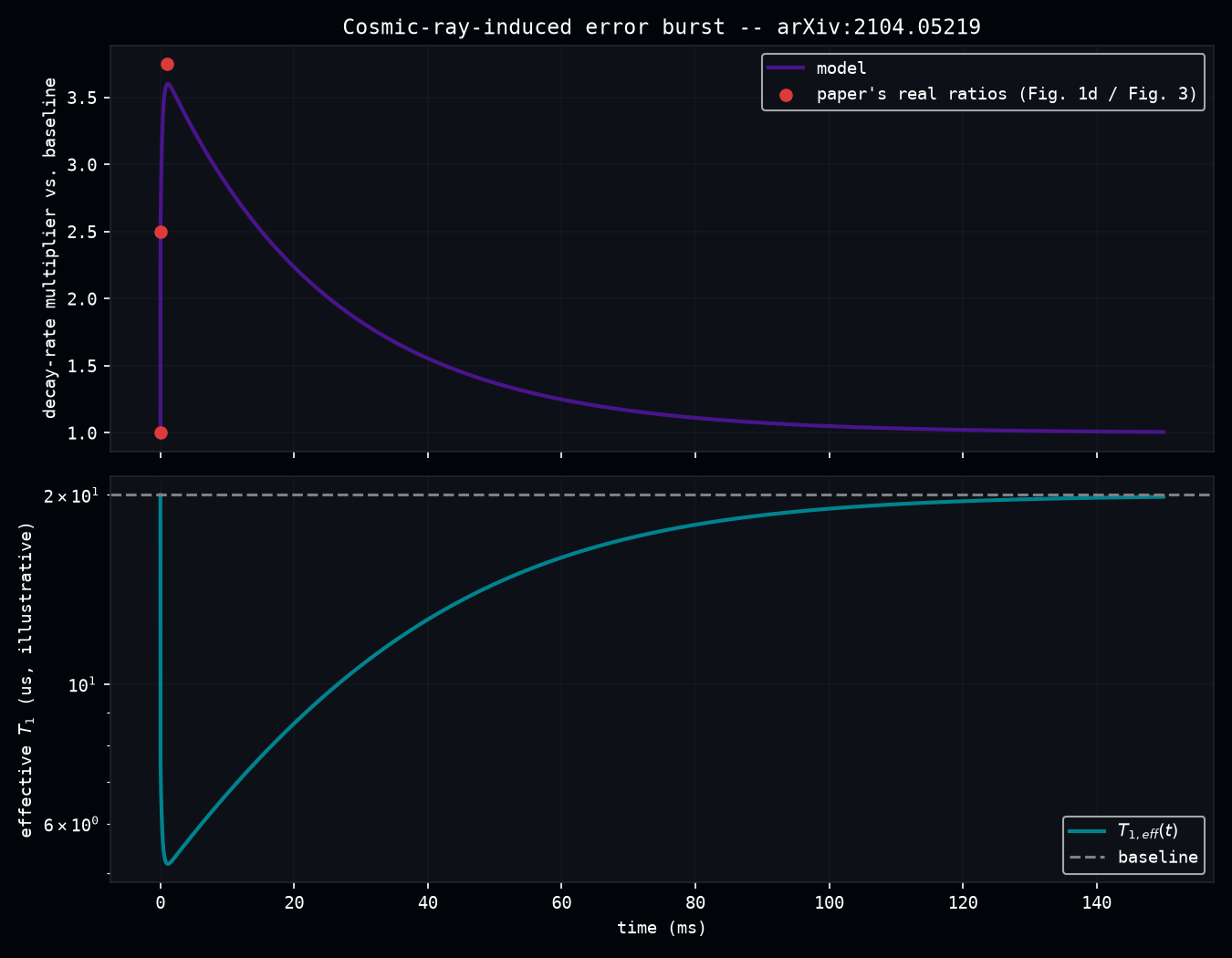
The top panel's model curve passes through the paper's three real (time, ratio) points by construction; the bottom panel translates the same profile into an effective T1 (illustrative, not a literal measured device T1 -- see the script's docstring), dropping 4x at peak and recovering to baseline over the fitted 25ms tail.
Amplitude damping, not depolarizing
dense_evolution.global_depolarizing_channel (the SPAM channel promoted from the germanium experiment) is symmetric -- it mixes any state toward the fully-mixed state. This paper's mechanism is asymmetric: population only ever moves |1> → |0>. The experiment defines its own amplitude-damping channel matching that, and checks directly that a |0><0| input passes through untouched -- the real signature the paper uses to identify quasiparticle poisoning.
Early-time survival: where the event's effect is actually visible
A continuously idle, unreset qubit with a 20us baseline T1 has already decayed to numerical zero long before the 25ms recovery tail is relevant -- 1ms is 50 baseline lifetimes. That is not a bug in the model; it is the paper's own point about quantum error correction needing to run faster than T1. The event's real, checkable effect is on the early decay rate, while both curves are still numerically distinguishable from zero:
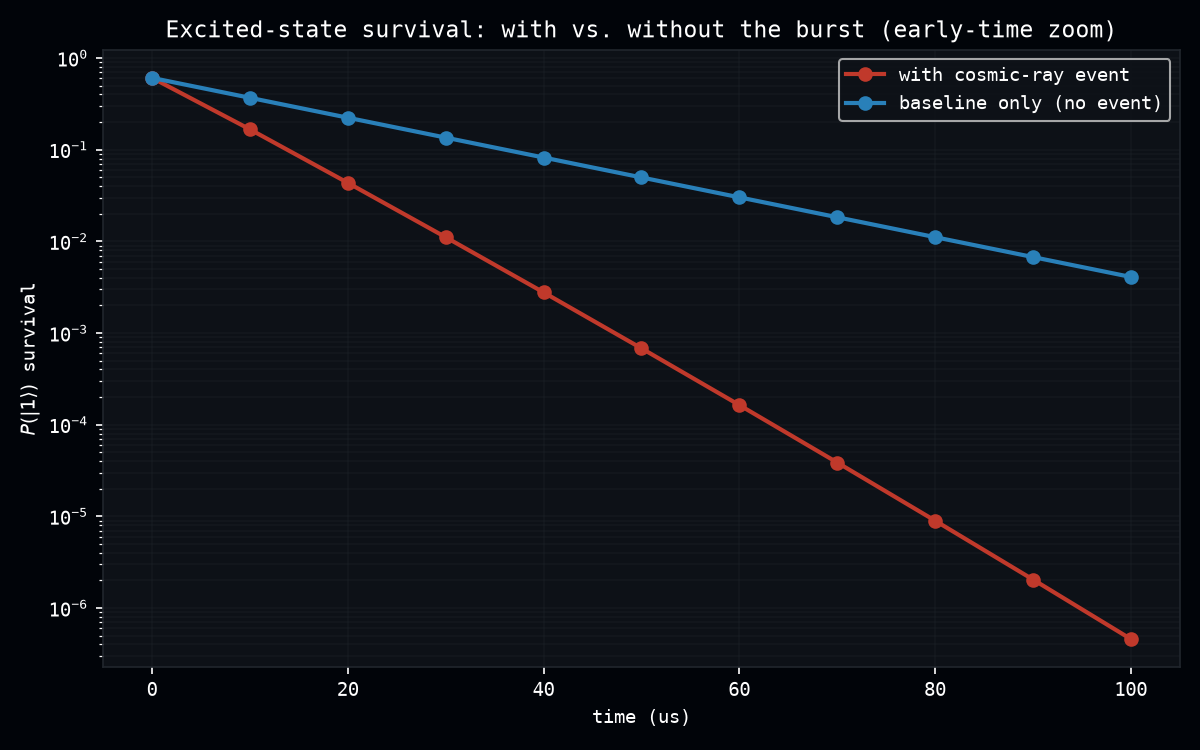
At t=20us, survival with the event is 5.1x lower than the undisturbed baseline (0.043 vs. 0.223) -- directly consistent with the paper's own framing of these events as "catastrophic" for any computation trying to hold a state through one.
Status
Validated in scripts/noise_mitigation_validation/cosmic_ray_burst_validation.py and tests/noise_mitigation_validation/test_cosmic_ray_burst_validation.py (7/7 passing). Uses continuous_dissipative_evolve/amplitude_damping_channel, both released in Dense-Evolution v8.1.67.