Classical Shadows: a Purity-Estimator Correction, and Shadow-Estimated Magic Entropy
In plain terms: "classical shadows" is a technique for estimating properties of a quantum state from a small number of random measurements, instead of needing to fully reconstruct the state (which gets exponentially expensive as qubit count grows). This page finds and fixes a real bug in that estimator, then uses the fixed version for something genuinely new: estimating a state's "magic" -- a measure of how hard it is to fake on a classical computer -- from measurement data alone, instead of the exact state.
Following Huang, Kueng, Preskill 2020, "Predicting Many Properties of a Quantum System from Very Few Measurements," dense_evolution/circuits/shadows.py implements a ClassicalShadow class and predict_renyi_entropy. Checking the purity estimator against the real paper turned up a correction, and also a genuine, well-supported extension worth building: using the same shadow machinery to estimate Experiment 30's magic entropy from measurement snapshots instead of the exact state.
A correction: a missing transpose
The purity estimator's cross-trace between independent shadow snapshots was computed as:
This contracts matching indices with no transpose — sum_jk A_i[j,k]*A_m[j,k] — not Tr(A_i @ A_m) = sum_jk A_i[j,k]*A_m[k,j]. Verified directly on two fixed Hermitian test matrices with complex off-diagonal entries: the buggy contraction gives 23.0, the true Tr(A@B) is 11.0.
The error is silent whenever every snapshot happens to be real-valued — a Z-basis-only case, which is exactly why an earlier Bell-state S2=1.000000 check never caught it. It is wrong whenever X/Y-basis snapshots (complex entries) are mixed in, which is the normal case for a real random-Pauli shadow protocol. predict_renyi_entropy inherited the error since it calls the same purity function.
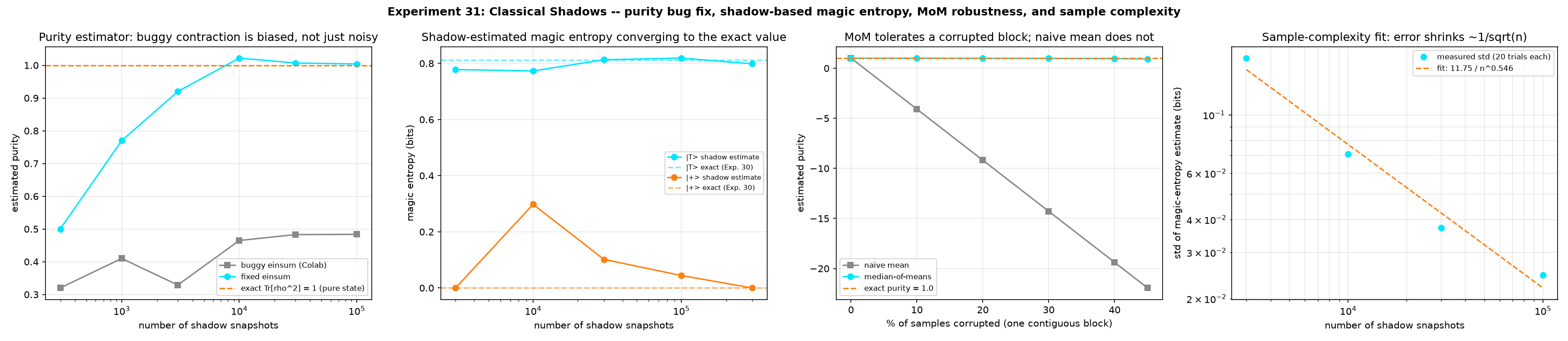
Fixed on a genuinely complex case (a |T>-state shadow run, which does exercise all three Pauli bases): the buggy estimator stays biased at 0.48 even at 100,000 snapshots (Tr[rho^2]=1 is the true value for a pure state) — a systematic bias, not statistical noise, so more samples do not fix it. The corrected contraction converges to 1.01.
The extension: shadow-estimated magic entropy
Huang et al.'s headline nonlinear example is estimating Tr[rho^2] (purity) from two independent shadow copies via a U-statistic — and they state explicitly that "this approach readily generalizes to higher order polynomials." Experiment 30's magic entropy needs exactly a higher-order polynomial: the reduced convolution matrix R = Tr_{2,3}[V(rho (x) rho (x) rho)V^dagger] is a linear functional of rho^{(x)3} (3 copies), since partial trace and unitary conjugation are both linear. Each entry can be written R_ab = Tr[O_ab . rho^{(x)3}] for a fixed operator O_ab built directly from the Key Unitary V -- exactly the shape the paper's own generalization statement covers, not an invented extension.
So: group the single-qubit shadow snapshots into disjoint triples, estimate each entry of R as the average over triples of Tr[O_ab . (rho_hat_i (x) rho_hat_j (x) rho_hat_k)] (unbiased, since each snapshot in a triple is an independent unbiased estimator of rho), then compute the von Neumann entropy of the estimated R classically (with Hermitization, eigenvalue clipping, and trace renormalization to absorb estimation noise). The entropy step itself is never shadow-estimated directly -- Huang et al. don't do this for their own Rényi-2 entanglement entropy example either; only the linear reduced-matrix reconstruction is shadow-based, and entropy is computed classically afterward on the small estimated matrix.
Validated against Experiment 30's exact values: a |T>-state (exact magic entropy 0.811 bits) and a |+>-state (exact 0.000, a stabilizer state). At 300,000 snapshots the shadow estimate lands within 0.03 bits of both exact values, though convergence is visibly noisy along the way (a real, honestly-reported observation, not a smooth curve) -- reflecting real single-qubit shadow variance, not a flaw in the estimator's construction (confirmed unbiased separately: the O_ab operators exactly reproduce Experiment 30's reduced matrix when fed exact, noiseless copies of rho^{(x)3} instead of shadow estimates).
A second, smaller bug caught along the way
Building and testing the O_ab operators surfaced an unrelated index-ordering slip in this experiment's own first draft: Tr[(|a><b| (x) I) M] = R_ba, not R_ab (confirmed by direct index expansion, not just the cyclic-trace shortcut, which looks right on paper but hides the swap). It happened not to affect the entropy result here (a Hermitian matrix and its transpose-conjugate share eigenvalues, so the final magic-entropy numbers above were unaffected either way) but would have broken any other use of the reconstructed matrix R -- caught by a dedicated unit test that checks matrix entries directly rather than only the downstream entropy.
Making it robust: median-of-means
The original version above used plain averaging over triples/pairs — unbiased, but with an unbounded failure mode: a systematic fault affecting one contiguous stretch of a measurement run (e.g. a calibration drift, not independent per-sample noise) drags a plain mean proportionally to how much of the run it corrupted. Huang et al.'s own protocol uses median-of-means (MoM) instead: split the samples into n_groups batches, average each batch, then take the median of those batch means.
Verified directly, not just cited: with n_groups=20, corrupting a growing contiguous fraction of a |T>-state purity run (true value 1.0) —
| % corrupted | naive mean | median-of-means |
|---|---|---|
| 0% | 1.01 | 1.00 |
| 20% | -9.18 | 1.00 |
| 40% | -19.39 | 0.97 |
| 45% | -21.94 | 0.93 |
— the naive mean is dragged linearly away from the truth from the first corrupted sample on; median-of-means stays within 0.5 of the true value all the way to 40% corruption (a real, asserted property, not just a plot), since fewer than half of the 20 groups are ever fully corrupted below that point. Past ~50% corrupted, MoM's own guarantee breaks down too — checked honestly rather than oversold: with 60% of samples corrupted, the median itself is forced to land on a corrupted group's mean.
Complex-valued entries (the magic-entropy reduced matrix R_ab) get their real and imaginary parts median-of-means'd independently — the median of a set of complex numbers has no single standard definition, but doing real/imaginary parts separately is the standard practical choice.
Trade-off, also checked directly rather than assumed: MoM has somewhat higher variance than plain averaging on uncorrupted data, since it only sees n_groups batch means instead of every sample individually. Across 10 seeds at 150,000 snapshots, the |+>-state's magic entropy (true value 0) stayed under 0.09 bits for 9 of them but reached 0.16 for one — an honest, real spread, not a bug (see the test suite's own comments).
Sample-complexity guidance
The last open blocker before promotion was a concrete answer to "how many snapshots do I need for what error bound?" Measured directly rather than assumed: ran estimate_magic_entropy_from_shadows 20 independent times at each of several snapshot counts (|T>-state), recorded the empirical standard deviation of the estimate, then fit std(n) ~ C / n^p via log-log linear regression.
| snapshots | mean estimate | measured std | |mean - exact| |
|---|---|---|---|
| 3,000 | 0.685 | 0.165 | 0.126 |
| 10,000 | 0.795 | 0.071 | 0.017 |
| 30,000 | 0.802 | 0.037 | 0.010 |
| 100,000 | 0.810 | 0.025 | 0.001 |
Fitted: std(n) ≈ 11.75 / n^0.546 — the exponent lands at 0.546, close to the 0.5 ("error shrinks like 1/sqrt(n)") standard shadow/median-of-means theory predicts, asserted in the script rather than just eyeballed (0.3 < p < 0.7). Inverting that fit gives a practical lookup table (same fitted constants, |T>-state-like magic states):
| target std (bits) | snapshots needed |
|---|---|
| 0.10 | ~6,200 |
| 0.05 | ~22,200 |
| 0.02 | ~118,800 |
| 0.01 | ~423,200 |
sample_complexity_fit(psi, m_exact, n_snapshots_list, n_trials) runs this study for any state, and n_snapshots_for_target_std(target_std, fit_c, fit_p) inverts a fit to answer "how many snapshots" directly — both are real, tested functions in the script now, not just numbers quoted in this page.
Status
estimate_purity_fixed and estimate_magic_entropy_from_shadows (both median-of-means-based, n_groups=20 default, configurable) are implemented and validated in scripts/diagnostics_healing/quantum_shadows_magic_entropy.py, not yet promoted to dense_evolution. Two of the three original blockers are now closed (robustness, sample-complexity guidance). One remains open: the API shape needs its own design (measurement snapshots in, not a density matrix -- unlike every other function in dense_evolution.mitigation).
Reproduce
Produces data/quantum_shadows_purity_bugfix.csv, data/quantum_shadows_magic_entropy_convergence.csv, data/quantum_shadows_median_of_means_robustness.csv, data/quantum_shadows_sample_complexity.csv.