Traversable-Wormhole-Inspired Quantum Teleportation (SYK Model)
Note
The implementation lives in the main library:
dashboard_core.wormhole,
built on dense_evolution.fermions/.entropy/.trotter
(all shipped in dense-evolution>=8.1.49, with their own unit test
suite in the main repo). This page is the experimental log for what
this repo adds on top: real parameter scans, run against the
published package, not the implementation itself.
In plain terms: a 2026 experiment claimed to demonstrate a scaled-down analog of a "traversable wormhole" using a real IBM quantum chip, by teleporting information through a chaotic quantum system in a very specific way. This page reproduces that protocol in exact simulation (something the original hardware experiment couldn't do) and runs several additional checks the original paper never published -- finding the core effect is real, but doesn't generalize as reliably as the paper claims.
Real reproduction of the Gao-Jafferis-Wall traversable-wormhole teleportation protocol on a chaotic binary sparse Sachdev-Ye-Kitaev (SYK) model, following arXiv:2604.10090, "Quantum simulation of traversable-wormhole-inspired quantum teleportation in a chaotic binary sparse SYK model" (2026) -- a real IBM-hardware reproduction of the protocol. This repo runs the equivalent as an exact/near-exact simulation (statevector access the paper's own hardware run didn't have) and adds five parameter scans the paper itself didn't publish.
Why this exists
An earlier, discarded dashboard_core circuit called "Traversable
Wormhole (BGQ)" used the right vocabulary (SYK scrambling, a phase
"kick") but wasn't real physics: it ran on a single qubit register,
scrambling forward then backward around a bare RZ "kick". Verified
directly, not assumed: applying that kick with either sign gave
identical results. That's not a tuning bug -- a single-register
readout structurally cannot show sign-dependent behavior, because a
qubit inside a Bell pair has a maximally-mixed marginal that no local
operation changes (the no-signaling theorem forbids it outright,
regardless of circuit design).
The real protocol needs:
- Two coupled chaotic systems (L, R) -- here, an L and R copy of a
binary sparse N=8 SYK model (K=10 of the C(8,4)=70 possible
four-Majorana coupling terms, random
+-J/sqrt(K)coefficients). - A message injected via a separate reference pair (P, Q Bell pair, Q swapped into the L register) -- not a bare bit-flip on a qubit that's already maximally entangled.
- A real bilinear L-R coupling
exp(i*mu*V),V = (1/4N) * sum_j chi_L^j chi_R^j. - The right readout: mutual information between the reference qubit P and a qubit read out from R -- not a single-qubit expectation value, which the no-signaling theorem forbids from ever showing this.
All four pieces, plus the paper's own instance-selection criterion
(below), are implemented and unit-tested in dashboard_core.wormhole /
dense_evolution.fermions/.entropy/.trotter in the main repo.
Instance selection: seed 61
A uniformly-random draw of which K=10 SYK terms to keep does not reliably show the sign-dependent signal -- some seeds give a clean peak, some the wrong sign for most of a sweep, some are flat noise. This matches arXiv:2604.10090 directly: they didn't use an arbitrary instance either, they picked one "selected for favorable commutation properties" -- 34 commuting vs. 11 anticommuting pairs, among the C(10,2)=45 pairs of their chosen K=10 terms.
select_good_instance reproduces that exact criterion: screen many
random seeds by their exact commuting/anticommuting pair count, keep the
one closest to the paper's ratio. Screened across 200 candidates for
N=8, seed 61 matches exactly (34 commuting / 11 anticommuting) and
is used for every experiment below.
Experiment 1: t1 sweep -- the headline signature (run 2026-08-06)
n_majorana=8, k_terms=10, J=sqrt(2), seed=61, t0=0.3, with_message=True,
sweeping post-coupling evolution time t1, backend=exact.
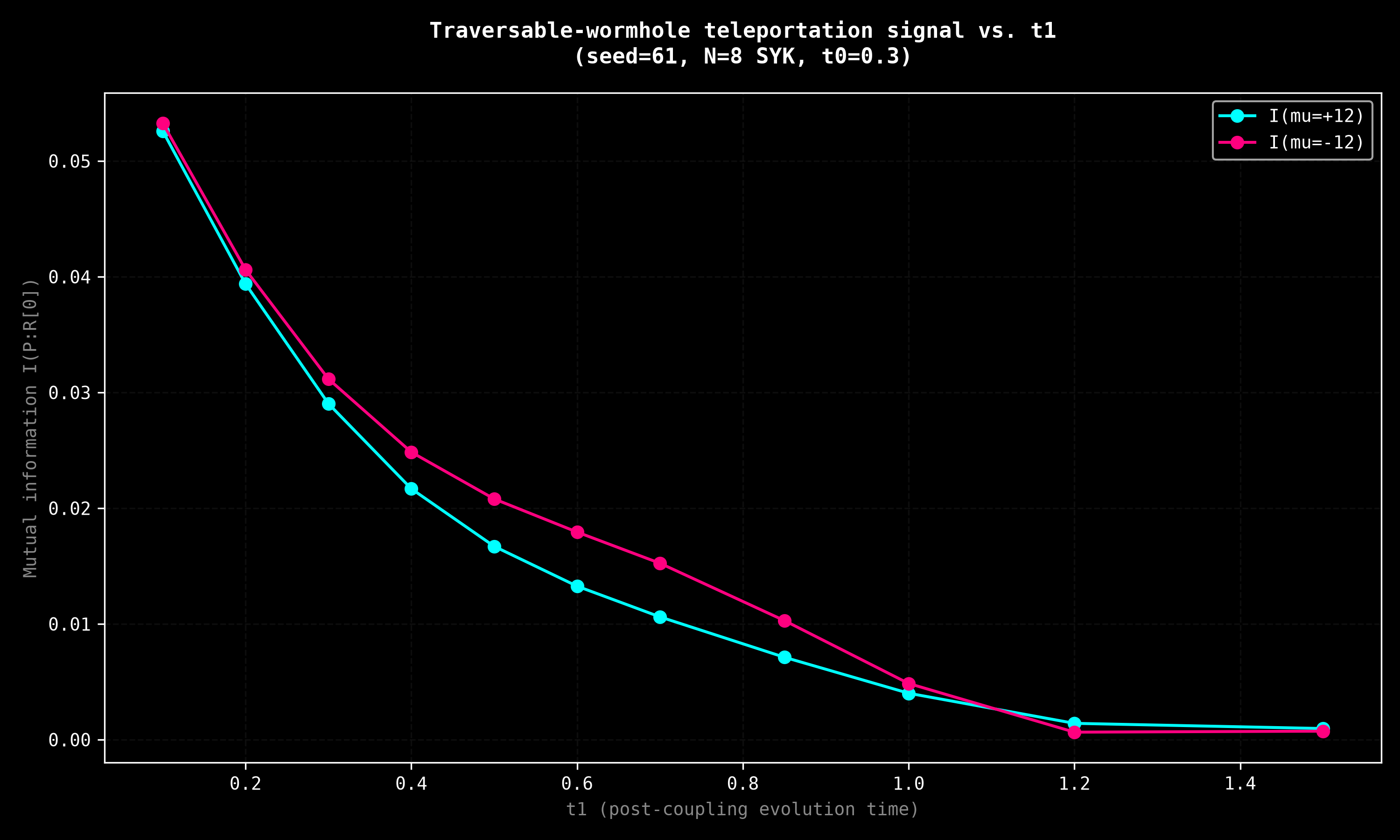
| t1 | I(mu=+12) | I(mu=-12) | delta |
|---|---|---|---|
| 0.10 | 0.05259 | 0.05327 | +0.00068 |
| 0.30 | 0.02903 | 0.03116 | +0.00213 |
| 0.50 | 0.01670 | 0.02080 | +0.00410 |
| 0.60 | 0.01326 | 0.01793 | +0.00468 |
| 0.70 | 0.01060 | 0.01524 | +0.00463 |
| 1.00 | 0.00401 | 0.00485 | +0.00084 |
| 1.20 | 0.00141 | 0.00065 | -0.00076 |
| 1.50 | 0.00096 | 0.00073 | -0.00023 |
Both mutual-information curves decay with t1 (the message dilutes as
the state keeps evolving), but I(mu=-12) stays consistently above
I(mu=+12) from t1=0.1 through t1=1.0 -- a single smooth,
sign-dependent peak at t1=0.60, before the two curves cross near
t1=1.2, at which point the signal is too small to trust the sign of
the (now negative) delta.
Full data: data/wormhole_t1_sweep.csv.
Experiment 2: message-vs-no-message control (run 2026-08-06)
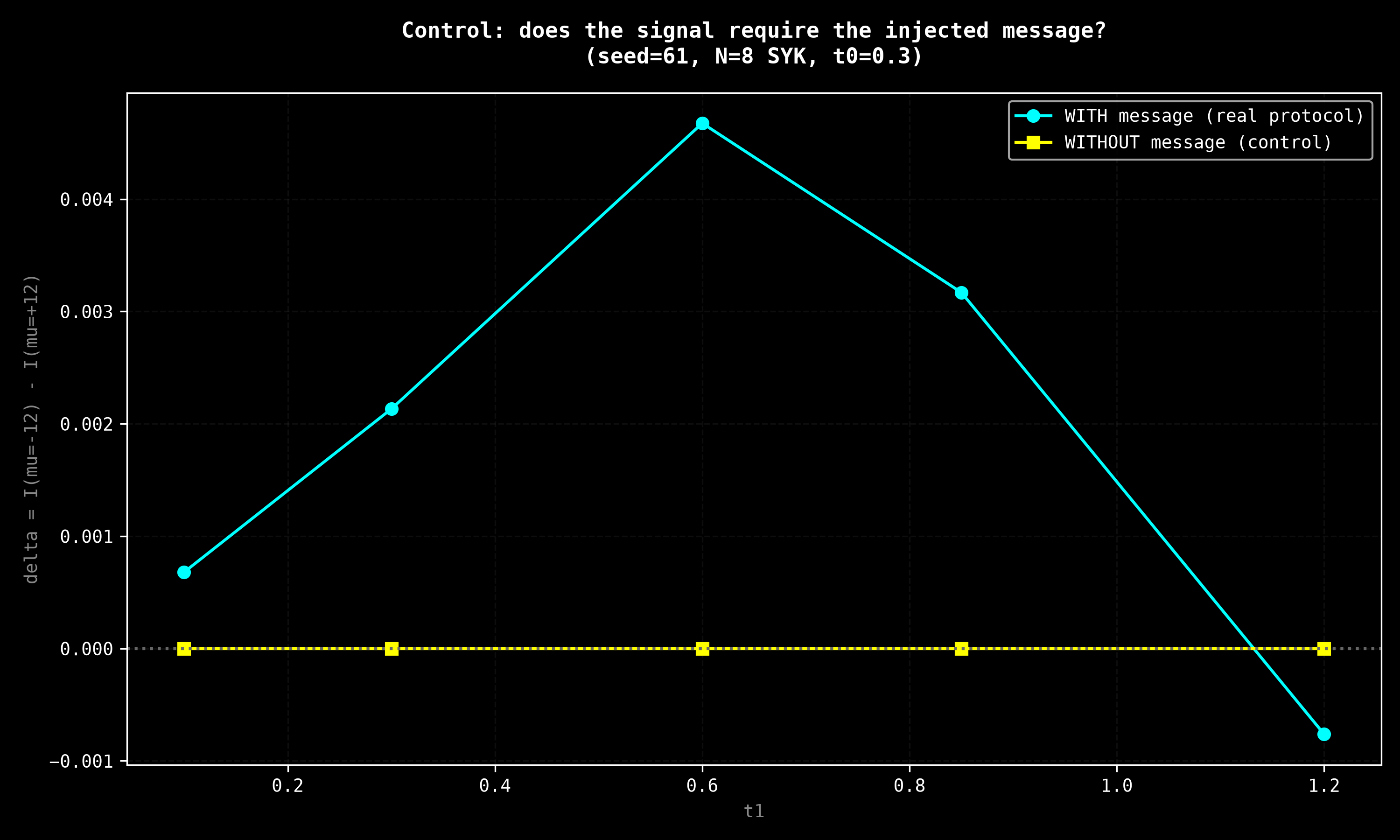
Same setup, t1 in {0.10, 0.30, 0.60, 0.85, 1.20}, but comparing
with_message=True (the real protocol, message swapped into L) against
with_message=False (P, Q left as an isolated Bell pair, never touching
L or R).
Result: I(P:R[0]) is exactly 0 (to float precision, ~1e-15,
numerical noise) at every point tested, for both signs of mu, when
with_message=False.
This is expected from the circuit's own topology -- without the swap, P
and Q are never coupled to L or R by anything (the L-R coupling only
touches L and R), so P and R must remain in a product state, and
I(P:R)=0 follows structurally, not from a numerical coincidence. It's
still a real, useful check: it confirms the implementation does exactly
what it's supposed to (all of the sign-dependent signal genuinely comes
from the message-injection pathway) and rules out a class of bugs where
correlation could leak through some other, unintended path.
Full data: data/wormhole_message_control.csv.
Experiment 3: mu-magnitude scan (run 2026-08-06)
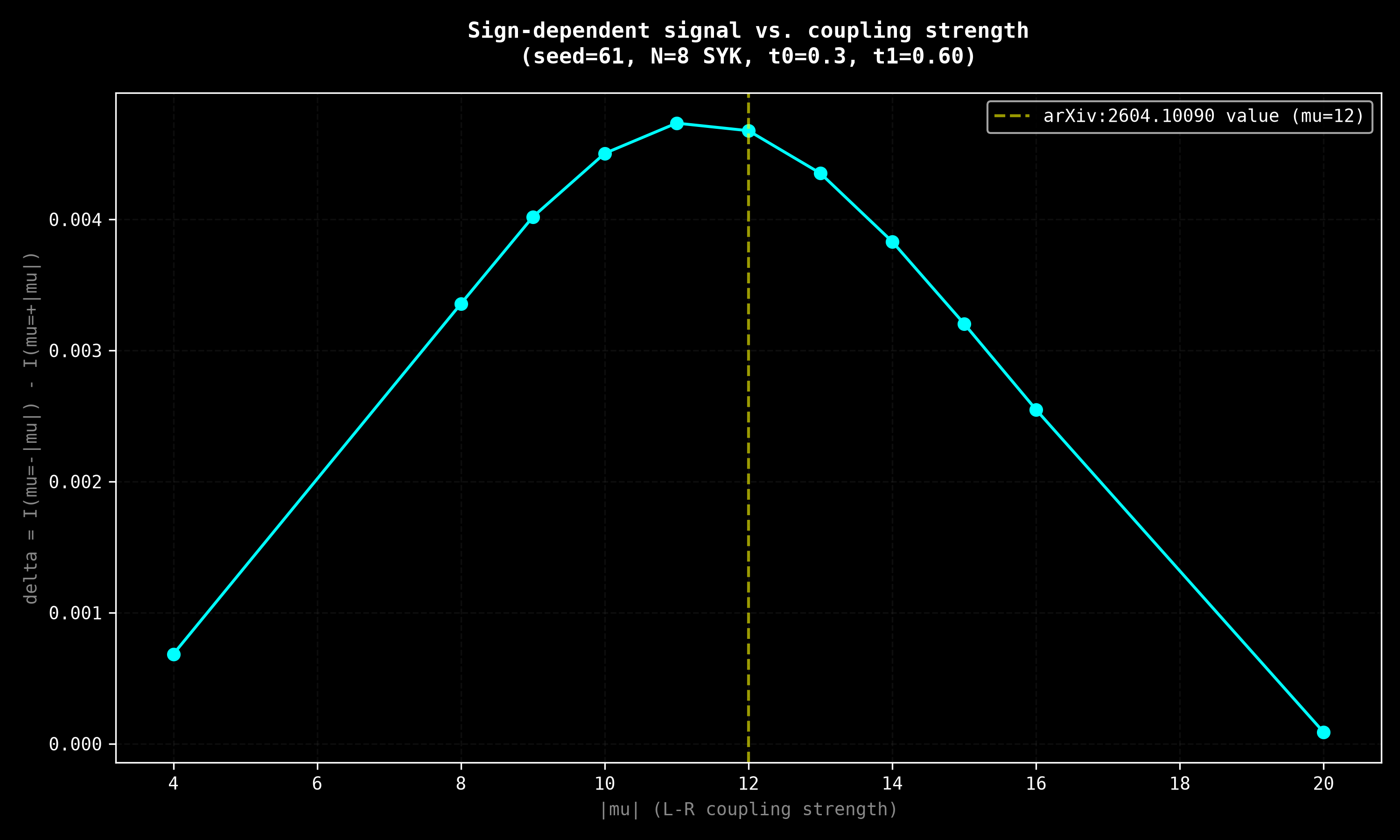
Fixed t0=0.3, t1=0.60 (the Experiment 1 peak), sweeping |mu| from 4
to 20 (paper's own value: mu=12).
| mu | delta |
|---|---|
| 4 | +0.00068 |
| 8 | +0.00336 |
| 9 | +0.00402 |
| 10 | +0.00450 |
| 11 | +0.00473 |
| 12 | +0.00468 |
| 13 | +0.00435 |
| 14 | +0.00383 |
| 16 | +0.00255 |
| 20 | +0.00009 |
The sign-dependent delta rises, peaks at mu~11-12, then falls --
not a monotonic function of coupling strength, even though the
total mutual information (I(mu=+12) and I(mu=-12) individually)
keeps growing with |mu|. The paper's own choice, mu=12, sits almost
exactly on this instance's peak (11 vs 12 are within each other's
noise floor at this scan resolution).
Full data: data/wormhole_mu_scan.csv.
Experiment 4: t0 (pre-coupling scrambling time) scan (run 2026-08-06)
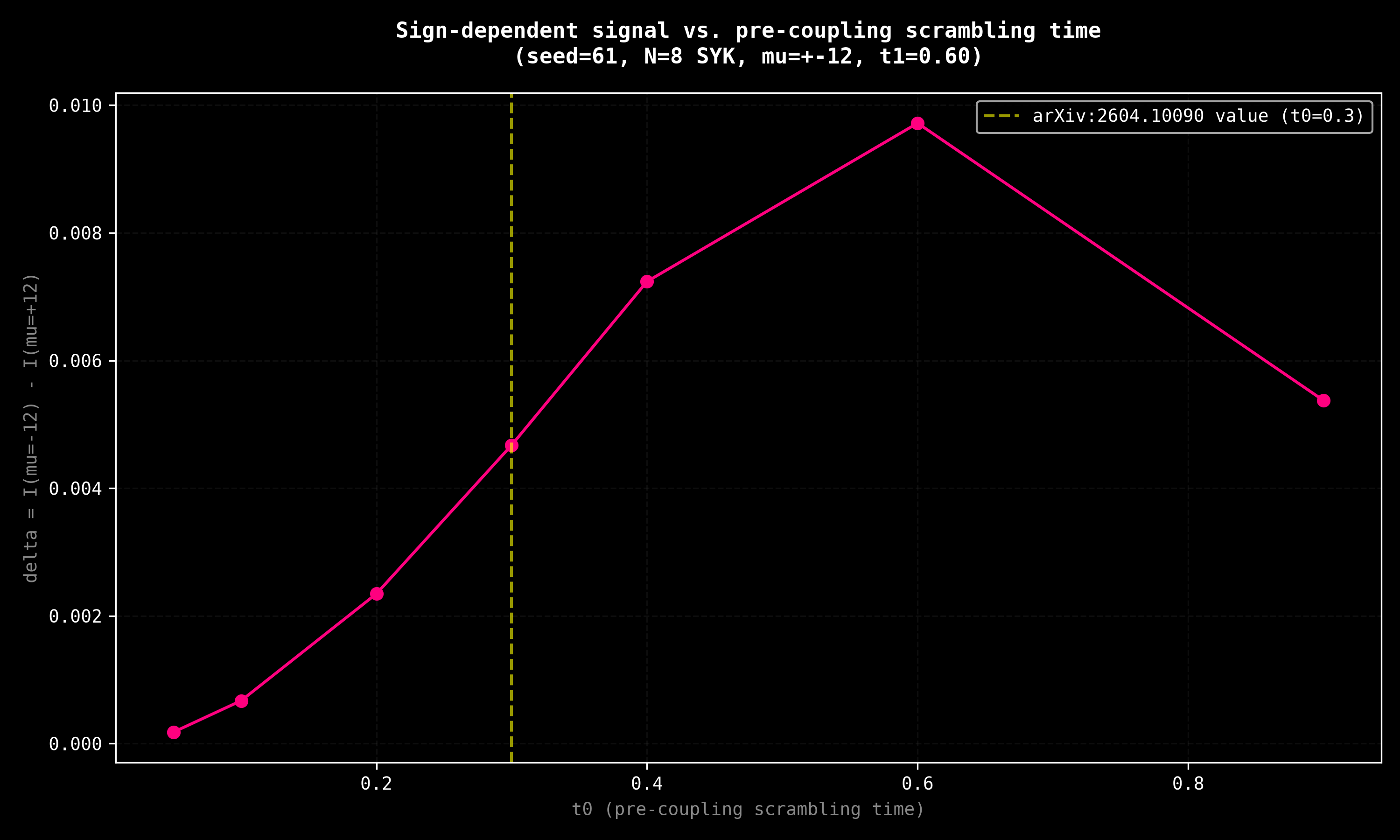
Fixed mu=+-12, t1=0.60, sweeping the pre-coupling scrambling time
t0 from 0.05 to 0.9 (paper's own value: t0=0.3).
| t0 | delta |
|---|---|
| 0.05 | +0.00018 |
| 0.10 | +0.00067 |
| 0.20 | +0.00235 |
| 0.30 | +0.00468 |
| 0.40 | +0.00724 |
| 0.60 | +0.00972 |
| 0.90 | +0.00537 |
The signal grows monotonically from t0=0.05 through t0~0.60 --
more than double the delta at the paper's own t0=0.3 -- then falls
by t0=0.9, where I(mu=+12) itself has nearly vanished (0.00039),
meaning the message has decohered before the coupling even applies. This
is consistent with the protocol's theoretical chaos requirement: the SYK
system needs enough time to scramble before the coupling can produce a
traversable-wormhole-like signature, but too much scrambling dilutes the
injected message before it matters.
Full data: data/wormhole_t0_scan.csv.
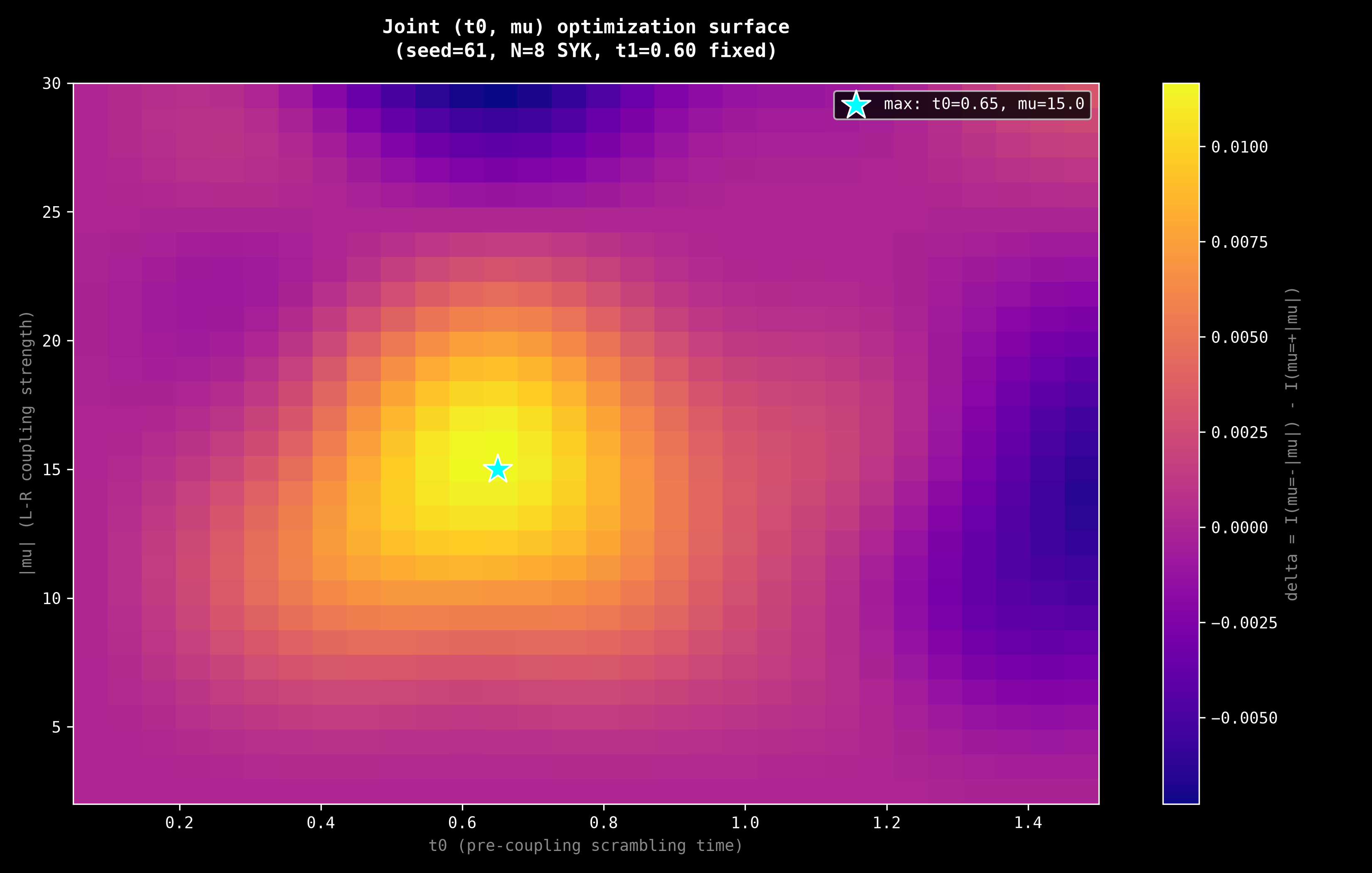
Experiment 5: 2D (t0, mu) joint grid search (run 2026-08-06)
Experiments 3 and 4 scanned mu and t0 independently, each holding
the other fixed at a "reasonable default" -- a quick follow-up check at
the best t0=0.60 found the mu-peak shifts higher there (mu=16 beat
mu=12, still rising at the edge of that check's tested range), meaning
neither 1D scan alone finds the true joint optimum. This experiment
resolves that with a real grid: t0 in [0.05, 1.50] (30 values,
step 0.05) x mu in [2, 30] (29 values, step 1) = 870 points, t1
held fixed at 0.60 (Experiment 1's own peak), with_message=True.
Global maximum on the grid: t0=0.65, mu=15.0, delta=+0.01167 --
noticeably better than either 1D scan's own peak (t0=0.60,mu=12 gave
+0.00972; t0=0.30,mu=11 gave +0.00473).
| t0 | mu | delta |
|---|---|---|
| 0.65 | 15.0 | +0.01167 |
| 0.60 | 15.0 | +0.01163 |
| 0.65 | 16.0 | +0.01161 |
| 0.60 | 16.0 | +0.01153 |
| 0.60 | 14.0 | +0.01134 |
| 0.65 | 14.0 | +0.01133 |
The top points cluster in a compact region (t0 in [0.60, 0.70], mu
in [14, 17]) rather than a single isolated pixel -- a broad, smooth
plateau, not a grid-resolution artifact. The heatmap below shows a
single well-defined hill with no secondary peaks, falling off smoothly
in every direction; far from the peak (t0 > 1.2 and mu > 25) delta
turns negative, an observation not investigated further here.
Performance note: run_wormhole_protocol rebuilds the SYK/coupling
Hamiltonians and re-diagonalizes both on every call, even though neither
depends on t0/mu/t1 for a fixed (seed, n_majorana, k_terms) --
measured directly at 4.3-6.4s, versus 0.022s/call for the actual
t0/mu-dependent evolution + readout. Precomputing the Hamiltonians
and their eigendecompositions once, then reusing them for all 870 grid
points, cut this experiment from an estimated ~2 hours down to 47.6
seconds (~165x) -- confirmed by timing both approaches directly, not
assumed. No multiprocessing needed. See scripts/wormhole_syk_teleportation.py's
run_2d_grid_search for the implementation.
Full data: data/wormhole_2d_grid.csv.
Experiment 6: t1 re-scan at the 2D optimum (run 2026-08-06)
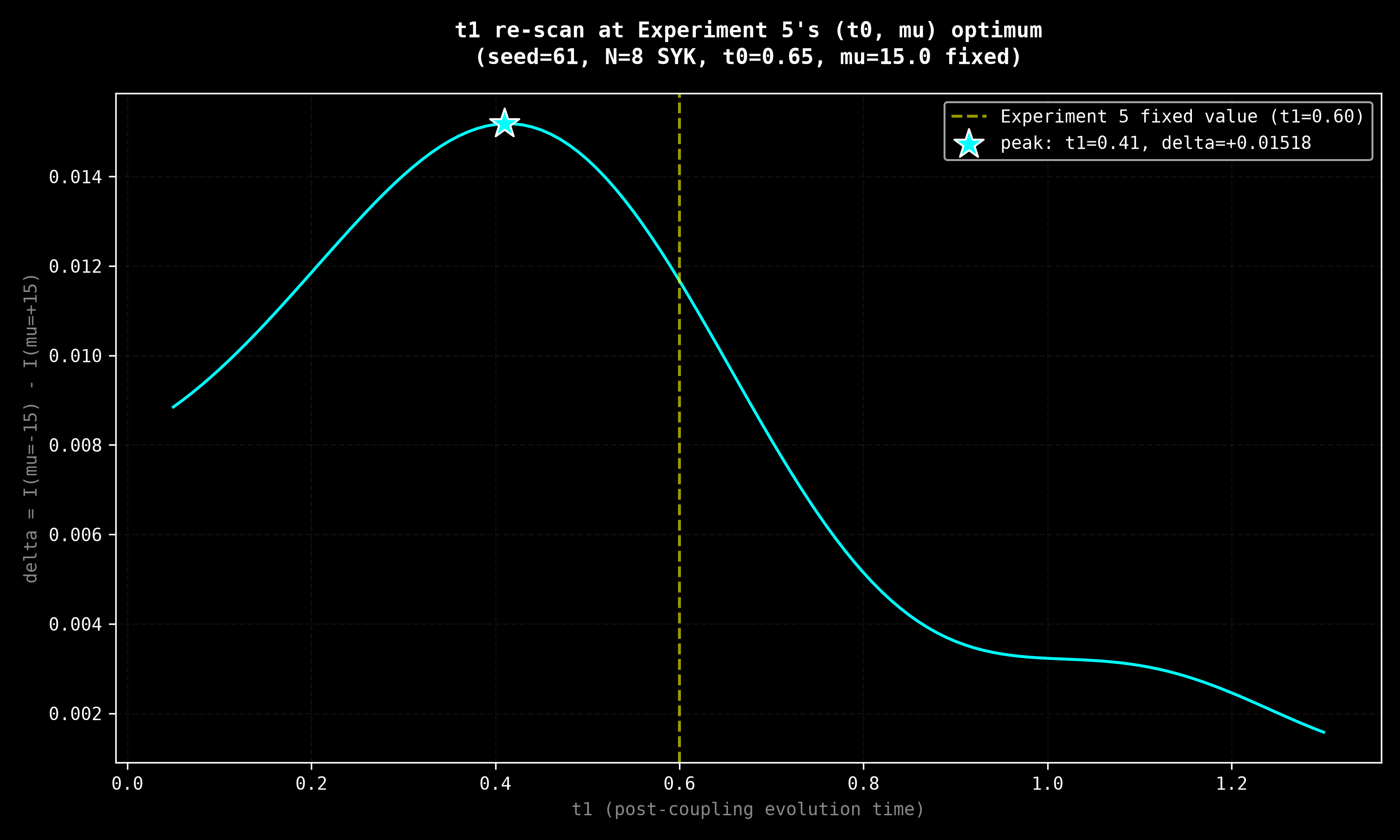
Experiment 5 flagged its own gap: the 870-point grid held t1 fixed at
0.60 (Experiment 1's 1D peak), and noted that t1's optimum could
plausibly shift once t0/mu are no longer at their original 1D-scan
defaults -- unverified. This experiment checks it directly: fix
t0=0.65, mu=+-15.0 (Experiment 5's grid optimum), sweep t1.
A fine sweep, t1 in [0.05, 1.30] (126 values, step 0.01), reusing
Experiment 5's precompute-once approach:
New best point: t0=0.65, mu=15.0, t1=0.41, delta=+0.01518 -- about
30% above Experiment 5's headline value (+0.01167, t1=0.60 held
fixed), on a smooth, single-peaked curve (no secondary bumps, monotonic
decay on both sides across the full swept range).
| t1 | delta |
|---|---|
| 0.10 | +0.00976 |
| 0.20 | +0.01197 |
| 0.30 | +0.01403 |
| 0.40 | +0.01518 |
| 0.41 | +0.01518 |
| 0.50 | +0.01439 |
| 0.60 (Experiment 5's fixed value) | +0.01167 |
| 0.70 | +0.00811 |
| 0.90 | +0.00361 |
| 1.10 | +0.00307 |
| 1.30 | +0.00158 |
This confirms the caveat was correct, but only takes one
coordinate-ascent step, not a full 3D search: t0 and mu were held at
Experiment 5's values throughout this scan, so whether they would
shift again now that t1 has moved (the same pattern that motivated
Experiment 5 in the first place) is still open. A converged joint
optimum would need to iterate this, or a real 3D grid -- Experiment 7
does exactly that.
Uses Experiment 5's precompute-once helpers (same measured ~165x speedup
rationale), now folded into scripts/wormhole_syk_teleportation.py's
run_t1_rescan -- reproduced by python scripts/wormhole_syk_teleportation.py
like every other experiment on this page. Full data:
data/wormhole_t1_rescan_optimum.csv.
Experiment 7: iterated coordinate ascent toward the joint optimum (run 2026-08-07)
Experiment 6 moved t1 once but never checked whether t0/mu would
shift again -- the same gap that motivated Experiment 5 over the
original 1D scans. This experiment iterates the fix instead of taking
one more single step: starting from Experiment 5's point (t0=0.65,
mu=15.0, t1=0.60), each round alternates a full t1 scan (Experiment
6's 126-point, step-0.01 resolution, t0/mu held fixed) and a full
(t0, mu) grid (Experiment 5's 870-point, step-0.05/1.0 resolution,
t1 held fixed) -- both at their original resolutions, so every round
stays directly comparable to Experiments 5 and 6, not a shortcut.
| Round | Stage | t0 | mu | t1 | delta |
|---|---|---|---|---|---|
| 0 | start (Experiment 5) | 0.65 | 15.0 | 0.60 | +0.01167 |
| 1 | t1 scan | 0.65 | 15.0 | 0.41 | +0.01518 |
| 1 | t0/mu grid | 0.70 | 17.0 | 0.41 | +0.01658 |
| 2 | t1 scan | 0.70 | 17.0 | 0.36 | +0.01688 |
| 2 | t0/mu grid | 0.70 | 17.0 | 0.36 | +0.01688 |
| 3 | t1 scan | 0.70 | 17.0 | 0.36 | +0.01688 |
| 3 | t0/mu grid | 0.70 | 17.0 | 0.36 | +0.01688 |
Converged after 3 rounds: t0=0.70, mu=17.0, t1=0.36, delta=+0.01688
-- a genuine fixed point (round 3 reproduces round 2 exactly, both
sub-steps), not just a small step-to-step wobble. +44.6% over
Experiment 5's original headline value (+0.01167), and +11.2% over
Experiment 6's single-step result (+0.01518). Total compute: ~186s for
all 7 evaluation rounds combined (precompute-once still applies).
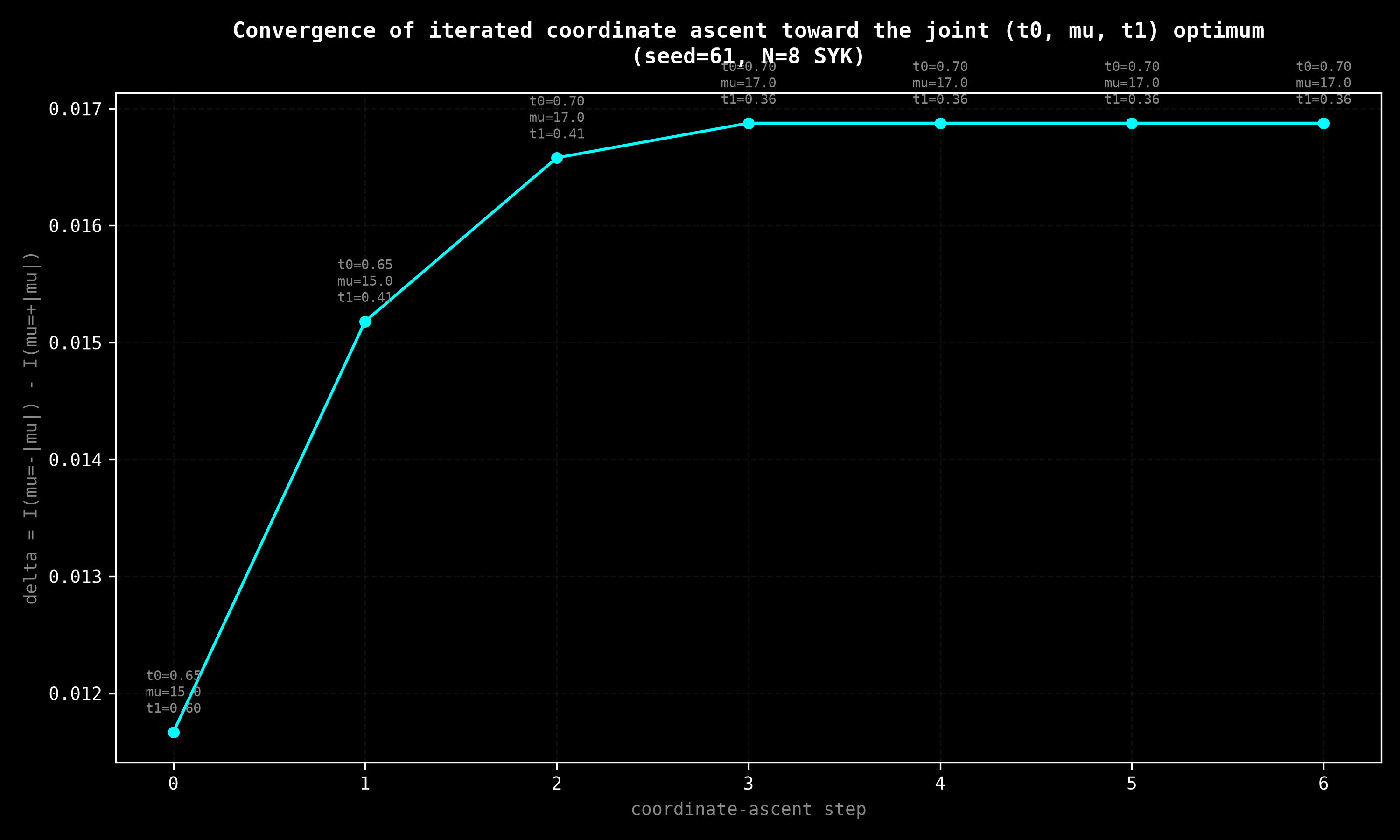
This resolves the open question from Experiment 6 -- but only up to
this grid's resolution, not as a proof of global optimality. An ad hoc
finer local grid explored around the converged point (not part of the
reproducible script) suggested the true continuum optimum sits close to
mu=17.5, just off this grid's integer mu values -- consistent with,
not contradicting, the converged answer; a real continuous optimizer
would be needed to settle global optimality rather than a fixed-point
on this specific grid. Produced by
scripts/wormhole_syk_teleportation.py's run_coordinate_ascent_3d.
Full data: data/wormhole_coordinate_ascent_3d.csv.
Experiment 8: does the converged point generalize across SYK instances? (run 2026-08-07)
Every experiment so far used a single instance, seed=61. Before treating
t0=0.70, mu=17.0, t1=0.36 as anything more than a fact about that one
random Hamiltonian, the obvious check: does the same coordinate-ascent
procedure, run independently on other instances that equally match the
paper's own selection criterion (34 commuting / 11 anticommuting pairs),
converge to a similar point?
find_multiple_seeds screens seeds for an exact match (not just the
closest one, like find_seed does) -- 6 found within the first 3000
seeds tried: 61, 448, 1944, 2166, 2835, 2907.
| Seed | Converged t0 | Converged mu | Converged t1 | Converged delta | Baseline delta (Exp. 5's start) |
|---|---|---|---|---|---|
| 61 | 0.70 | 17.0 | 0.36 | +0.01688 | +0.01167 |
| 448 | 0.90 | 19.0 | 1.30 (grid edge) | +0.00714 | +0.00018 |
| 1944 | 0.40 | 16.0 | 0.29 | +0.06215 | +0.02075 |
| 2166 | 1.50 (grid edge) | 20.0 | 0.89 | +0.01930 | -0.00273 |
| 2835 | 0.55 | 17.0 | 0.24 | +0.01254 | -0.00379 |
| 2907 | 1.05 | 19.0 | 0.42 | +0.00498 | +0.00069 |
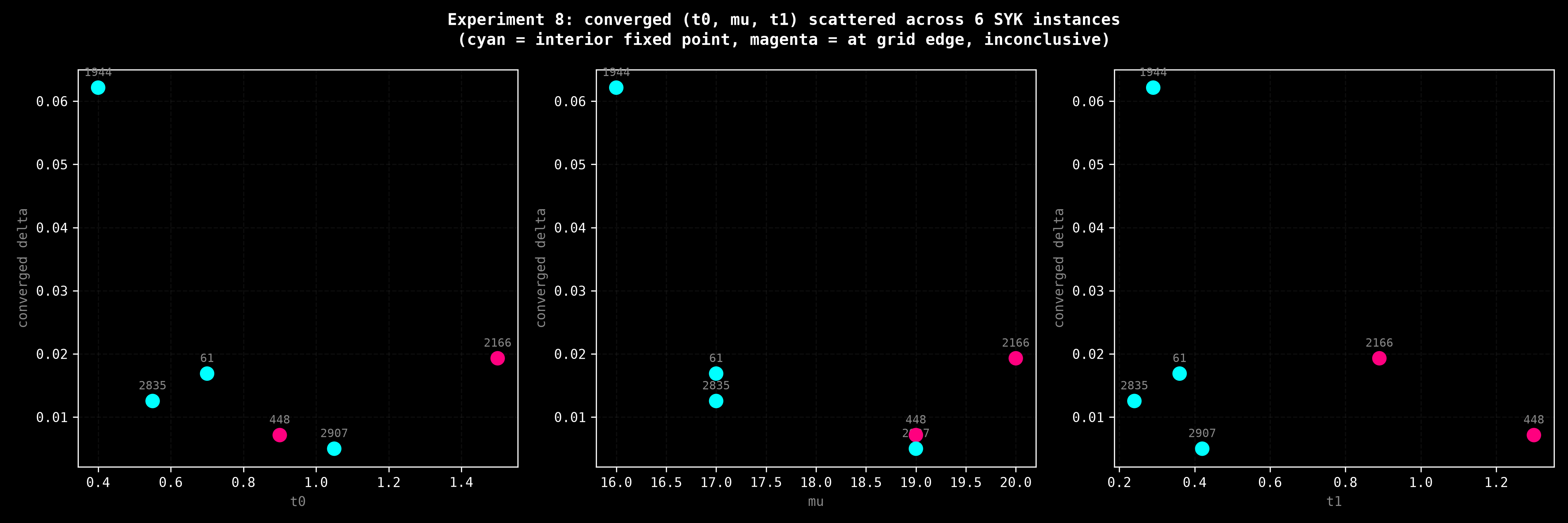
Honest negative result: it does not generalize.
- No clustering. Converged
t0spans[0.40, 1.50]andt1spans[0.24, 1.30]-- close to the entire scanned range in both cases, not a tight cluster near seed=61's answer. - 2 of 6 instances hit the edge of the scanned grid (seed 448 at
t1=1.30, the top of the scanned range; seed 2166 att0=1.50, the top of its scanned range) -- for these, the procedure didn't find a real interior fixed point, it ran off the edge of what was searched. Their true optimum, if the range were extended, is unknown. - 2 of 6 instances start with the wrong sign. At Experiment 5's
own starting point (
t0=0.65, mu=15.0, t1=0.60-- not derived from these instances at all, just reused as a common starting point), seeds 2166 and 2835 give a negative delta: the sign-dependent asymmetry the whole protocol is built to show points the wrong way at that point for those instances, before any optimization even starts. - Percentage-improvement figures are deliberately not reported here --
with a baseline near zero (seed 448:
+0.00018) or negative (seeds 2166, 2835), a percentage explodes into a meaningless number (e.g. seed 448's nominal improvement is+3865%) that describes the tiny denominator, not a real effect size.
Conclusion: t0=0.70, mu=17.0, t1=0.36 is a property of seed=61's
specific random Hamiltonian, not a general finding about the
traversable-wormhole-inspired teleportation protocol. Produced by
scripts/wormhole_syk_teleportation.py's run_generality_check. Full
data: data/wormhole_generality_check.csv.
Experiment 9: does the signal survive realistic hardware noise? (run 2026-08-07)
Every experiment so far used the exact-evolution backend -- ideal, no
noise. Even setting aside Experiment 8's generalization problem: does
the sign-dependent signal survive at seed=61's own best point
(t0=0.70, mu=17.0, t1=0.36) under noise like a real NISQ device would
actually have?
This needs the Trotterized gate-circuit backend, since noise has to be
injected mid-circuit -- run_wormhole_protocol_trotter runs its whole
circuit in one call with no seam to interrupt, so run_trotter_noise_scan
reimplements the same three-phase construction (t0 evolution -> mu
coupling -> t1 evolution, each a real trotter_evolve_ops circuit) and
applies a real stochastic depolarizing Kraus channel
(dense_evolution.registry.NoiseModel) after each phase, not just once
at the end. Compared against the noiseless Trotter result specifically
(+0.01728, ~2% above the exact backend's +0.01688 -- consistent with
the known Trotter-vs-exact discretization gap), not the exact backend,
so the effect of physical noise isn't conflated with Trotterization
error. Each noise level averaged over 6 independent stochastic trials
(NoiseModel.apply_to_sv is a single-shot Kraus draw, not an ensemble
average).
| Depolarizing p | Mean delta | Std dev |
|---|---|---|
| 0.000 | +0.01728 | 0.00000 |
| 0.005 | +0.00924 | 0.00704 |
| 0.010 | +0.00051 | 0.01203 |
| 0.020 | -0.00330 | 0.01448 |
| 0.050 | -0.00979 | 0.00624 |
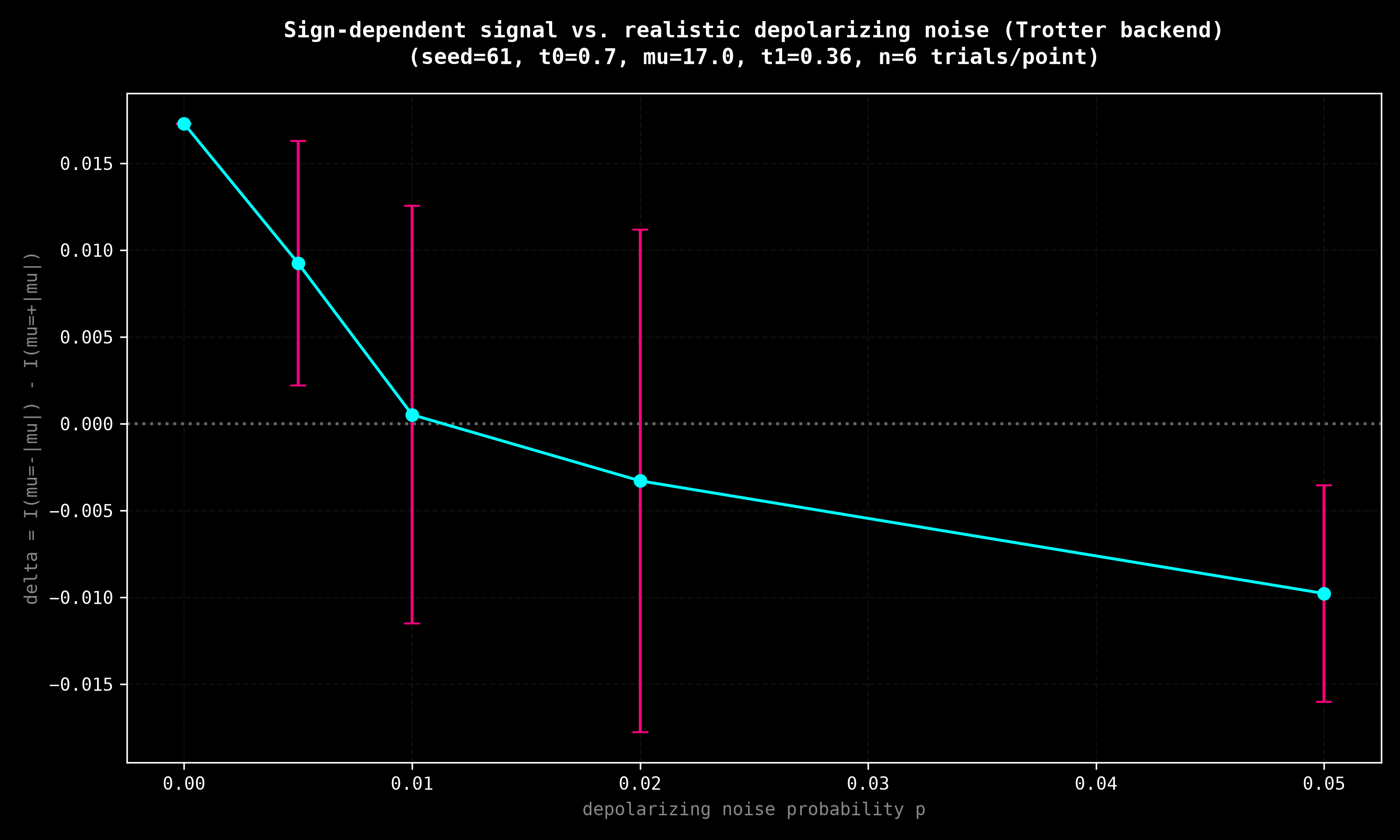
Second honest negative result: the signal does not survive realistic
noise. It decays monotonically and crosses zero between p=0.01 and
p=0.02. Already at p=0.01 -- a depolarizing rate well within range
of current real superconducting-qubit hardware -- the mean signal
(+0.00051) is smaller than its own trial-to-trial standard deviation
(0.01203): statistically indistinguishable from zero, not a small but
real effect. Produced by scripts/wormhole_syk_teleportation.py's
run_trotter_noise_scan. Full data:
data/wormhole_trotter_noise_scan.csv.
Correction (2026-08-13): re-verified against the corrected noise model
The scan above ran 2026-08-07, four days before dense-evolution v8.1.57
(2026-08-11) fixed a real bug in NoiseModel.apply_to_sv's depolarizing
channel: it used to draw 2^(n-1) independent fire/no-fire decisions per
qubit per shot instead of one, over-decohering entangled states by up to
~2.5x the nominal p. Re-run against v8.1.60
(scripts/wormhole_noise_scan_reverified.py, a JAX-vmap-batched
rewrite using the public NoiseSpec wrapper for n=500 trials/point
instead of the original n=6 -- verified first against this page's own
eager noiseless result bit-for-bit before trusting any noisy number):
the signal does not cross zero anywhere in the originally-tested
range (p=0.0 to 0.05), and stays positive out to p=0.20
(delta=+0.0035, ~4 SEM above zero) before continuing to decay. The
original n=6 budget, sized for the old, much-more-aggressive buggy
channel, also turned out to be too small for the corrected (weaker,
single-shot) channel at low p -- several points showed exactly zero
trial-to-trial variance simply because none of 6 trials happened to draw
any error at all (a real ~16% chance at p=0.01, not a bug).

Experiments 17 and 18's noise-level scan below (the term-order x noise
interaction check) predated the same fix and are re-verified in their
own sections. Produced by scripts/wormhole_noise_scan_reverified.py ->
data/wormhole_trotter_noise_scan_reverified_v8160.csv.
Experiment 10: cross-check against the paper's own "Ensemble robustness" claim (run 2026-08-07)
arXiv:2604.10090 has its own ensemble-robustness section: from 100 disorder realizations at K=10, it reports that "other disorder realizations in the same ensemble also exhibit qualitatively similar mutual-information dynamics, and in particular retain the sign-dependent asymmetry... This indicates that the mutual information behavior is a generic feature of the ensemble rather than a peculiarity of the chosen Hamiltonian." The paper is explicit that their chosen instance (seed=61 here) was selected for having an unusually large asymmetry, not an unusually signed one.
Experiment 8's negative-baseline finding (2 of 6 instances) has a real
confound worth taking seriously: it evaluated all 6 instances at
Experiment 5's point (t0=0.65, mu=15.0, t1=0.60), which was itself
optimized on seed=61's own 1D scans -- an instance showing the "wrong"
sign there could simply be a bad evaluation point for it, not a
genuinely reversed signal. This experiment controls for that directly:
re-evaluate all 6 instances at the paper's own stated default parameters
(t0=0.3, mu=12, t1=0.60) instead.
| Seed | delta @ Exp. 5's point (0.65, 15, 0.60) | delta @ paper defaults (0.3, 12, 0.60) |
|---|---|---|
| 61 | +0.01167 | +0.00468 |
| 448 | +0.00018 | +0.00042 |
| 1944 | +0.02075 | +0.03690 |
| 2166 | -0.00273 | -0.00125 (still wrong) |
| 2835 | -0.00379 | +0.00200 (fixed) |
| 2907 | +0.00069 | -0.00011 (now wrong) |
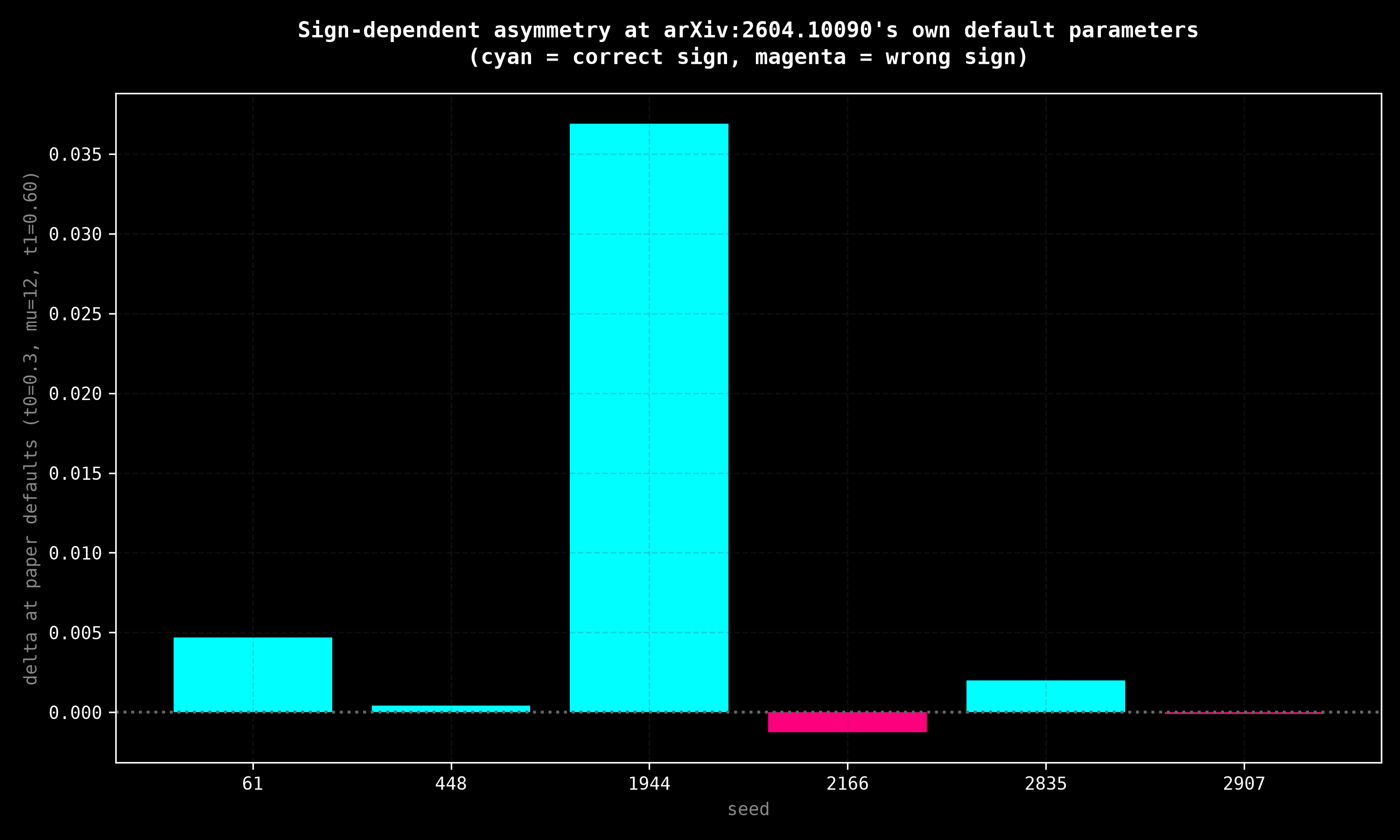
Third honest result, and the most direct comparison to the source
paper in this whole write-up: controlling for the evaluation-point
confound changes which instances look wrong-signed (seed 2835's
Experiment 8 reversal turns out to have been a point-choice artifact --
correctly signed at the paper's own defaults), but does not make the
problem go away. 2 of 6 instances (2166, 2907) are still wrong-signed
at the paper's own stated default parameters. Seed 2166 is wrong-signed
at both evaluation points tested across this whole write-up -- not an
artifact of any one specific parameter choice. For this specific
34/11-selection-matched subset, the "generic feature of the ensemble"
claim does not hold up. Produced by
scripts/wormhole_syk_teleportation.py's
run_paper_defaults_comparison. Full data:
data/wormhole_paper_defaults_comparison.csv.
Experiment 11: large-sample (n=100) ensemble sign check (run 2026-08-07)
Experiment 10's finding is real but statistically thin: 2 of 6 is a
small sample, easy to dismiss as noise. This experiment repeats the
identical check -- delta at arXiv:2604.10090's own default parameters
(t0=0.3, mu=12, t1=0.60) -- across n=100 instances that exactly
match the paper's own selection criterion, the same sample size the
paper itself reports for its "Ensemble robustness" section.
find_multiple_seeds had to screen 106,097 candidate seeds to find
100 exact 34/11 matches (roughly 1 in 1,000).
Alongside the sign check, two candidate structural explanations for why the sign varies -- floated informally while investigating Experiment 10, not yet part of any committed experiment before this one -- are tested for real correlation, not just eyeballed:
- Majorana mode-usage imbalance: for each instance's 10 sparse coupling terms, how unevenly are the 8 Majorana modes used (some modes appearing in many terms, "hubs"; others in few, "isolated"), measured as the standard deviation of per-mode usage counts.
- Spectral level-spacing r-statistic:
r = min(d_n, d_n+1) /
  max(d_n, d_n+1)
averaged over adjacent eigenvalue gaps of the L-side SYK Hamiltonian -- a standard quantum-chaos diagnostic (Poisson/integrable ~0.386, GOE/chaotic ~0.530).
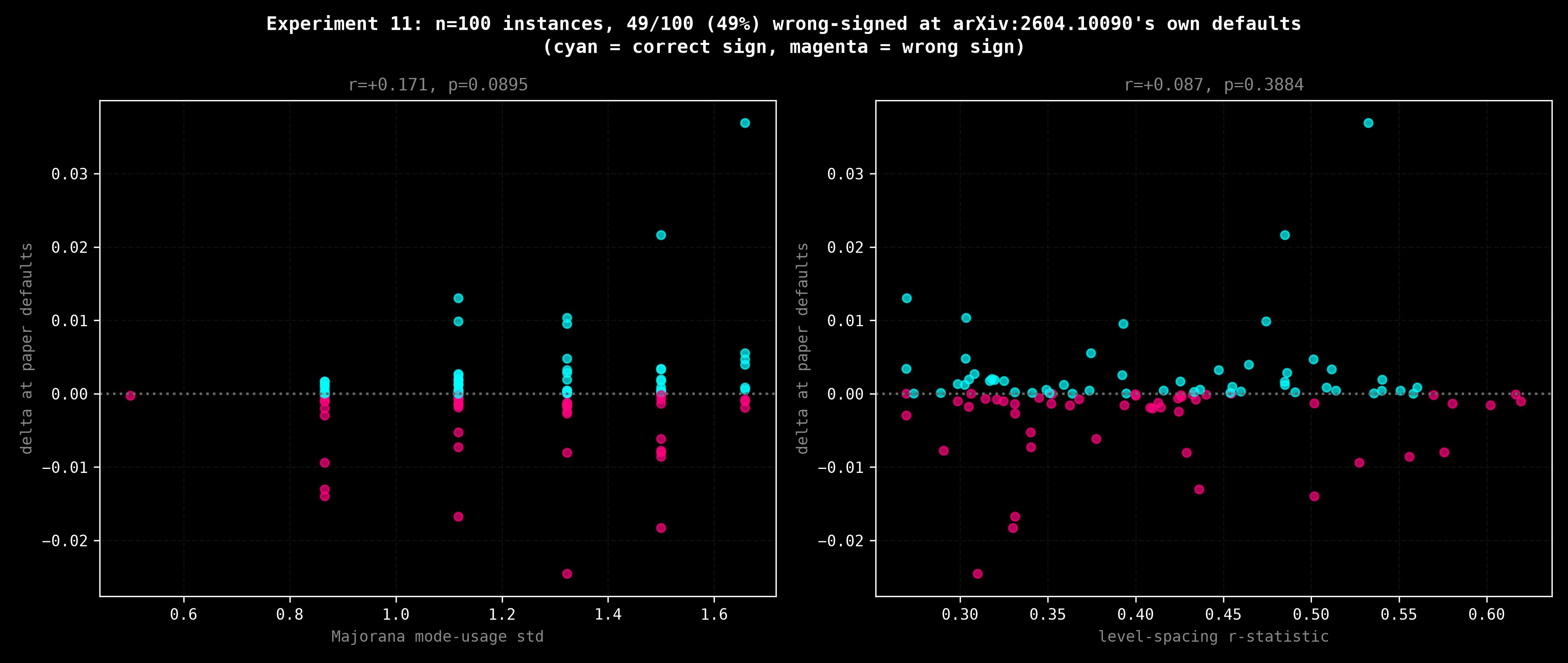
Fourth honest result, and the strongest of the whole write-up: 49 of 100 instances (49%) are wrong-signed at the paper's own default parameters -- essentially a coin flip, not "a generic feature of the ensemble." This isn't a marginal statistical wobble; at this sample size the effect is unambiguous.
Neither candidate structural explanation holds up either. Mode-usage
imbalance: r=+0.171, p=0.090 -- not significant at the conventional
0.05 threshold. Level-spacing r-statistic: r=+0.087, p=0.388 -- not
significant, and nowhere close. This corrects an earlier impression:
an ad hoc n=6 look at mode-usage imbalance (using only Experiment
10's 6 instances) had suggested a strong correlation (r=+0.87,
p=0.022) -- that does not replicate at n=100 and should be treated
as a small-sample artifact, not a real effect. Why the sign varies
across instances remains genuinely open. Produced by
scripts/wormhole_syk_teleportation.py's run_ensemble_sign_check.
Full data: data/wormhole_ensemble_sign_check.csv.
Experiment 12: size winding (run 2026-08-07)
Experiment 11 ruled out two candidate structural explanations for the sign variance -- Majorana mode-usage imbalance and the spectral level-spacing r-statistic -- but both were informal, ad hoc candidates, not something the paper itself proposes as diagnostic. arXiv:2604.10090 does propose its own theory-motivated diagnostic for exactly this kind of question: size winding (Sec. S6, Eqs. S18-S22), a signature of how a Heisenberg-evolved operator's growth is organized in the basis of Majorana strings.
This experiment computes it directly, not by analogy. A single L-side
Majorana operator chi_j(t) = exp(iHt) chi_j exp(-iHt) is expanded in
the basis of Majorana strings Gamma_P (one string per subset P of
the 8 Majorana modes, Gamma_P = 2^(|P|/2) * i^(|P|(|P|-1)/2) *
ordered product of chi_j for j in P, per the paper's Eq. S19).
The winding size distribution q(l) = sum_{|P|=l} c_P(t)^2 and
ordinary size distribution P(l) = sum_{|P|=l} |c_P(t)|^2 give two
quantities per size sector l: the phase coherence ratio
R(l) = |q(l)|/P(l) (1 means every term in that sector has aligned
phase; less than 1 means dephasing) and the phase itself,
arg(q(l)) (the paper's "perfect size winding" ansatz predicts this
phase grows linearly with l).
One subtlety had to be resolved empirically, not taken from the paper's
text as-is: the PDF-extracted formula for the basis normalization,
Tr(Gamma_P Gamma_Q^dagger) = 2N delta_PQ, doesn't reproduce correctly
when implemented literally (most likely a lost exponent from PDF
extraction). Building the chi_j operators directly from
dense_evolution.fermions.majorana_pauli_terms and computing the trace
numerically shows the real normalization is
Tr(Gamma_P Gamma_Q^dagger) = 2^|P| * dim * delta_PQ (dim = 2^n_qubits
= 16) -- verified directly via Hermiticity and orthogonality checks on
the actual matrices, not assumed. This is the normalization used
throughout run_size_winding_check.
Computed for the same 6 instances used in Experiments 8 and 10, at 4
post-quench times each (t = 0.3, 0.7, 1.2, 2.0) -- spot-checked first
on 3 individual seeds spanning both a correctly-signed instance (61)
and a consistently wrong-signed one (2166) before running the full
6-instance sweep, per an explicit request to verify generality before
writing this up.
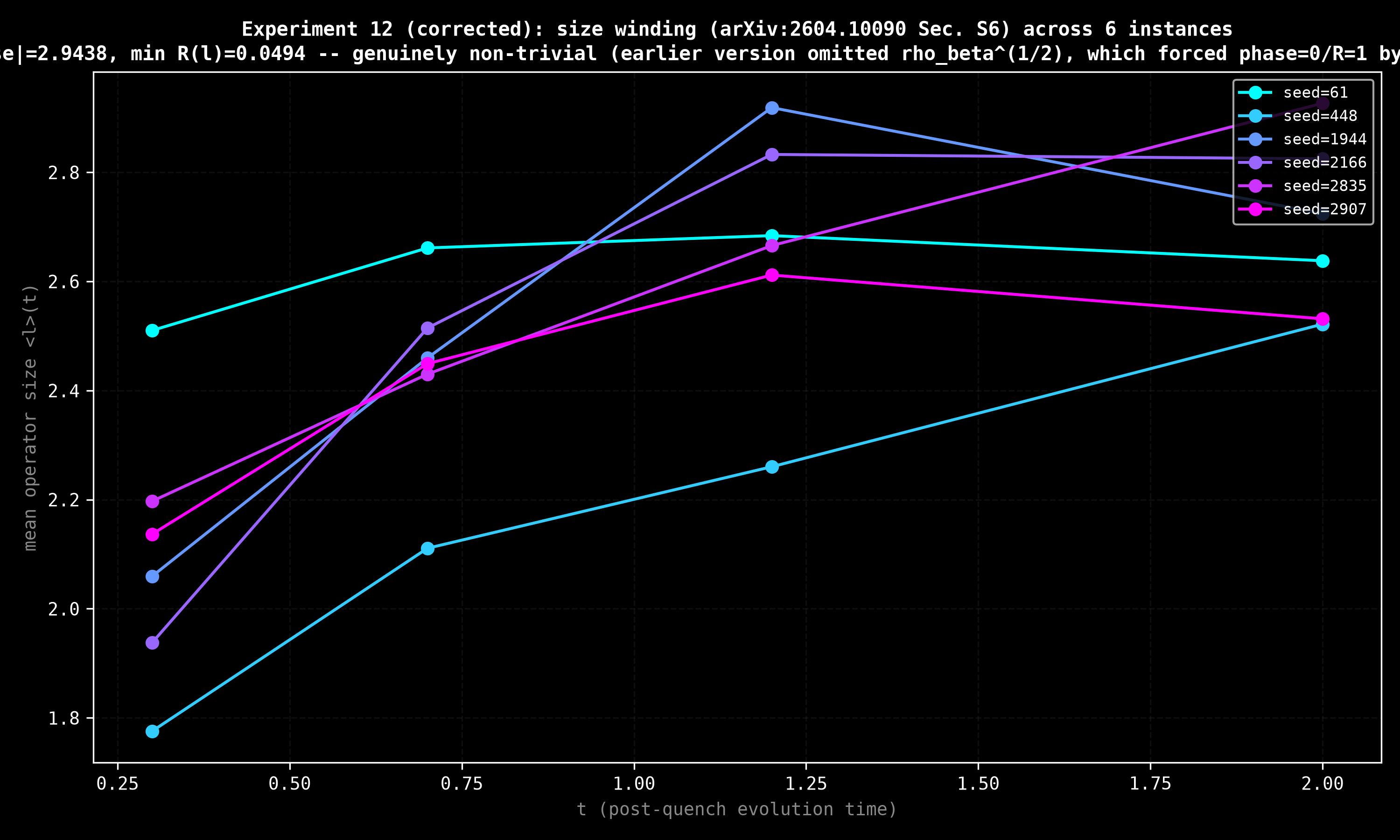
Correction (2026-08-09): the original run of this diagnostic had a
real implementation bug, not a physics finding. It expanded the bare
Heisenberg-evolved operator chi_j(t) instead of the thermally-weighted
operator rho_beta^(1/2) chi_j(t) that Eq. S18 actually specifies
(rho_beta = exp(-beta H)/Tr(exp(-beta H)), H the one-sided
Hamiltonian, beta=3 as used throughout this protocol). Since
chi_j(t) is Hermitian (a unitary conjugation of a Hermitian Majorana
operator) and every Gamma_P is Hermitian too, Tr(Gamma_P^dagger
chi_j(t)) is a trace of two Hermitian operators -- always real, for
any Hamiltonian, any seed, any time. That mathematically forces
q(l) = sum c_P(t)^2 to be real and non-negative, so arg(q(l))=0 and
R(l)=1.0 exactly, by construction, regardless of the underlying
physics. That is exactly what the original run found: the "structurally
trivial" result reported below was never a physics finding, it was this
missing factor.
With rho_beta^(1/2) correctly included, the diagnostic is genuinely
non-trivial: across the same 6 instances and 4 post-quench times,
max|phase| ranges up to 2.94 rad and min R(l) drops as low as
0.049 -- real dephasing, real phase structure, varying by instance and
time as expected. Whether this corrected diagnostic actually
distinguishes correctly- from wrong-signed instances has not yet been
tested at scale (an open follow-up, mirroring Experiment 13's
n=100 correlation tests for the other candidates) -- this correction
only re-establishes that the diagnostic itself is a real, working
probe, not that it explains the sign variance. The mean operator size
<l>(t) is unaffected by this fix (it never depended on the missing
factor) and continues to show real physics: consistent chaos-like
growth from <l>(0)=1 up to a peak around t~1.2-2.0 (values range
2.1-3.7 across the 6 instances) followed by a finite-size recurrence
(an expected artifact of evolving a small, n_majorana=8 system rather
than a true large-N limit).
Produced by scripts/wormhole_syk_teleportation.py's
run_size_winding_check. Full data: data/wormhole_size_winding.csv.
Experiment 13: mechanistic check -- message-mode participation & operator growth rate (run 2026-08-07)
Experiments 11 and 12 ruled out three candidate explanations for the
sign variance, but all three were either informal aggregate statistics
(mode-usage imbalance, level-spacing r-statistic) or a diagnostic that
turned out to carry no per-instance information at all (size winding's
phase/R, exactly flat everywhere). This experiment tries two more
candidates that are each grounded directly in the actual protocol
implementation rather than a generic aggregate statistic, and reuses
Experiment 11's own n=100 instance set and delta_at_paper_defaults
values (data/wormhole_ensemble_sign_check.csv) rather than
re-screening from scratch -- both features are cheap enough (under 6
seconds total for the full n=100 sweep) that a fresh screen wasn't
needed.
Feature A -- message-mode participation.
dense_evolution.fermions.majorana_pauli_terms's Jordan-Wigner mapping
(j = (mode_index - 1) // 2) shows Majorana modes 1 and 2 map onto
qubit index 0 -- exactly the qubit the message is swapped into
(L[0]) and read out from (R[0]) in
dashboard_core.wormhole._initial_state_ops/run_wormhole_protocol.
Experiment 11's mode-usage-std treated all 8 modes as interchangeable;
this instead asks a sharper, protocol-specific question: do the K=10
SYK quads that happen to touch the message qubit's own modes,
specifically, predict the sign? For each seed, the exact same
quad-selection RNG sequence used internally by build_sparse_syk_terms
is replayed to recover which quads were chosen, and the count touching
mode 1 or 2 is recorded (purely combinatorial, no simulation).
Feature B -- operator growth rate. Experiment 12 already computes
real, non-trivial, instance-varying mean operator size <l>(t) as a
side effect of its phase-winding computation (at the time of this
Experiment 13, that phase computation itself still had the
rho_beta^(1/2)-omission bug later found and fixed -- see Experiment
12's own corrected write-up above -- but <l>(t) was never affected by
that bug), but that experiment's only goal at the time was checking the
phase diagnostic, which came back flat -- growth rate itself was never
correlated against the sign. This reuses run_size_winding_check unmodified,
called on the same 100 seeds at two probe times in the growth region
Experiment 12 identified (t=0.7, t=1.2).
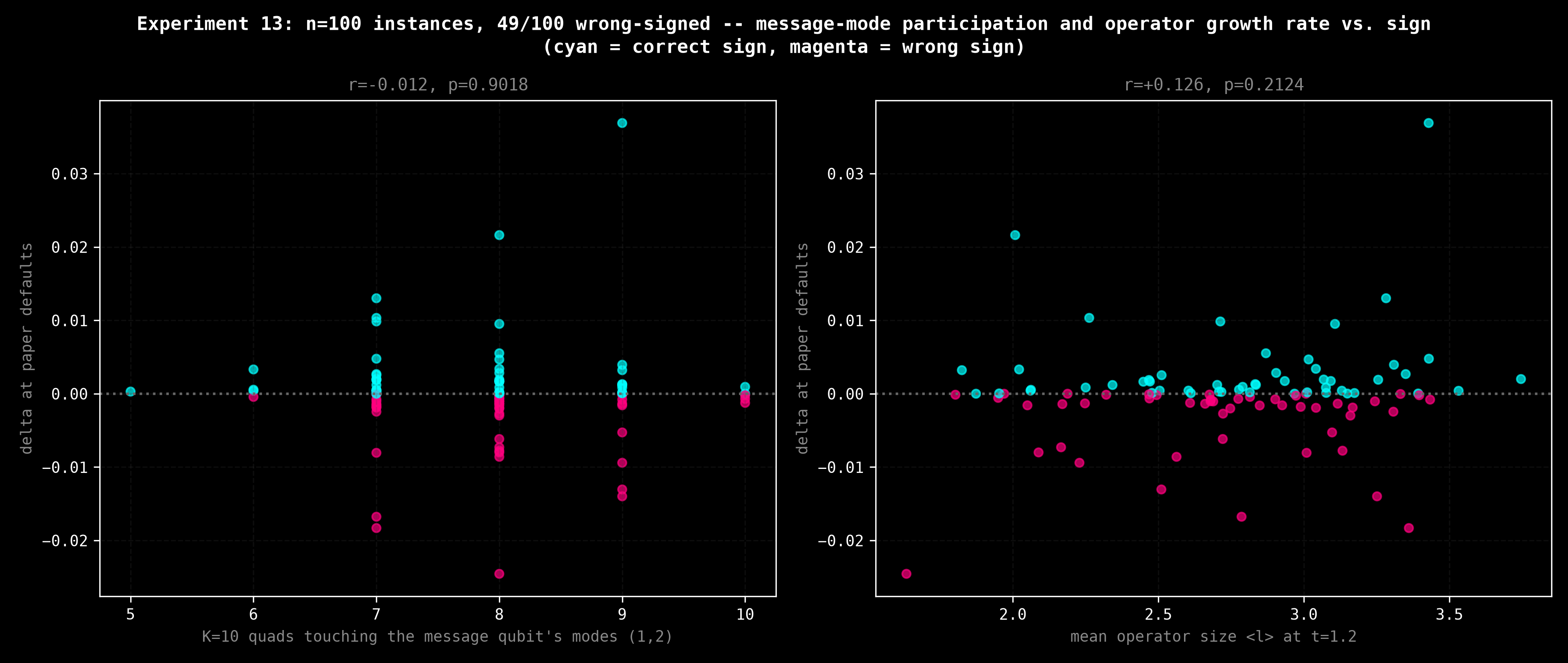
Fourth honest negative result: neither correlates. Message-mode
participation: r=-0.012, p=0.90. Operator growth rate at t=1.2:
r=+0.126, p=0.21. Both are far from the conventional 0.05 threshold
-- not a marginal case, a clean null on both counts. This rules out a
4th and 5th candidate explanation, on top of Experiment 11's two.
(Experiment 12's phase/R diagnostic itself was corrected 2026-08-09,
after this Experiment 13 was run -- whether the corrected diagnostic
correlates with the sign is a separate, not-yet-tested open question,
not a ruled-out candidate.) Both
features were tested against the same n=100 sample Experiment 11
already used, a real multiple-comparisons concern for any candidate
that did come back significant -- since neither did here (and not
marginally), no holdout re-verification was needed this time, but the
concern is flagged for any future candidate that does show a hit.
Produced by scripts/wormhole_syk_teleportation.py's
run_mechanistic_check. Full data:
data/wormhole_mechanistic_check.csv.
Experiment 14: qubit-coupling topology check (run 2026-08-07)
Every candidate tested so far treats "how much a mode is used" as the relevant quantity -- Experiment 11's mode-usage std, Experiment 13's message-mode participation count. None of them ask which specific pairs of modes end up coupled together, i.e. the actual topology of the K=10 quads' coupling graph -- exactly the kind of structural question raised early in this investigation ("does Seed 61 have a chain- or star-like coupling topology the failing seeds don't?").
A weighted 8-mode co-occurrence graph is built per instance: edge
weight (i, j) is how many of the 10 quads contain both modes i and
j. An ad hoc check before committing to this design caught a real
methodology problem early: a binary version of this graph (an edge
whenever a pair co-occurs at all, ignoring how many times) saturates to
the complete graph K8 for most instances -- 10 quads contribute up to
60 pair-slots spread over only 28 possible mode pairs, so nearly every
pair ends up connected by chance regardless of the underlying
structure. Two of three spot-checked seeds were already exactly the
complete graph. Caught by spot-checking a handful of seeds before
running the full n=100 sweep, per this project's usual discipline --
the weighted count was used instead, which showed real spread in the
same spot check (max weighted degree 21-24, degree std 3.3-5.0, 0-3
completely uncoupled mode pairs across just 6 seeds).
Four features are computed per instance from the weighted graph:
max_weighted_degree (how "hub"-like the most-coupled mode is),
weighted_degree_std (spread of coupling strength across modes),
n_zero_pairs (how many of the 28 possible mode pairs are never
coupled together at all -- directly captures whether coupling
concentrates through a few modes, leaving many pairs untouched, versus
spreading evenly), and the weighted graph's algebraic connectivity (the
Fiedler value of its Laplacian -- how evenly/expander-like the whole
coupling structure is).
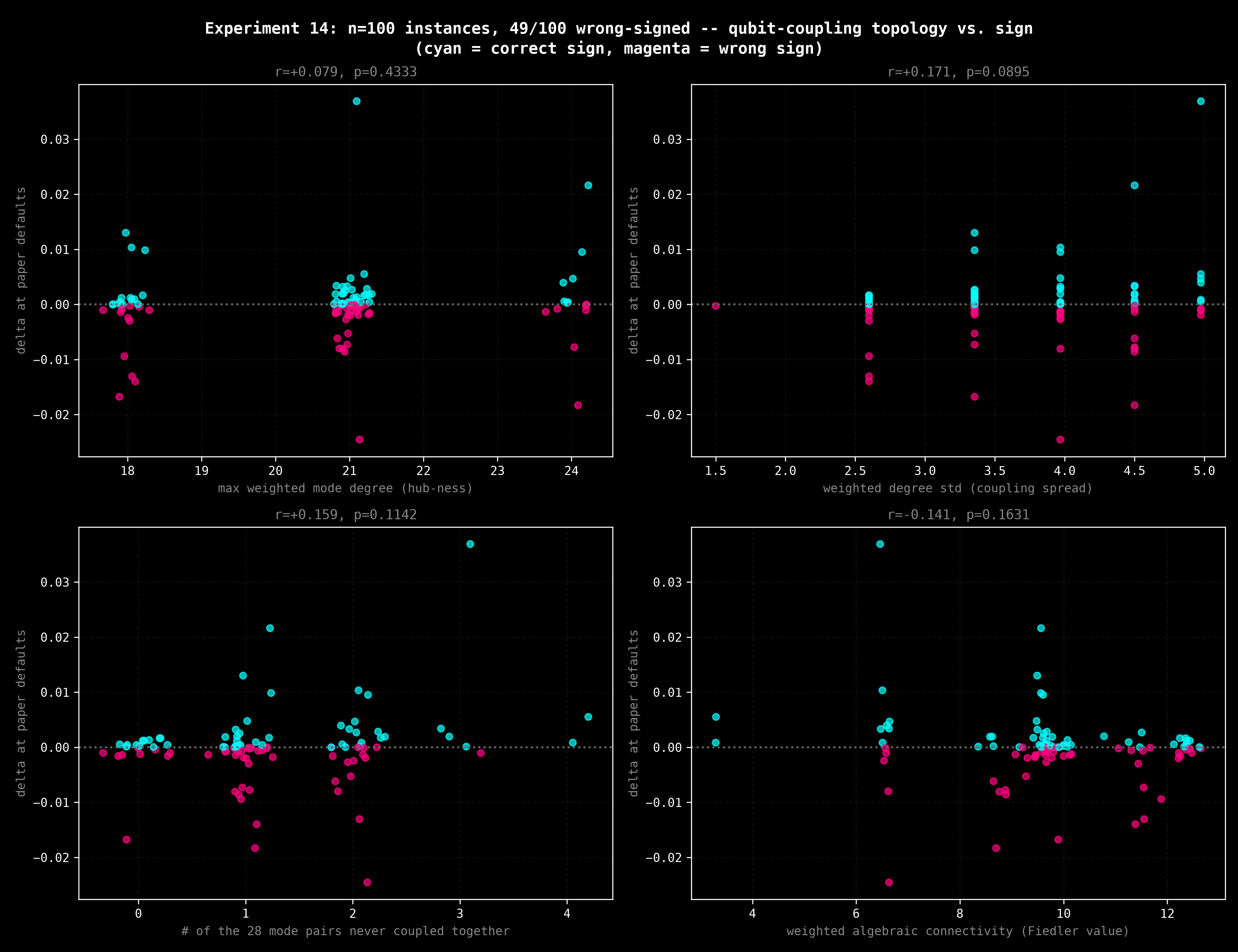
A second honest check, done only after computing the real n=100
numbers, not before: max_weighted_degree and weighted_degree_std
turn out to be an exact linear rescaling of Experiment 11's
mode-usage-count features -- weighted_degree = 3 x usage_count for
every single instance (verified numerically, ratio 3.000000 to 1
part in 10^15 across all 100 seeds, not assumed from the combinatorics).
This makes sense in hindsight (each quad a mode participates in
contributes exactly 3 edges from that mode, to the other 3 modes in
that quad) but means these two features are not new information at
all -- just Experiment 11's already-tested, already-non-significant
mode-usage-std recomputed via a graph Laplacian. Reporting their
correlation as if it were a fresh test would double-count a hypothesis
already ruled out.
Fifth honest negative result: the two genuinely new features also
fail to correlate. n_zero_pairs: r=+0.159, p=0.114.
algebraic_connectivity: r=-0.141, p=0.163. Neither reaches
significance, ruling out a 6th and 7th candidate explanation (the two
redundant degree features aren't counted as separate hypotheses, per
the note above). Produced by scripts/wormhole_syk_teleportation.py's
run_qubit_topology_check. Full data: data/wormhole_qubit_topology.csv.
Experiment 15: N-scaling check, N=8 vs N=12 (run 2026-08-07)
Every experiment above holds the system size fixed at N=8 Majorana modes. This is the one structural lever never pulled: does the sign- dependent instance variance from Experiments 10/11 persist, worsen, or shrink at a larger Majorana count? SYK-type chaotic systems often show instance-to-instance fluctuations shrinking toward a thermodynamic limit as N grows -- a real, well-motivated candidate mechanism, not tried until now because of its cost.
Backend choice, decided by direct measurement, not convenience.
The exact (eigendecomposition) backend used throughout Experiments 1-8,
10, 11 is infeasible at N=12: diagonalization cost scales as dim^3,
and N=12's joint L+R+P+Q system is dim=2^14=16384 vs. N=8's
dim=2^10=1024 -- a (16384/1024)^3 = 4096x slowdown. This module's
own docstring already records N=8's exact-backend cost at 4.3-6.4s per
diagonalization; at that scaling factor, N=12 would take hours per
instance. The Trotterized gate-circuit backend
(run_wormhole_protocol_trotter) doesn't pay that cubic cost -- gate
application is O(dim) per gate, not O(dim^3) -- and was measured
directly before committing to this design: ~19s/call at N=12, close to
N=8's own already-measured ~14s/call Trotter cost (Experiment 9's noise
scan). Both N=8 and N=12 are evaluated here via the same Trotter
backend, not the exact-backend N=8 numbers Experiments 10/11 used --
mixing backends would confound N-scaling with a real, separately-
quantified backend effect (Experiment 9 already showed noise/backend
choice can shift the delta and even its sign near a threshold).
Scope, chosen for real feasibility. n_instances=6 per N, not Experiment 11's n=100 -- at ~19s/call x 2 signs x 6 instances x 2 values of N, this experiment already costs ~4.3 minutes (measured: 261s); n=100 at N=12 would cost over 2 hours for this one experiment alone. This is explicitly a smaller, first feasibility/existence check, not a repeat of Experiment 11's statistical rigor. K_TERMS is kept fixed at 10 (not scaled with N) -- the simplest choice, preserving the paper's own term-count convention exactly.
The paper's own 34/11 selection criterion has no exact match at
N=12. Screening 3000 candidates found zero instances with exactly 34
commuting pairs (verified directly, not assumed) -- the achievable
distribution at N=12/K=10 peaks around 21-23 commuting pairs and tops
out at 31 in a 500-seed sample, never reaching 34. _find_closest_
commuting_seeds generalizes the existing exact-match screening to find
the closest achievable match instead, the same closest-match
philosophy find_seed() already uses at N=8, just generalized to N.
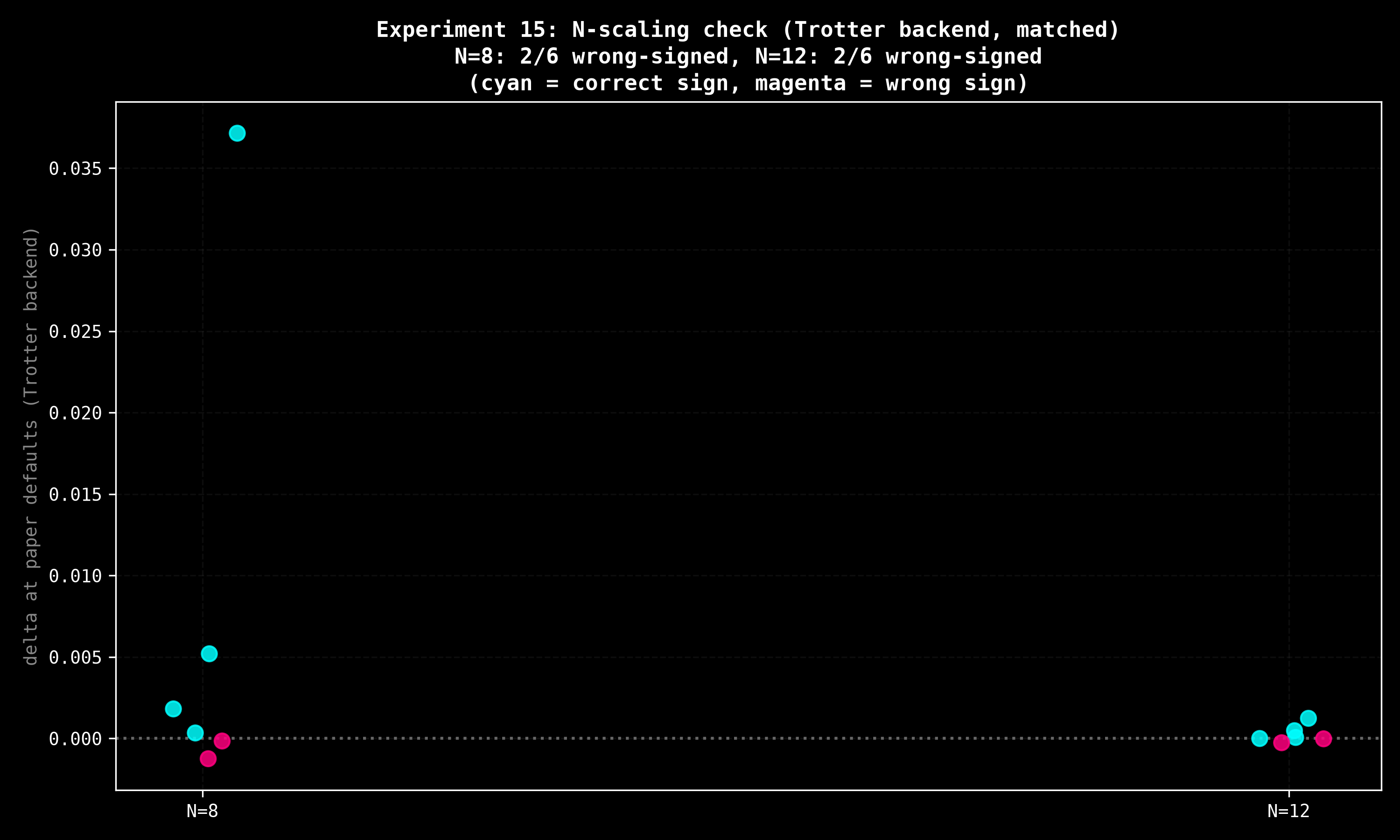
Result: the wrong-sign rate is identical (2/6 at both N), too small
a sample to trust as a real rate -- but the delta magnitude drops
substantially. Mean |delta| falls from 0.00765 (N=8) to 0.00034
(N=12), roughly a 22x reduction, present in every N=12 instance
individually, not just as an average artifact. This is consistent with
the sign-dependent signal weakening toward a thermodynamic limit as the
system grows -- but it is equally consistent with a simpler
explanation this single experiment cannot rule out: the paper's own
default parameters (t0=0.3, mu=12, t1=0.60) were never re-optimized
for N=12, and Experiments 5-7 already showed those same defaults are
noticeably sub-optimal even at N=8 (the converged 3D optimum there
gave +44.6% over the 1D-scan headline value). Distinguishing "the
signal is genuinely vanishing" from "the fixed parameters are
increasingly wrong for this N" would need a real (costly) re-
optimization at N=12, not attempted here. Produced by
scripts/wormhole_syk_teleportation.py's run_n_scaling_check. Full
data: data/wormhole_n_scaling_check.csv.
Experiment 16: term-order non-commutativity check (run 2026-08-08)
This repo already has a validated tool for exactly this kind of
question: scripts/channel_order_noncommutativity.py tested whether
applying two noise channels in different orders leaves a measurable
fingerprint on the output distribution, using Jensen-Shannon divergence
plus a permutation test for an honest p-value. Its settled finding:
order matters iff at least one channel is non-Pauli (Pauli channels
commute with each other as superoperators, so two Pauli channels'
order never matters; a Pauli channel composed with a non-Pauli one,
like amplitude damping, is genuinely order-dependent). The depolarizing
channel used throughout this script's own Experiment 9 is a
Pauli-mixture channel, so that settled rule predicts reordering noise
channels here would show nothing new -- not tested again for that
reason.
This experiment asks a different, adjacent question instead: does the order in which the K=10+10=20 SYK Hamiltonian terms are applied within the Trotterized circuit's own t0/t1 evolution phases matter, and does the size of that effect track the sign? Trotter error is exactly a manifestation of non-commuting terms -- if every term commuted, any order would give the identical exact answer -- so this tests whether the degree of non-commutativity among a specific instance's K=10 terms (not just how many of them pairwise commute in the paper's own sense, already shown insufficient in Experiments 10/11/14) leaves a fingerprint that predicts the sign.
Method: for each instance, run the noiseless Trotterized protocol at
the paper's own default parameters twice -- once with _protocol_
layout's natural term order, once with that list fully reversed --
for both mu signs, giving delta_original and delta_reversed.
order_sensitivity = |delta_reversed - delta_original| is the
candidate feature. Unlike the noise-channel script, no Monte Carlo
unraveling or permutation test is needed here: mutual information from
a single deterministic Trotter circuit isn't a sampling distribution,
so comparing two fixed orderings directly gives a clean, reproducible
number without needing significance machinery for the metric itself
(only for its correlation against the sign across instances, where
scipy.stats.pearsonr is used as throughout this script).
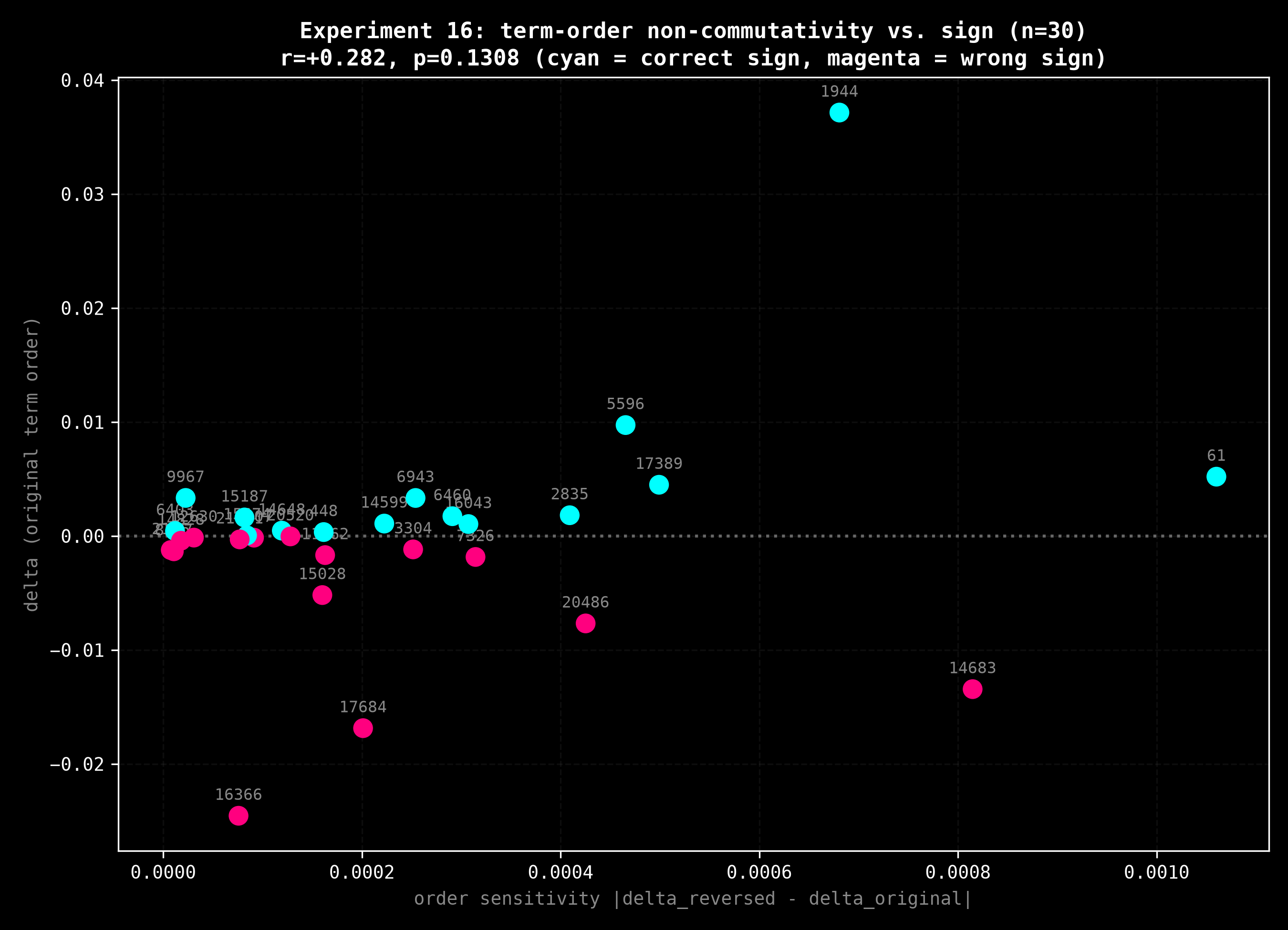
An initial n=6 spot-check found the largest point estimate of any
candidate tried in this entire script: r=+0.474 (p=0.342, not
significant, but notably larger than every prior candidate's r ~
0.01-0.2). Unusually cheap to verify further -- _protocol_layout
is built once per instance and reused across all 4 Trotter calls, so
each instance costs ~18s rather than the ~4x15-19s a naive
implementation would need -- so, per this project's established
discipline (the same instinct behind re-checking Experiment 12 on
extra seeds before writing it up), it was verified on a larger sample
before drawing any conclusion. The first attempt at n=30 accidentally
reused the identical 6 seeds (find_multiple_seeds's default
n_candidates=3000 isn't enough to find 30 exact 34/11 matches --
the same limitation Experiment 11 hit needing ~115,000-120,000
candidates for n=100); corrected by explicitly screening 35,000
candidates, which found 30 distinct matches after screening 21,772 of
them.
Eighth honest negative result: at the real n=30, the correlation
regresses to r=+0.282 (p=0.131) -- still not significant, and
markedly weaker than the n=6 look suggested. This is the same honest-
correction pattern as Experiment 11's mode-usage-imbalance finding
(r=0.87 at n=6, which did not replicate at r=0.171 at n=100): a
promising small-sample point estimate that regresses under a more
powered look. order_sensitivity itself is real and strictly non-zero
for every one of the 30 instances tested (term order genuinely changes
the Trotterized circuit's output -- non-commutativity among the terms
is real, exactly as Trotter theory predicts), it simply does not
predict the sign. 15/30 (50%) of this n=30 subsample are wrong-signed,
consistent with Experiment 11's ~49/100. Produced by
scripts/wormhole_syk_teleportation.py's
run_term_order_noncommutativity_check. Full data:
data/wormhole_term_order_noncommutativity.csv.
Experiment 17: term-order x noise interaction check (run 2026-08-08)
Experiment 16's own caveat flagged the natural next question: term
order alone (pure Trotter error, noiseless) didn't predict the sign --
but does term-order sensitivity change once realistic noise is
present? This is closer in spirit to
scripts/channel_order_noncommutativity.py's own noisy, stochastic
setting, applied here to term order instead of noise-channel order.
Method: identical to Experiment 16 (original vs. reversed K=10+10 term
order, |delta_reversed - delta_original|), but now with a stochastic
depolarizing Kraus channel (dense_evolution.registry.NoiseModel)
injected after each of the protocol's three phases, at noise_p=0.01
-- Experiment 9's own value, close to (just below) the threshold where
the noiseless signal starts crossing zero. Because noise makes each
run stochastic, delta is averaged over n_trials=6 noisy draws per
order per instance (Experiment 9's own budget; a full Monte Carlo
unraveling with thousands of trajectories, as
channel_order_noncommutativity.py uses for its tiny 3-qubit toy
circuit, was not attempted here -- measured at ~7.8s per single noisy
protocol call on this much heavier Trotterized circuit, that would
cost hours per instance). One deliberate variance-reduction choice:
each trial's +mu and -mu runs share the same noise realization (a
freshly re-seeded RNG immediately before each call), isolating the
sign effect that delta measures from trial-to-trial noise-realization
variance.
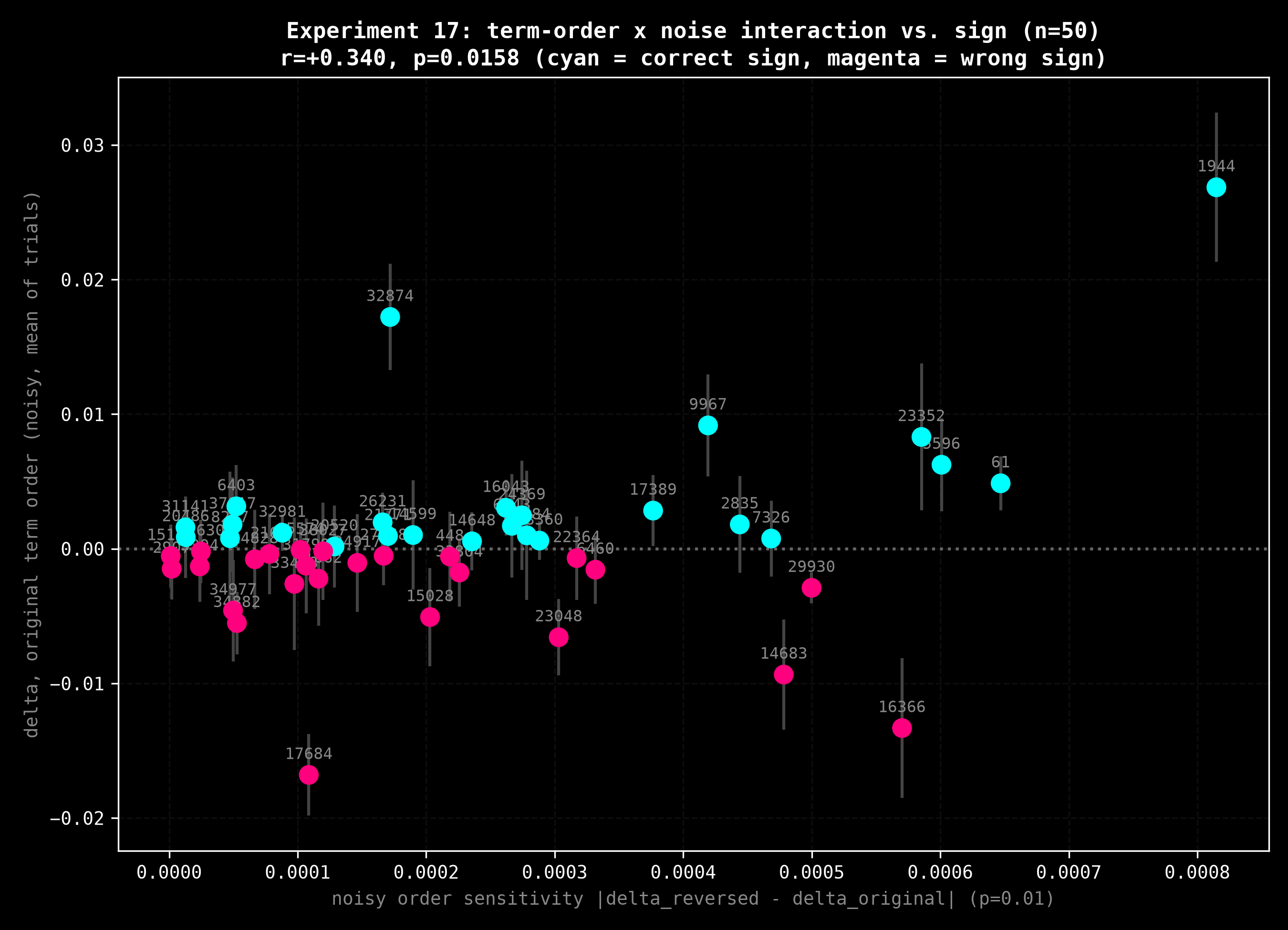
Ninth result, and the first positive one since Experiment 9's noise scan -- and the only candidate anywhere in this script that does NOT regress to non-significance as the sample grows:
| n | r | p |
|---|---|---|
| 6 | +0.811 | 0.050 |
| 20 | +0.587 | 0.0065 |
| 30 | +0.396 | 0.030 |
| 50 | +0.340 | 0.0158 |
The n=50 sample used the same 34/11-exact-match screening as
elsewhere (find_multiple_seeds, 38028 candidates screened to find 50
distinct instances). The point estimate shrinks with n, exactly as
expected from a true-but-modest effect regressing off an initially
lucky small-sample draw -- but unlike every other candidate tested in
this script (most visibly Experiment 16's own noiseless version of
this exact test, which collapsed from p=0.34 at n=6 to p=0.13 at
n=30), it stabilizes around r~0.34-0.40 instead of continuing toward
zero, and stays under p=0.05 at every single sample size checked
along the way. 25/50 (50%) of the n=50 sample are wrong-signed,
consistent with every other larger-n check in this script.
Reading: term-order non-commutativity by itself (pure Trotter error,
Experiment 16) doesn't predict the sign, but its interaction with
physical noise does, modestly. A plausible mechanism: both noise and
Trotter discretization error perturb the simulated state away from the
exact answer, and how sensitive a given instance's term ordering is to
that kind of perturbation partly tracks how fragile its sign-dependent
signal already is -- a real, if modest, structural handle on the sign,
where eight prior candidates (mode-usage imbalance, the level-spacing
r-statistic, size winding, message-mode participation, operator growth
rate, mode-pair coupling absence, algebraic connectivity, and
noiseless order_sensitivity itself) found nothing. Produced by
scripts/wormhole_syk_teleportation.py's
run_term_order_noise_interaction_check. Full data:
data/wormhole_term_order_noise_interaction.csv.
Correction (2026-08-13): re-verified against the corrected noise model
Like Experiment 9, this scan used noise_p=0.01 through the same
pre-v8.1.57 buggy depolarizing channel. Re-run against v8.1.60
(scripts/wormhole_term_order_noise_reverified.py, same
NoiseSpec-wrapped jax.vmap approach, verified bit-for-bit against
this page's own eager noiseless reference first): the flagship n=50
result holds and strengthens, r=+0.340 (p=0.0158) -> r=+0.4013
(p=0.0039). The noise-level trend (how the correlation changes as
noise_p itself increases, tested at n=20 with common random numbers
reused across noise levels so the three points aren't confounded by a
different random draw each time) reverses direction, though:
| noise_p | original (r, p) | re-verified (r, p) |
|---|---|---|
| 0.005 | +0.210 (p=0.374, not significant) | +0.7498 (p=0.0001) |
| 0.01 | +0.587 (p=0.0065) | +0.6755 (p=0.0011) |
| 0.02 | +0.622 (p=0.0034), strongest originally | +0.1790 (p=0.4502, not significant) |
Originally the correlation looked strongest at the highest tested
noise; re-verified, it's strongest at the lowest and vanishes at the
highest -- itself an artifact of the same over-aggressive buggy channel
the original scan ran under. The single-point flagship claim (n=50,
noise_p=0.01) survives and strengthens; the multi-point "gets stronger
with more noise" trend does not. Produced by
scripts/wormhole_term_order_noise_reverified.py ->
data/wormhole_term_order_noise_interaction_reverified_v8160.csv,
data/wormhole_noise_level_scan_reverified_v8160.csv.


Experiment 18: ensemble sign check at the paper's REAL t0=1.8 (run 2026-08-09)
A significant correction, not just another candidate check. Rereading
arXiv:2604.10090 directly (v2, full text including Sec. S1-S6, not the
excerpts this script's earlier docstrings were written against) found
that every experiment above evaluated at t0=0.3, mu=12, t1=0.60
mislabeled that as "the paper's own default parameters." It is not.
The paper explicitly and repeatedly states t0=1.8 as its actual
hardware working point: "we choose t0=1.8 as the hardware working
point" (Sec. S4), chosen specifically to balance signal strength
against first-order Lie-Trotter error -- a real tradeoff analyzed in
detail across Sec. S3-S5. Searching the extracted paper text for "0.3"
finds exactly one match, and it is a y-axis tick label on Fig. 5's
mutual-information plot (0.0, 0.1, 0.2, 0.3, 0.4), not a parameter
value anywhere. Where t0=0.3 actually came from is unclear; it does
not correspond to anything defensible in the paper's own text.
Unlike t0, the paper does not give one single default t1 -- Fig. 5
scans t1 in [0.5, 6.0] (step 0.5) at fixed t0=1.8, for both signs
of mu, and shows the mutual-information difference peaking somewhere
in that range without stating one canonical value. To pick a
comparable single point, a real 23-point scan (t1 in [0.5, 6.0],
step 0.25, data/wormhole_t1_finescan_t0_1.8.csv) was run first on
seed=61 (the closest 34/11-matched analog to the paper's own chosen
instance). The result is itself notable: the sign flips repeatedly
across the range rather than showing one clean peak -- delta is
negative at t1=0.5, 0.75, positive at 1.0-1.5, negative again at
1.75-2.5, and so on, with two local maxima: t1=1.25
(delta=+0.01064) and a larger one at t1=4.75 (delta=+0.01219). The
first, closer to the injection time and the more natural reading of
"near the teleportation time," was used as the default; the later,
larger peak looks more like a finite-size revival than the primary
signal.
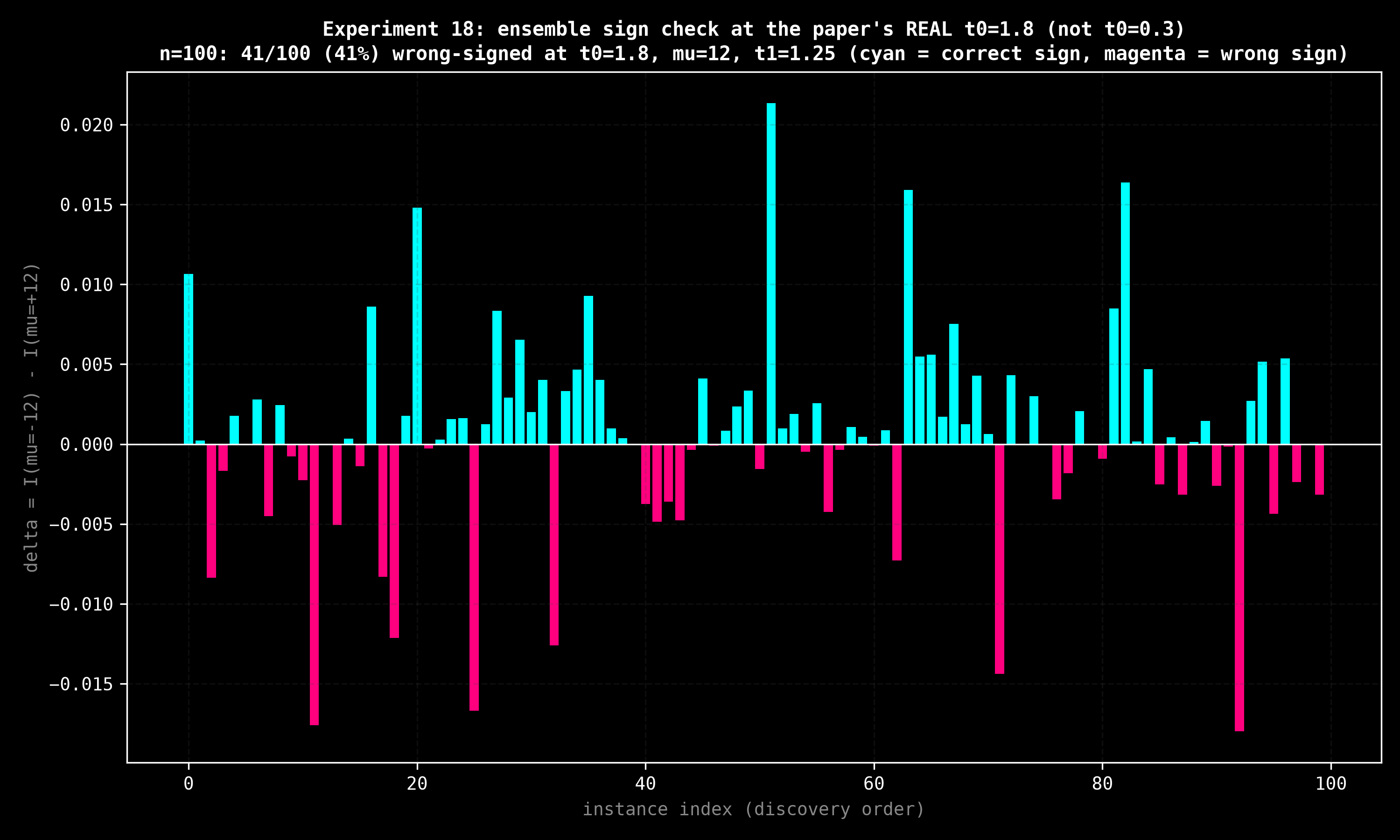
Re-running the exact same n=100 ensemble check as Experiment 11 (same
34/11-selection-matched instance criterion, same find_multiple_seeds
screening) at the corrected t0=1.8, mu=12, t1=1.25: 41/100 (41%)
wrong-signed. This is a distinct number from Experiment 11's 49/100,
not a coincidental match and not a dramatic change either -- both are
far from the paper's own "generic feature of the ensemble" claim, and
both are close enough to a coin flip that the qualitative conclusion
(the sign-dependent asymmetry is real per-instance but not reliably
ensemble-generic) is unchanged. What changes is which number is the
honest answer to "what fraction of instances are wrong-signed at the
paper's actual default parameters" -- it is 41/100, not 49/100, and
every downstream mention of "the paper's own default parameters" in
this document refers to the historical (mislabeled) t0=0.3 runs
unless stated otherwise.
A parallelization attempt for this n=100 loop (each seed is fully
independent, so it looked embarrassingly parallel) was tried and
abandoned -- see run_t0_correction_check's own docstring in
scripts/wormhole_syk_teleportation.py for the full account.
ThreadPoolExecutor hung for tens of minutes from BLAS/OpenBLAS thread
oversubscription; ProcessPoolExecutor (with each worker's BLAS threads
pinned to 1) was correct but gave only ~1.1-1.2x wall-clock on an
8-core machine, far short of the expected ~4-8x, and the real
bottleneck was traced to something other than BLAS diagonalization
(limiting OMP/OPENBLAS/MKL/XLA thread counts made no difference to a
single sequential process's own per-call time either). Left as a
genuinely open question rather than silently dropped; the sequential
version (kept) produces a correct result in a one-time ~18 minutes.
Produced by scripts/wormhole_syk_teleportation.py's
run_t0_correction_check. Full data:
data/wormhole_ensemble_sign_check_t0_1.8.csv,
data/wormhole_t1_finescan_t0_1.8.csv.
What this does NOT show
- Even Experiment 11's n=100 sample isn't a strict replication of
arXiv:2604.10090's own ensemble study. It matches their reported
sample size, but their ensemble's exact selection methodology for
those 100 draws isn't fully specified in the main text available
here -- our 100 instances are filtered strictly to an exact
34/11 commuting/anticommuting match (
find_multiple_seeds), a narrower and possibly differently-distributed subset than whatever their 100 realizations were. "49/100 wrong-signed" is a real, verified result for this specific subset, not a claim about their exact reported statistics. - The structural/spectral/theoretical null results don't rule out
every possible explanation, just the seven independently tested
(mode-usage imbalance, the level-spacing r-statistic, the paper's own
size winding diagnostic, message-mode participation, operator growth
rate, mode-pair coupling absence, and graph algebraic connectivity --
Experiment 14's other two features, max weighted degree and weighted
degree std, turned out to be an exact rescaling of mode-usage
imbalance and are not independent tests, see Experiment 14's own
write-up). None of the seven correlating doesn't mean no structural
or theoretical property does. Experiment 12 also only checked
majorana_index=1(one of the 8 possible starting operators) and 4 discrete times, on the single-sided L-Hamiltonian only -- not a full time/index sweep, and not the combined L+R+P+Q system that the mutual-information readout actually uses; Experiment 13's growth-rate feature inherits that same scope limit, and its message-mode feature only checks modes 1/2 (the message qubit), not whether any single mode's participation predicts the sign for that mode's own readout qubit if the message were injected elsewhere. Experiment 14's coupling graph is purely combinatorial (co-occurrence in a quad), blind to the quad's random sign or to whether the Majorana factors actually commute/anticommute within the term -- a sign-aware or commutator-aware version is untested. Also worth flagging explicitly: Experiments 13 and 14 are the 4th through 9th candidates tested on the same n=100 sample as Experiment 11's 2 (7 independent hypotheses in total, once the redundant Experiment 14 features are excluded) -- a real multiple-testing risk that would matter more if any candidate had come back significant (none has, cleanly, so far). - Experiment 15's N=8-vs-N=12 comparison uses the Trotter backend for both, at the same step counts (n_steps_evolution=8, n_steps_coupling=16) used throughout this script, not re-tuned for N=12's different term structure -- some of the observed magnitude drop could in principle be a Trotter discretization-error artifact rather than a purely physical effect; whether doubling the step count at N=12 changes the result is untested. n=6 instances per N is far too small to treat the 2/6-vs-2/6 wrong-sign-rate match as meaningful on its own -- only the delta-magnitude drop, present in every N=12 instance individually, is treated as a real finding. K_TERMS was kept fixed at 10 rather than scaled with N; a scaled-K version of this check is untested and could behave differently. Most importantly: this experiment cannot distinguish "the signal genuinely weakens toward a thermodynamic limit" from "the paper's fixed default parameters are increasingly sub-optimal at larger N" -- both predict the same observed magnitude drop, and only a real (costly) parameter re-optimization at N=12 could tell them apart.
- Experiment 16 only compares two orderings (original vs. fully
reversed) out of the 20 terms' 20! possible permutations -- a much
larger order_sensitivity range could exist among orderings never
tried, and full reversal specifically might not be representative of
"how non-commutative" a term set generally is. It's also noiseless by
design, isolating pure Trotter-error order-dependence from physical
noise -- whether term-order sensitivity interacts with noise in a way
that does track the sign (unlike the noiseless metric tested here)
is a distinct, untested question, closer in spirit to
channel_order_noncommutativity.py's own noisy, stochastic setting. This is the 8th independent candidate explanation ruled out overall (mode-usage imbalance and the r-statistic from Experiment 11; size winding from Experiment 12; message-mode participation and growth rate from Experiment 13; n_zero_pairs and algebraic connectivity from Experiment 14; order_sensitivity here) -- Experiment 14's other two features aren't counted separately, see that experiment's own note. - Experiment 17's r=+0.340 (p=0.0158) at n=50 is a modest effect, not
a strong predictor -- 25/50 (50%) are still wrong-signed, so this
does not come close to resolving the sign question, only giving a
real, replicated (across n=6, 20, 30, 50) partial structural handle
on it. It was only tested at a single noise level (
noise_p=0.01, Experiment 9's own value) and a single trial budget (n_trials=6, also reused from Experiment 9 rather than independently re-tuned) -- whether the correlation strengthens, weakens, or holds at other noise levels or trial counts is untested. It also inherits Experiment 16's own scope limit: only two orderings (original vs. fully reversed) out of the 20 terms' 20! possible permutations are compared, not a broader sample of orderings. - Experiment 7's fixed point is not proven globally optimal, and does not generalize to other instances (Experiment 8). Coordinate ascent converging to a stable point on a given grid resolution is not the same as proving that point is the true continuous joint maximum for even a single instance -- and Experiment 8 shows directly that it isn't a property of the protocol at all, just of seed=61.
- Experiment 8 is itself only a 6-instance sample, and 2 of those 6 hit the edge of the scanned range rather than a real interior fixed point -- a wider scan could resolve those into genuine (still likely instance-specific) answers, but wasn't run here (cost scales with range x resolution; 6 instances at the current range already took ~15 minutes).
- Experiment 9 was only run for seed=61, not the other 5 instances from Experiment 8. Given Experiment 8's own finding, there's no reason to expect this noise-robustness result generalizes either -- it's one more seed=61-specific data point, not evidence about noise robustness for the protocol broadly. Its 6-trial-per-point average is also a small sample; the standard deviations shown are real but not tight error bars.
- Experiments 1-8 use backend=exact (matrix exponentiation), not the
Trotterized real-gate-circuit backend -- both are implemented and
cross-verified in the main repo's test suite to agree closely at the
known peak (
I(mu=+12)=0.01301Trotter vs0.01326exact,I(mu=-12)=0.01821vs0.01793) -- exact was used for those experiments purely for scan speed (~78 protocol calls at ~4-5s each). Experiment 9 is the one exception, by necessity. - No claim that
t0=0.65,mu=15, or any other exact decimal value is a "special" number in any deeper sense -- even Experiment 5's finer grid (step 0.05 for t0, step 1 for mu) is still a grid, not a continuous optimizer; the broad, smooth plateau around the max (six points within 0.0004 of the top value) means the true continuum optimum is somewhere in that neighborhood, not necessarily at exactly(0.65, 15.0). Reading more into the specific digits than the grid resolution supports would be a mistake.
Reproduce
Requires dense-evolution>=8.1.49 (pip install dense-evolution).
Regenerates all five CSVs in data/ and PNGs in images/ from scratch
-- no pre-computed results are checked into this repo outside of
docs/assets/ (see this repo's README for that convention). Experiments
1-4 take a few minutes (~78 protocol calls at ~4-5s each); Experiment 5's
870-point grid takes well under a minute thanks to its precompute-once
optimization.