The Hubbard Square: Mott Localization and d-Wave Pairing (Arovas et al.)
In plain terms: the Hubbard model is the simplest description of electrons that both hop between neighboring atoms AND feel a real energy cost for two electrons sharing the same site (Pauli exclusion plus Coulomb repulsion). At weak repulsion, electrons spread out and entangle across the whole lattice; at strong repulsion, each site "freezes" into holding exactly one electron, since doubly-occupying any site becomes too costly -- the Mott transition. This page reproduces that transition on the smallest interesting case (4 sites in a ring, the "Hubbard square") and checks it against a real published paper's formulas and predicted ground-state symmetry, not just a textbook description.
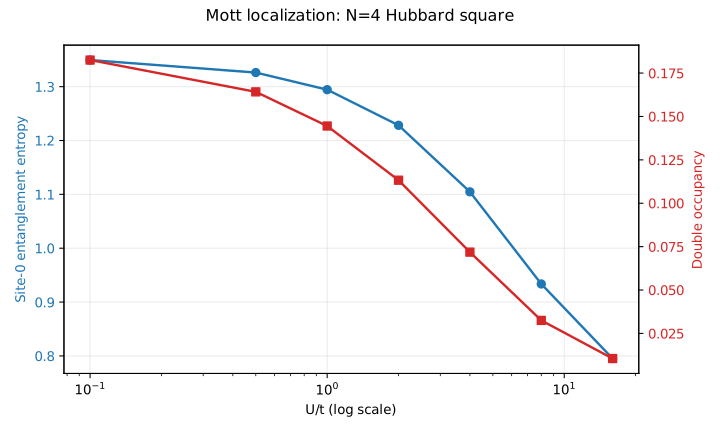
Real data from the script below: as U/t grows from 0.1 to 16, site-0's entanglement entropy drops from 1.349 to 0.795 bits and its double occupancy drops from 0.183 to 0.011 -- a site increasingly likely to hold exactly one electron, increasingly disentangled from its neighbors, both signatures of the same underlying localization.
Reproduces Arovas, Bandyopadhyay & Zhu, "The Hubbard Model" (Annual Review of Condensed Matter Physics 2022, arXiv:2103.12097) -- specifically Table 2 (p.6), the N=4 periodic-ring row's small-U/t perturbative ground-state energy formula and its identification of that ground state's orbital symmetry as x^2-y^2 (B1g/d-wave).
The physics
Periodic 4-site ring, one spin-up and one spin-down qubit per site (8 qubits total):
H = -t * sum_<ij>,sigma (c^dagger_i,sigma c_j,sigma + h.c.) + U * sum_i n_i,up n_i,down
mapped onto qubits via the standard (non-Majorana) Jordan-Wigner convention, c_q = sigma+_q * (Z-string). Table 2's small-U/t perturbative formula for this exact N=4 case:
E_0(U) = -4t + (3/4)*U - (13/128)*(U^2/t)
Why the periodic wraparound bond needed a self-test before trusting it: on a ring, the bond connecting site N-1 back to site 0 is the one place a naive Jordan-Wigner implementation could plausibly need an extra fermion-parity sign correction -- some conventions do, for a short Pauli string spanning that boundary. This implementation always uses the full-length Jordan-Wigner string between the two mapped qubit indices instead, the exact fermionic identity for any pair of modes regardless of lattice adjacency -- so no correction should be needed, but that claim was checked directly against an independent brute-force fermionic construction before being trusted, not just argued from the formula.
Three checks
1. Periodic Jordan-Wigner self-test: the Pauli-string Hamiltonian (including the wraparound bond) matches an independent brute-force fermionic-operator construction to 0.00e+00 at N=2, 3, and 4 -- machine-exact, confirming no extra parity correction is needed.
2. Perturbative formula, deep in its regime of validity: at U/t=0.05, exact diagonalization gives -3.962753; Table 2's formula gives -3.962754 -- agreement to 2.7e-07 relative, exactly where a small-U/t expansion should hold. At U=0.5 (moderate, not deep small-U), exact gives -3.648988 vs. the formula's -3.650391 -- a real 1.4e-03 gap, since the perturbative series is only asymptotically exact as U/t -> 0, not a general-purpose formula for any U.
3. Ground-state symmetry: Table 2 identifies this exact model's ground state as x^2-y^2 (B1g/d-wave) orbital symmetry. The real, physical signature of that symmetry is a specific sign pattern in the pairing correlator <Delta_0^dagger Delta_j>: positive on axis (nearest) neighbors, negative on the diagonal (next-nearest) neighbor. At U=4.0: j=1 (axis) +0.0333, j=2 (diagonal) -0.0052, j=3 (axis) +0.0333 -- exactly that pattern.
Result
| check | value | reference |
|---|---|---|
| periodic JW mapping vs. brute-force (N=2,3,4) | max diff 0.00e+00 |
machine-exact |
perturbative formula, U/t=0.05 |
exact -3.962753, formula -3.962754 |
2.7e-07 relative |
perturbative formula, U=0.5 (out of regime) |
exact -3.648988, formula -3.650391 |
1.4e-03 gap, expected |
entropy/double occ., U: 0.1 -> 16.0 |
1.349 -> 0.795 bits, 0.183 -> 0.011 |
monotonic decrease (Mott) |
pairing correlator, U=4.0, axis vs. diagonal |
+0.0333 vs. -0.0052 |
matches B1g/d-wave sign pattern |
Status
Both real claims in Arovas et al.'s Table 2 for this exact model -- the perturbative energy formula and the x^2-y^2 ground-state symmetry -- reproduced and verified against independent references (exact diagonalization, brute-force fermionic construction), not assumed from the paper's text alone. A genuinely reusable function came out of this: hubbard_hamiltonian_pauli_terms, promoted to Dense-Evolution's dense_evolution.physics.fermions module (a different, non-Majorana Jordan-Wigner convention from the module's existing majorana_pauli_terms) -- see its docs page for the differentiable-VQE-ready version built on PauliSumOperator.