Chunk: Multi-Device and Disk-Backed Simulation
Note
The implementation lives in the main library:
dense_evolution.Chunk
(shipped in dense-evolution>=8.1.67, with its own unit test suite in
the main repo). This page is the experimental log for what this repo
adds on top: the distributed path actually run on real multiple
devices, and the disk-overflow path actually run against real files —
not just demonstrated up to the point where they would run.
In plain terms: simulating more qubits needs exponentially more memory, until a normal simulator runs out of RAM. Chunk is Dense-Evolution's answer -- splitting the simulation across multiple devices, or spilling to disk when it doesn't fit in memory at all. This page actually runs both of those paths for real (multiple real devices, real files on disk), not just up to the point where they'd theoretically work.
Why a normal simulator isn't enough
A statevector simulator has to hold one complex number for every possible outcome of the qubits it simulates. Four qubits means 16 outcomes — a tiny array. Forty qubits means over a trillion outcomes — many terabytes, more than any single computer's RAM.
Chunk runs the exact same kind of circuit without ever building that one
giant array. It splits the array into smaller, RAM-sized pieces, and runs
gates across those pieces instead. This page checks, by really running it,
that three different ways of holding those pieces — all in one computer's
RAM, spread across several separate devices, or spilled to disk when even
several devices aren't enough — all compute the exact same physics.
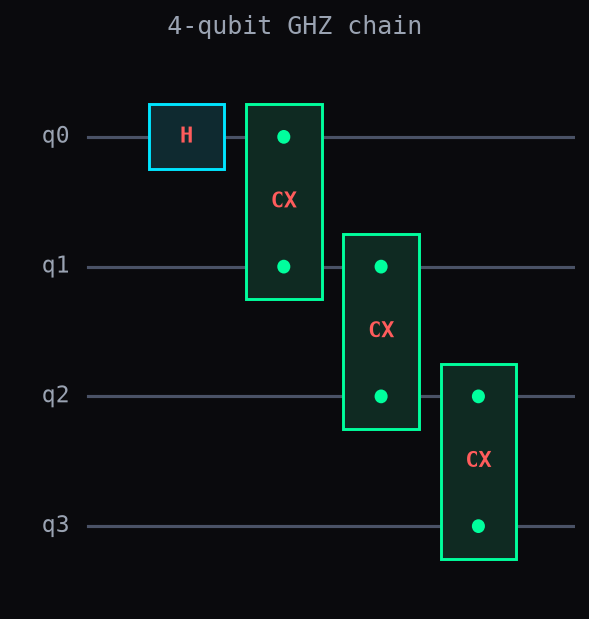
Step 1. The circuit: a 4-qubit GHZ chain
import dense_evolution as de

qasm = 'OPENQASM 2.0; include "qelib1.inc"; qreg q[4]; h q[0]; cx q[0],q[1]; cx q[1],q[2]; cx q[2],q[3];'
circuit = de.QASMParser().parse(qasm)
ops = circuit.to_tuples()
h q[0] puts qubit 0 into an equal superposition of 0 and 1. Each
cx (controlled-NOT) then copies that qubit's value onto the next one, so
the whole chain ends up either all-0 or all-1, never anything in
between — the standard "GHZ state" used throughout quantum computing to
check that entanglement survives a pipeline end to end.
Step 2. The reference answer: one plain simulator
baseline = de.DenseSVSimulator(4)
baseline.run_circuit_jit(ops)
baseline.get_probabilities().round(4)
Half the probability on outcome 0000, half on 1111, nothing else —
exactly the GHZ signature. Every other step on this page checks against
this same number.
Step 3. Splitting the array into 4 pieces, still in RAM
from dense_evolution.backends.chunk import Chunk
from dense_evolution import chunk as chunk_mod

chunk_mod.get_dynamic_chunk = lambda dtype_target: 2
ram = Chunk(4)
ram.run_chunk(ops)
ram.num_chunks, ram.get_probabilities().round(4)
Forcing the safe piece size down to 2 qubits splits the 4-qubit array into
4 separate pieces of 4 amplitudes each — on a real machine Chunk only
does this once a circuit genuinely doesn't fit, but forcing it here shows
the split working on a circuit small enough to check by eye. Identical
result to Step 2, computed as 4 small pieces instead of 1 array.
Step 4. The same 4 pieces, on 4 real separate devices
Each of those 4 pieces can also live on its own physical device instead of
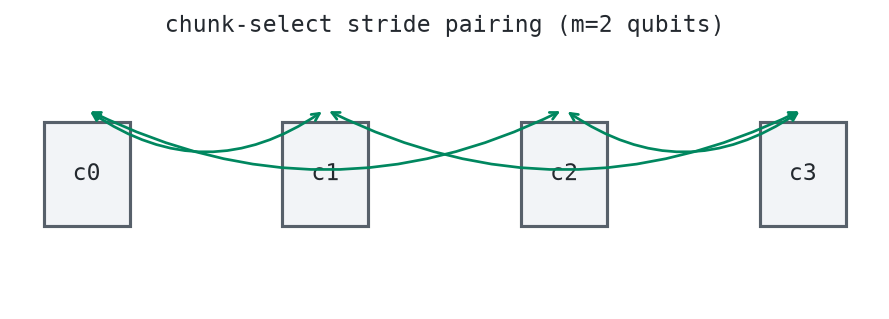
sharing one process's RAM. Two of the 4 qubits (the two Chunk used to
pick which piece a gate belongs to) decide, for a gate that touches both
pieces, which pair of pieces needs to exchange data:
import os
os.environ["XLA_FLAGS"] = "--xla_force_host_platform_device_count=8"
import jax

dist = Chunk(4)
dist.run_chunk_distributed(ops)
jax.device_count(), dist.get_probabilities().round(4)
XLA_FLAGS set before JAX starts up makes this machine present 8 separate
CPU devices instead of 1 — enough to give each of the 4 pieces its own
device. The two pieces on either side of an arrow above really send their
data to each other over that connection (jax.lax.ppermute), not through
shared memory. Same GHZ result again.
Step 5. Past even that: pieces that don't all fit at once
disk = Chunk(4, memory_threshold=0.999999, allow_disk_overflow=True)
disk.run_chunk(ops)
disk.get_probabilities().round(4)
memory_threshold=0.999999 forces Chunk to decide the 4 pieces can't
safely fit together — on a real machine this only happens at a piece
count too large for actual RAM. allow_disk_overflow=True makes it fall
back to keeping every piece as a file on disk instead of raising an
error, loading only the one or two files a gate actually needs at a time:
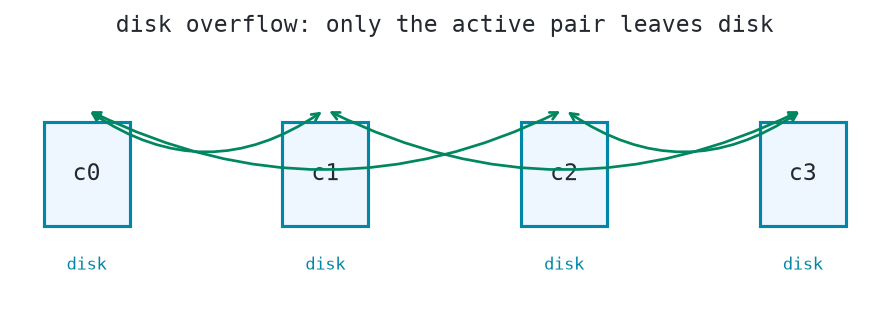
Same GHZ result a third time — call disk.close() afterward to remove the
temporary files.
Real timing, all three ways (one run on this machine)
| Path | Time | Matches Step 2? |
|---|---|---|
| Baseline (Step 2) | 564 ms | — (reference) |
| RAM, 4 pieces (Step 3) | 992 ms | Yes |
| 4 real devices (Step 4) | 1079 ms | Yes |
| Disk-backed (Step 5) | 4112 ms | Yes |
All three include a one-time JAX compilation cost on first use — none of this is a fair speed comparison, only a correctness one. The ordering itself is still the expected one: real network exchange between devices costs more than reading from the same process's RAM, and real file I/O costs far more than either.
Details
Two real papers behind these two extra paths
The device-to-device pairing in Step 4 follows the same scheme LaRose 2018 (arXiv:1801.01037, "Distributed Memory Techniques for Classical Simulation of Quantum Circuits") used on a real MPI/OpenMP supercomputer (up to 33 qubits across 26 processors): a fixed number of qubits chosen to select which piece of the array a gate belongs to, the rest handled purely locally within a piece. This repo's own run above is 8 simulated CPU devices on one machine, not a real multi-host cluster — that remains untested here.
The disk-backed fallback in Step 5 follows Pednault et al. 2019 (arXiv:1910.09534, "Leveraging Secondary Storage to Simulate Deep 54-qubit Sycamore Circuits") — the technique IBM used to classically simulate circuits believed at the time to be beyond classical reach, by never holding more than the currently active pieces in memory.
Why disk-backed can't just be "a memmap"
The obvious-looking shortcut — back each piece with a numpy.memmap file
instead of a plain array — doesn't work here: dense_evolution's arrays
are always live jax.Array objects, and JAX has no notion of a
memmap-backed device array. A piece only genuinely "lives on disk" while
idle if it isn't loaded into a jax.Array at all until a gate needs it —
which is what dense_evolution/backends/chunk/disk_overflow.py actually
does, one gate (or one pair of pieces) at a time. This is the same reason
the main library's own docs/api/chunk.md gives for this design; see
that page for the phase-classification details.
Why the main library's own docs stop short of this
docs/api/chunk.md's own Step 6 demonstrates the distributed path only
as far as the RuntimeError it raises when too few JAX devices are
present — the library's own doc build never sets XLA_FLAGS beforehand.
This experiment sets it as the very first lines of the script, before
dense_evolution or jax are imported at all — JAX's device count is
fixed the first time it initializes, so setting the flag any later has no
effect — specifically so this page could show the real communication path
running, not just the guard clause in front of it.
The distributed check only runs for real outside the shared test suite
XLA_FLAGS only works if it's set before JAX initializes for the very
first time in the whole process — and this repo's CI runs every test
file in one shared pytest process. If an earlier-collected test file
imports dense_evolution/jax first, JAX has already locked in 1 real
device by the time this script's own XLA_FLAGS line runs, and Step 4
falls back silently to reporting it as unavailable instead of running.
Running python scripts/simulator_infrastructure/chunk_distributed_disk_experiment.py on its own
(as this page's own numbers were produced) always hits the real
8-device path — tests/simulator_infrastructure/test_chunk_distributed_disk_experiment.py skips
that one check, with the reason above, when it detects this.
Reproducing this page
scripts/simulator_infrastructure/chunk_distributed_disk_experiment.py runs everything on this
page top to bottom, including generating the three images above via
dense_evolution.circuits.diagram.plot_circuit (Step 1) and this
script's own small matplotlib helper for the piece-pairing diagrams
(Steps 4-5) built from the run's own real num_chunks/stride values, not
drawn by hand. tests/simulator_infrastructure/test_chunk_distributed_disk_experiment.py checks
its results on every CI run.
See Also
- Chunk API reference — the full guide this experiment builds on, including the in-RAM-only Steps 1-5.
- Traversable-Wormhole-Inspired Quantum Teleportation — another experiment log built directly on top of a published main-library feature.