A Universal Point-to-Point Trajectory Generator, Closed-Form
Two real papers (both read in full, not trusted from a summary) proposed very different scopes for a "universal" trajectory planner: Lozer, Scalera, Boscariol & Gasparetto, "Planning optimal minimum-jerk trajectories for redundant robots" (Robotics and Autonomous Systems) does multi-stage optimization with a full dynamic model on a real 7-DOF Franka Panda; Fried & Paternain, "A Bi-Level Optimization Approach to Joint Trajectory Optimization for Redundant Manipulators" (arXiv:2412.07859) does a convex inner/primal-dual outer optimization validated on a real UR10e. Both need a full kinematic/dynamic model (URDF parsing, Jacobians, torque limits) -- a large, separate undertaking, deliberately not attempted here.
Instead: the simplest real, closed-form piece both analyses agree is the right starting
point -- a minimum-jerk-continuous point-to-point generator, universal in the sense that
matters for this repo's own stack: it needs no URDF, no kinematics, no dynamics, and no
robot connection at all, and it composes directly with rate_limiter/cbf_filter (which
already own rate-of-change and spatial safety -- this generator doesn't need to worry about
either).
Step 1. The closed-form quintic
t, q, v, a = quintic_trajectory(q0=[0.0], qf=[10.0], T=2.0,
                                 v0=[1.0], a0=[0.5], vf=[-2.0], af=[0.3])
A unique degree-5 polynomial per joint, solved directly from its 6 real boundary conditions
(position/velocity/acceleration at t=0 and t=T) -- not memorized from a textbook formula,
solved as a real 6x6 linear system, so a transcription error would fail the boundary-check
test below instead of silently shipping a wrong trajectory. Works for any number of joints
at once (any robot) since each joint's polynomial is independent.
Step 2. A real, honest first validation attempt -- and why it was thrown out
The first thing tried: take a real SO-101 pick-and-place episode's first and last frame as
q0/qf, generate a quintic over the real episode duration, and compare peak velocities.
Degenerate result: several joints' start and end positions were nearly identical (a real
pick-and-place task often returns close to its own starting configuration), giving the
quintic almost nothing to do and nothing meaningful to compare against. Not a useful test --
thrown out rather than reported as if it meant something.
Step 3. A fair real comparison
For each real joint, independently: find the real frame of its own minimum and the real
frame of its own maximum value within the episode -- a genuine point-to-point excursion --
and compare the quintic's peak velocity (same q0, qf, real elapsed duration) against the
real peak velocity actually observed between those two real frames.
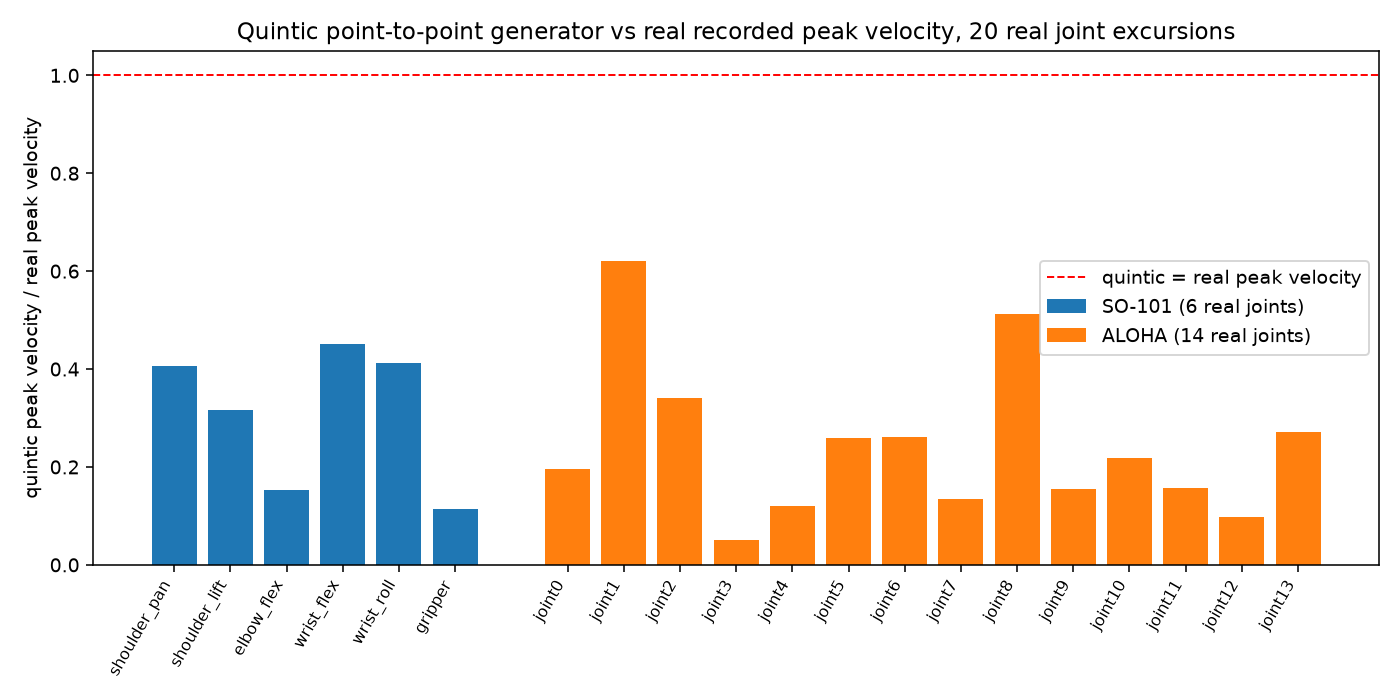
Result
Both real domains, 20 real joint excursions total: the quintic's peak velocity is always lower than the real recorded peak velocity (ratio 0.05-0.62, mean 0.26). Expected, not a bug: the quintic is the smoothest possible path between two points, so it needs less peak speed than a real (teleoperated, not necessarily efficient) trajectory covering the same net real displacement in the same real time.
Details
Why point-to-point only, not multi-waypoint chaining: scoped down deliberately from the much larger proposal in the source notes (URDF-aware bi-level optimization, B-splines for many waypoints, automatic joint selection for redundant robots). Chaining several quintic segments is a real, natural next step, not attempted in this pass.
Real domains: SO-101 (single 6-DoF arm, real 30Hz, 6 real joint excursions) and ALOHA (bimanual, 14-DoF, real 50Hz, 14 real joint excursions) -- the same two real LeRobot datasets already used throughout this repo's other robot-command experiments.
Reproducing this: python scripts/trajectory_planning/quintic_validation_so101_aloha.py
(reuses the ALOHA parquet already cached by robot_sensor_validation/'s own experiments if
present, downloads it otherwise).
Status: promoted to Dense-Armor as quintic_trajectory after this real 2-domain
validation.