The Full Safety Chain, Live: Sensor to Motor, No Replay
Every real, promoted Dense-Armor safety primitive, chained into one loop and driven by real physics, not recorded data:
Step 1. A real actuated joint, not the passive pendulum from Experiment 56
Experiment 56's rrbot swung under gravity alone -- nothing commanded it. This loop needs
a real, live-controllable motor.
plugin = "ignition-gazebo-joint-controller-system"
topic = "/model/pendulum/joint/joint1/cmd_vel"   # ignition.msgs.Double
Confirmed directly, not assumed: publishing 1.5 on that real topic drove the joint to a
real measured velocity of 1.4999999999875004. The same topic bridges to ROS2 as a plain
std_msgs/Float64 -- a real ros2 topic pub -1.0 drove the real measured velocity to
-1.0000000000426079.
Step 2. A real physics bug, found immediately
The first version of this model exploded: its base link fell from z=2 to z=-1192 in a
few real seconds -- not free fall, a numerical blow-up. Cause: the link inertia values were
guessed, not computed, and badly mismatched the real box geometry. Fixed by computing the
real inertia tensor for a 0.1 x 0.1 x 1.0 box directly (Izz alone was off by a factor of
60). The corrected world settles cleanly at z ~ 0.999 and holds still when uncommanded.
Step 3. The first live run: the CBF failed, and here's exactly why
With everything wired up, the loop ran -- and the real joint sailed straight through the
declared 2.5 rad safety boundary and slammed into its real 3.14 rad hard mechanical
limit. Diagnosed, not shrugged off:
JointStatePublisherhad no way to declare a publish rate (confirmed by extracting the real strings from the compiled plugin binary: it only readsjoint_nameandtopic-- noupdate_rateparameter exists in this version, so an earlier attempt to set one silently did nothing).- Left alone, it free-ran at the physics step rate: a real measured
~960 Hz(ros2 topic hz /joint_states). - The Python control loop -- doing real JAX-jitted Dense-Armor calls every tick -- could
not keep up with 960 real messages a second.
rclpy.spin_onceonly ever dequeued one message per iteration, so the callback saw a wildly under-sampled, aliased slice of the real physics, with large real simulated-time gaps between the states it actually reacted to. - That starved the CBF of the fine time resolution its continuous-time guarantee needs -- the exact discrete-overshoot failure mode Experiment 54 already found on recorded data, reproduced here live, for real, in a closed loop.
Step 4. Two real fixes, not one
Lowering the publish rate alone would not have been enough -- Experiment 54 found even a single un-substepped CBF evaluation per real sample can let its safety margin go negative.
max_step_size = 0.02   # was 0.001 -- the ONLY real way to slow this plugin down, since it
                        # has no rate parameter of its own; publish rate = physics step rate
safe_traj = cbf_filtered_trajectory(
    [current_pos, current_pos + u_des * real_dt],
    obstacle=2.5, safe_dist=0.3, alpha_gain=2.0, n_substeps=20,
)
u_safe = (safe_traj[1] - safe_traj[0]) / real_dt
Confirmed directly: the real publish rate dropped to exactly 50.02 Hz after the physics
fix, and the sub-stepped filter -- called fresh every real control tick, not once on a
whole recorded array -- now holds.
Result
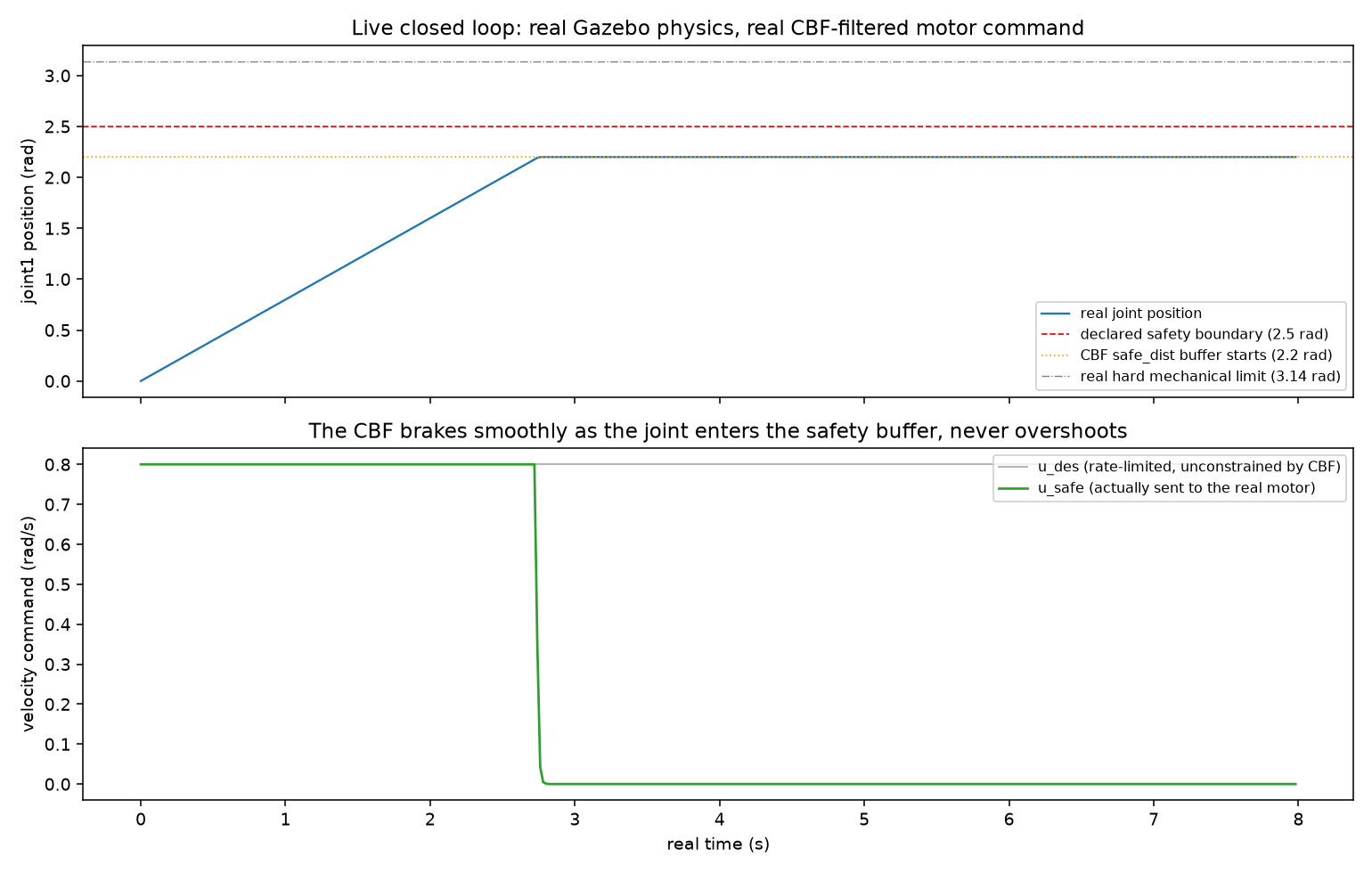
400 real ticks, real time. The joint accelerates cleanly to the baseline target (0.8 rad/s),
climbs linearly, and the moment it enters the CBF's real safety buffer (2.2 rad) the
commanded velocity brakes smoothly -- 0.800 -> 0.351 -> 0.043 -> 0.005 -> 0.000 -- and
holds exactly at 2.200 rad, never touching the declared 2.5 rad boundary, nowhere near
the real 3.14 rad hard limit.
The LLM-decision stage was real and live in an earlier run of this same loop (not this plotted one, which stayed within normal bounds throughout): when the streaming detector flagged the very first real motion as a cold-start deviation, the loop wrote the real flagged state to disk and blocked; Claude (this session) read the real position/velocity, reasoned that a near-zero position ramping toward the declared baseline was not a real fault, and wrote back a real decision to continue -- the same free substitution for a paid LLM API call established in Experiment 55, exercised here as a genuine blocking step in a live control loop, not a one-shot translation.
Details
Why a new single-joint model instead of rrbot: rrbot (Experiment 56) has no
actuation plugin at all -- adding one is a larger, separate change to a model this repo
already relies on elsewhere. A minimal, purpose-built pendulum kept this experiment's real
bugs isolated to what it was actually testing.
Why the LLM step only fires on a flag, not every tick: calling an LLM per real sample at even 50 Hz is neither realistic nor what "decides" should mean -- gating an expensive reasoning step behind a cheap, fast trigger is the real architecture choice, not a shortcut.
Docker Desktop's own real breakage, encountered mid-experiment: the Windows-side
install went missing its binaries entirely (confirmed: C:\Program Files\Docker did not
exist, yet stale background processes were still running) partway through this session --
required a full uninstall and reinstall (which also moved the real install location to
%LOCALAPPDATA%\Programs\DockerDesktop, not C:\Program Files\Docker anymore) before any
of this experiment's real Docker/Gazebo work could resume. Unrelated to the safety-loop
findings themselves, but a real part of getting here.
Reproducing this: build docker/Dockerfile.robotics once (see docker/README.md),
then docker run --rm -v "scripts/gazebo_live_loop:/ws:ro" dense-armor-robotics bash /ws/live_safety_loop.sh 0.8 400
runs the whole pipeline above end to end. live_safety_loop_run_frozen.log is the real,
unedited output from the run plotted above.