Cross-Channel Mahalanobis Fusion: A Real Negative Result
The Mahalanobis-SVDD Audio-IMU paper (Yang, Zhao et al. 2025, arXiv:2505.05811, indexed
in quantumrag) claims a fault can break the normal correlation between two sensor
channels without being a large deviation in either channel alone -- and that a joint
distance over both channels catches this where a single-channel detector structurally
cannot. This experiment tests that claim directly, closed-form only (no neural network,
per explicit instruction), on real IMU data already used in this repo (imu_sensor_
validation.md): UCI HAR's real accelerometer and real gyroscope, subject 17, a real
23-second WALKING segment.
Step 1. Two real channels, one real fault
accel = real_accel_magnitude(subject=17, activity="WALKING")   # 3-axis, real device
gyro = real_gyro_magnitude(subject=17, activity="WALKING")     # 3-axis, same real device
accel and gyro come from the same real sensor, at the same real timestamps, during
real human gait -- two genuinely different sensing modalities (linear acceleration vs
angular velocity) that should, in principle, move together with the gait rhythm.
The real test is in the fault: swap a 3-second window of gyro for a time-reversed
copy of itself.
Every sample value inside that window is still real and still has exactly the same
distribution as before (verified: sorted(gyro_fault[700:850]) == sorted(gyro[700:850]))
-- a single-channel detector calibrated on magnitude has little reason to fire. Only the
real temporal correspondence with the concurrently-recorded accel signal is destroyed.
This is deliberately a correlation-breakdown fault, not a magnitude fault -- exactly
the case the paper's method is supposed to catch and a single-channel detector is not.
Step 2. Attempt 1: a point-wise joint Mahalanobis distance
d_accel, d_gyro = diff(accel), diff(gyro_fault)
mean, cov = fit(d_accel[:400], d_gyro[:400])   # real calibration window, no lookahead past it
dist[t] = mahalanobis([d_accel[t], d_gyro[t]], mean, cov)
Result: 0% of the fault window flagged -- worse than either single-channel detector alone (accel 4%, faulted gyro 3%), and no higher than the real false-positive rate on unfaulted data (2.5%).
Diagnosed, not just accepted: a point-wise joint distance only asks whether one
(d(accel)[t], d(gyro)[t]) pair looks unusual on its own. It has no way to tell that the
pairs are arriving in the wrong order -- real gait excursions are close enough to
time-symmetric that a reversed sample still lands inside the normal-looking ellipse most
of the time.
Step 3. Attempt 2: a rolling correlation (sensitive to order, unlike Step 2)
This construction is sensitive to reordering. But the real baseline correlation, on unfaulted real data, turned out to already be close to zero (mean 0.04, std 0.11 over the calibration window) -- there was little real cross-channel structure left for the fault to break in the first place. The fault window's mean (0.20) is barely different.
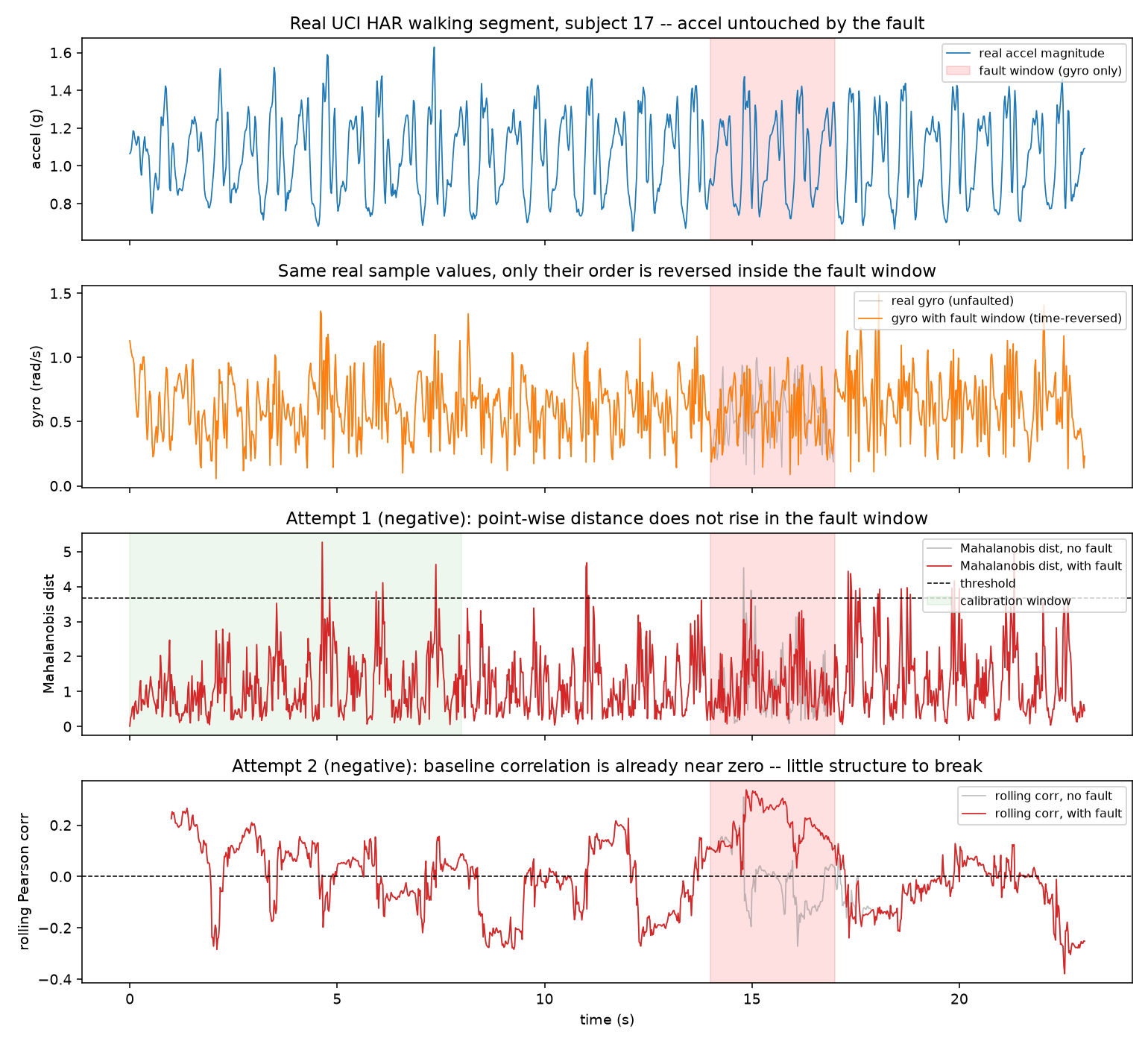
Result
Neither closed-form construction beat single-channel detection on this real data. Kept
as a real, disclosed negative finding, not smoothed into a positive story -- consistent
with this repo's own standard (e.g. the causal healing_filter rewrite's dead end).
Details
Why accelerometer+gyroscope, not audio+IMU: no real paired audio+IMU dataset was available in-session. Accel and gyro are two genuinely different real IMU sensing modalities from the same real device at the same real timestamps -- the part of the underlying hypothesis (cross-modality correlation as a fault signal) this experiment could actually test honestly with data on hand.
Likely cause of the weak baseline correlation, not chased further here: both channels
were reduced to 3-axis Euclidean magnitudes before comparison. That discards the
directional/phase information (which axis is rotating vs accelerating, and when) that
most plausibly carries the real physical coupling between linear acceleration and
angular velocity during gait. A fairer test would compare matched per-axis signals
(e.g. total_acc_x against the gyro axis measuring rotation about the corresponding
plane) instead of magnitudes -- a real, separate undertaking (correct axis/frame
alignment between the two real sensors), not attempted here.
Not a promotion candidate. Both real domain-1 attempts came back negative -- this project's own 2-domain bar for promoting a Discovery utility to Dense-Armor was never in reach here; the result itself is the deliverable of this experiment, not a shipped function.
Reproducing this: python scripts/robot_sensor_validation/cross_channel_mahalanobis_imu.py
(downloads the real 61MB UCI HAR dataset on first run if not already cached from
imu_sensor_validation.md's own experiment).