The Dynamic Vacuum Pressure Theory
Salvatore Pennacchio — Independent Researcher — September 2026
We propose that the vacuum regularizes itself through a single mathematical shape — cosh — and that this shape is not chosen by hand: we force it from three independent directions (a no-go theorem, a statistical derivation, and a dynamical-attractor proof), and show it holds correctly across four unrelated physical applications (black holes, cosmology, neutron stars, the Coulomb potential). We close with an honest look at falsifiable predictions (Section 6) and a full epistemic-status table for every claim (Section 10): the cosh shape itself is derived on two independent fronts (statistical and dynamical); the exponent n = d-2 is a motivated extension of the area law, not a theorem; deviations from GR stay confined to scales below the resolution of current instruments. A companion result, presented here as an equal part of this work rather than an appendix, identifies the same abstract symmetry behind this shape, the Bell entangled state, and the yin-yang duality. Every numerical claim below has been independently verified by computation, not asserted — where a check is marked "independently reproduced," that computation was re-run from scratch while preparing this page.
This is our primary citable record of the work: published directly on Dense-Evolution-Discovery, archived on Zenodo with a permanent DOI, in place of a separate arXiv submission.
1. Starting point
A human observer sees only an infinitesimal slice of the universe. Classical mechanics, quantum mechanics, and general relativity are descriptions built from what we've managed to observe — not absolute descriptions of reality. We work backward from that premise: start from observational data, subtract what is already known, and look for the mechanism that remains.
The result is organized into five levels of increasing derivational strength:
- A no-go theorem (Level 2.5) ruling out one entire class of quantum-gravity actions as a source of the
coshshape. - A statistical derivation (Level 3) identifying
coshas the partition function of a two-state vacuum, with its exponent fixed by symmetry, not fit to data. - A geometric interpretation (Level 4): the vacuum's lack of an "inside" forces convexity, and gravity is reinterpreted as the memory of stabilized configurations.
- A dynamical derivation (Level 5):
coshis independently shown to be the attractor of a minimum-entropy-production dynamics. - Four applications cross-checked against real EHT, LIGO, and NICER data.
A companion result (Section 8, its own major finding) then asks whether this cosh structure connects to anything outside physics, and finds a precise, checkable answer: yes, through the group Z2, shared with quantum entanglement and with the yin-yang duality of Taoist philosophy.
The vacuum's story
Start from pure cosmic vacuum. No dynamics at all — dynamics is not an original property of the vacuum; the vacuum, as vacuum, is simply empty.
The vacuum touches its own limits. That limit creates a force opposed to the vacuum. The opposing force creates convexity in the vacuum itself. Convexity creates the dynamics that was not there before. This is the whole mechanism in one line: dynamics is not original, it is born from the limit — before the limit, the vacuum has no dynamics, because nothing opposes it; the limit is what introduces opposition, and opposition is what introduces movement.
At the moment the universe is born, that opposition fixes a single orientation of the cosmic-vacuum space it acts within — a single, dynamical, topological direction. This is what an arrow of time is, on this view: not a separate axis laid on top of space, but topology itself becoming dynamical and temporal at the moment the opposition is fixed.
That single direction is proposed here to be a topological entanglement connecting the whole universe. Real physics does place entanglement at the center of two things this framework leans on. First, the correlation itself is genuinely instantaneous, not light-speed-limited: measuring one particle of an entangled pair fixes the correlated property of the other with no wait for a light-speed signal to cross the distance between them — a real experimental test (Salart et al. 2008 [22]) bounds any hypothetical light-speed-limited mechanism behind this at more than 10,000× c, over an 18 km baseline. What stays impossible, precisely, is using that instantaneous correlation to send a chosen message: the outcome on each side is individually random, so encoding a deliberate bit into it is not possible, and comparing the two outcomes to notice they were correlated still requires an ordinary, light-speed-limited channel. The correlation is faster than light; a controllable signal riding on it is not — these are two different claims, and only the second is what the no-communication theorem rules out. Separately, Maldacena & Susskind's ER=EPR conjecture (2013 [23]) proposes that any maximally-entangled pair of particles is connected by a wormhole (an Einstein-Rosen bridge, at the Planck scale, non-traversable) — that entanglement and wormhole geometry may be the same phenomenon described two ways. Reading the universe's single topological direction as this kind of entanglement, connecting everything within it, is this framework's own extension of these two real results, not a claim already established by either.
That dynamics is the dimensional tear: vacuum waves → pressure points → semi-particles → particles. The opposition born from the limit is space and nothingness themselves: the cosmic vacuum, understood as devoid of void, evolves into topological space, and space and nothingness, being opposite energies, can find the symmetry that gives rise to a pressure point in the vacuum. Space is not time — space is the opposite of nothingness. Spacetime, the dynamical arena in which events can happen at all, is born from the symmetry between vacuum and space, not assumed as a pre-existing stage they act within. There are no real "points" in the geometric sense — only energies and opposite energies. The language of points is a convenience for the observer, not a fact about the vacuum itself.
When two opposite energies meet, one of two things happens. They can annihilate. Or they can entangle, and in entangling, give rise to a configuration of pressure. Entanglement here is not a late consequence of vacuum fluctuations — it is more fundamental than that: it is born from the very same opposition that the limit introduced. We exist at a point of entanglement, because without entanglement there would be no pressure to exist in.
In the vacuum, matter as we ordinarily picture it does not exist. What exists is energy, energy density, and pressure. Pressure is the one thing that is actually real; matter, particles, and dark matter are all causal dynamics of pressure — different modes in which pressure organizes itself. Information itself is pressure: there is no separation between the two. This identification is a conceptual postulate, not a mathematical derivation — it supplies the language for this framework, but is not used quantitatively anywhere in the sections that follow.
The vacuum's waves rarely settle into a stable combination. When they do, a pressure point is born — a configuration of energy that manages to concentrate and hold itself in tension. What happens next depends entirely on how long that configuration lasts. If it persists, it stabilizes into a visible particle. If it does not, the information it carried is not lost — it falls back into pressure. That fallen, unstabilized pressure-information is dark matter: not a particle that remains, but what remains once a configuration fails to.
Gravity is how this pressure-information manifests and binds cosmic structures together; dark matter guides the gravity of galaxies and constellations. Energy that fails to stabilize as a pressure point is pushed, by dynamical necessity, into the space of dark matter, where it can discharge its energy as gravity instead. The one purpose running through all of this is to keep the pressure point from collapsing.
On this view, we are ourselves pressure points in the cosmic vacuum. That atomic nuclei occupy a vanishing fraction of the atom's volume is not a new observation — it was established by Geiger & Marsden's 1909 gold-foil scattering experiment and Rutherford's 1911 analysis of it [17], the founding result behind mass-energy equivalence: what we perceive as solid matter is condensed energy, not stuff. What this framework adds to that old fact is a specific reading of it: the condensed energy we call matter is itself a vibrating dynamic pressure — the same pressure-point mechanism described above, recurring at a different scale. A pressure point can always disappear, and the universe's way of not repeating a disappearance is active, not passive: unstable configurations that fail are stored as dark matter, encoded as gravitational memory, so that the same failure is not repeated as easily the next time. When a configuration disappears at the end of its cycle, its reappearance draws on that stored backup rather than starting from nothing. The claimed observational signature: stellar nucleosynthesis follows a specific, non-random sequence, not an arbitrary one — Hoyle's 1954 prediction of a resonance in carbon-12 [18], confirmed experimentally three years later [19], is the sharpest real example: without that exact resonance, stars would not produce enough carbon for the chemistry of life to exist at all. Burbidge, Burbidge, Fowler & Hoyle's full theory of stellar nucleosynthesis [20] is the broader real theory this ordering sits inside. Read here as a trace of processes drawing on the same gravitational memory this framework proposes, rather than recurring independently and randomly each time. Persistence, in this picture, is closer to error avoidance than to a static tendency to survive.
This raises the natural question: how can the universe already be ordered at its birth, and where is the memory that orders it actually stored? Within this framework the answer is direct, not a separate assumption: the memory is stored exactly where this story already puts it — in dark matter and dark energy, the pressure-information that failed to stabilize as visible particles. That dark matter is what structures where and how galaxies and stars form is itself real, established astrophysics, not a new claim of this framework: White & Rees's 1978 two-stage theory [21] showed that dark matter halos collapse first under gravity alone, and galaxies — and the stars within them — condense afterward inside those halos as gas dissipates and cools. What directs stellar formation, on this view, is not a separate, unexplained agent: it is that same stored gravitational memory acting on new pressure points as they form.
The universe carries a historical memory of its earlier configurations — not stored in any material body, but embedded directly in the dynamical configuration of space itself. The more a configuration recurs, the more the universe develops a resonance that makes its reappearance and stabilization easier. Nothing is created, nothing is destroyed: everything transforms. In a dynamical space, what is conserved is not matter — it is pressure.
At the largest scales, the universe is proposed to be a fractal matryoshka: every scale has a limit, nothing descends to true infinity, and moving to a smaller scale means jumping to a different "doll," not endlessly subdividing the same one. A measurement is the most an observer can see given the smallest thing they can resolve — different observers see the same universe differently, but it remains the same universe underneath. Space and time are not separate; both are descriptions of one underlying dynamics, and that dynamics is causal — the universe does not speak, does not think, does not ask questions. It produces causal dynamics. The language of questions is only how a human observer chooses to narrate it.
vacuum → symmetry → opposite energies → entanglement → pressure point → particle or dark matter → gravity as memory, feeding back
This narrative is the interpretive scaffold the rest of this page derives, checks, and applies mathematically — nothing in this section is itself a tested claim; the math starts now.
2. The vacuum as a two-state system
The central postulate: at every scale r from a source, the vacuum carries two pressure states P+ and P-, separated by an energy gap Δ(r), with canonical partition function
This is stated as a postulate, not derived from anything deeper — that is the theory's one genuinely unproven starting assumption, and it stays that way throughout (see Section 11, Limits). What the paper does derive, rigorously, is the exact form of Δ(r) once this postulate is granted.
Scale symmetry fixes the functional form. The vacuum has one intrinsic coherence length ℓ0; the only dimensionless combination of r and ℓ0 is x = r/ℓ0, so Δ(r) must be a function of x alone.
The entanglement area law fixes the exponent. We assume the number of independent information channels contributing to the gap at scale r equals the number of transverse directions on the boundary of a sphere of radius r — the same counting behind the area law of entanglement entropy, S_ent(r) ~ A(r)/4G ~ r^{d-2}. In d = 4 spacetime dimensions, this gives exponent n = d - 2 = 2.
It has to be said plainly: carrying the area law's exponent over from the entropy of an entangled region to the energy gap of the vacuum is a motivated extension, not a derivation from a fundamental action. The area law is established for entanglement entropy in QFT; applying it to the vacuum's own gap at distance r from a source requires an additional assumption, listed as its own line in the epistemic-status table (Section 10).
Combining both: Δ(r) = (r/ℓ0)n, with n = d-2, and
No free parameters remain once the postulate is accepted: the functional form comes from scale symmetry, the exponent from the area law, and ℓ0 is the vacuum's one dimensional scale.
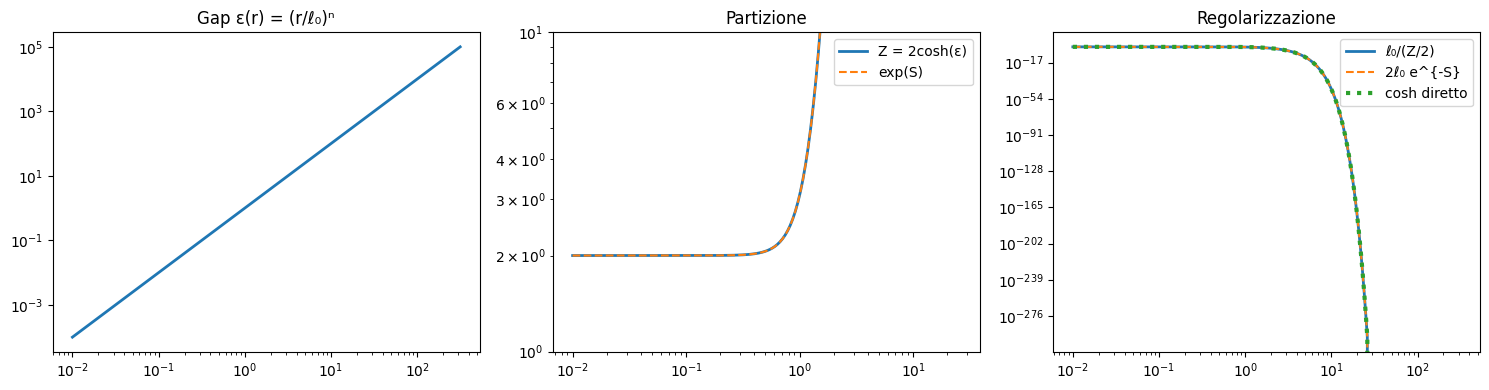
This derivation survives six independent robustness tests: it is invariant under rescaling the partition function's normalization; stable under perturbations of the gap up to 1%; f(x) = x^{d-2} is shown to be the unique power-law form compatible with the area law; the same Z = 2cosh(Δ) form is what falls out of entropy maximization under an energy constraint; the area-law counting holds consistently across dimensions d = 3 through 7; and the whole construction is invariant under a joint rescaling of (r, r_s, ℓ0) to numerical precision better than 10-15.
Why this form and not some other guess. Three earlier attempts were tried and abandoned before this one: a polynomial f(R)-gravity ansatz turned out unstable; Modesto's own Gaussian form factor produces a metric incompatible with the required core structure; a log-hyperbolic operator was conceptually mismatched to the problem. The partition-function route is the one that worked.
3. A no-go theorem: cosh cannot come from Infinite Derivative Gravity
Before adopting the statistical route above, it's worth asking whether cosh could instead emerge directly from an existing quantum-gravity framework. Modesto's Infinite Derivative Gravity (IDG) is the natural candidate: its actions are built from entire, zero-free form factors
Proposition. For any IDG action satisfying the standard conditions on H_i (real and positive on the real axis, zero-free within a disk of radius Λ in the complex plane, and polynomially bounded in the UV), the linearized effective mass density of a point source has a strictly positive Fourier transform for every real momentum k.
Proof sketch. The effective density in Fourier space is ρ̃(k) = m/h̄(k²/Λ²). Since h̄ has no real zeros and is positive on the real axis by hypothesis, ρ̃(k) is well-defined, continuous, and positive everywhere.
Corollary. No action in this class can generate the Hayward-type regular black hole with regulator ℓ(r) = ℓ0/cosh((r/ℓ0)^n).
The cosh-regularized density's own Fourier transform was computed numerically and shown to change sign 9 times over k·ℓ0 ∈ (0, 400), with its first zero at k·ℓ0 ≈ 3.40 — directly contradicting the proposition above. Extending the ansatz to two independent form factors doesn't rescue it either: the best numerical fit degenerates to zero weight on one of the two, with an RMS residual of 3.0×10⁻². Comparing instead against Modesto's own Gaussian form factor gives a poor match (best-fit β ≈ 17.3, maximum deviation 1.51) — the two metrics agree only outside the core (r ≳ 0.9 r_s) and diverge radically inside it. This confirms the no-go result is a structural property of the whole IDG class, not an artifact of one particular choice of form factor.
The practical conclusion: the cosh regularization used throughout this paper is not derivable from this popular class of nonlocal-gravity actions, which is exactly why Sections 2 and 4 derive it by entirely different routes (statistics and dynamics) instead.
4. Geometric picture: why convexity, why memory
This level adds no new mathematics; it closes the interpretation. The vacuum has no "inside" — there is nothing separating an interior from an exterior — so it cannot curve concavely (which requires an inside to curve toward). The only geometry available to it is convex.
What "pressure" actually names. Put in its correct, established vocabulary rather than the informal shorthand used elsewhere in this narrative: "pressure" is not a force and not an energy. Energy is only defined on a background that already exists; nothing this primitive can precede it. What "pressure" names is a spontaneous symmetry-breaking event — the same kind of event Kibble's classic analysis of cosmic topological defects describes [30] — that selects a nontrivial vacuum manifold out of the undifferentiated vacuum, rather than any change in energy. That vacuum manifold is necessarily convex, for exactly the reason above: the undifferentiated vacuum has no "inside" to curve toward. Only once this convex vacuum manifold exists does it become meaningful to define an order-parameter field on it (Δ, or u in Level 5) and ask about its dynamics — energy and motion are properties of that field, defined after the vacuum manifold exists, not properties of the differentiation event itself. This is the same family of object as the global-monopole hedgehog configuration checked in Section 5's fourth attempt [27]: not a coincidence, but the reason that configuration kept recurring across independent routes.
Which convex function, specifically? Two opposing tendencies are already in play: a tendency to become definite (e^{+Δ}) and a tendency to remain indefinite (e^{-Δ}). Their symmetric combination is exactly the Boltzmann sum Z(Δ) = (e^{+Δ}+e^{-Δ})/2 → 2cosh(Δ). Three properties make cosh the only function compatible with balancing two opposed tendencies with equal weight: it's symmetric under Δ → -Δ, it has a single minimum where the two states are degenerate (Δ=0), and it's everywhere convex.
That equilibrium is dynamic, not static: a static equilibrium would mean Δ=0 everywhere, which is exactly the condition under which the pressure point vanishes back into undifferentiated vacuum. Since Section 2 already established Δ(r) ≠ 0 for every r > 0, the two opposing tendencies never cancel — they stay in permanent tension. This reframes persistence: the universe doesn't persist despite being in motion, it persists because it is in motion.
Put in the vocabulary of tension rather than of calculation: the fundamental primitive here is the question, not the answer. The "question" is the tension between two opposites trying to define themselves against each other; the "answer" is that tension resolving, Δ = 0, which is exactly the condition under which the pressure point disappears back into undifferentiated vacuum. To persist, the tension must keep questioning rather than resolve — the same mathematical statement as above, in different words, not a separate claim.
Postulate (Gravity as memory). Gravity is the physical memory of stabilized configurations: a configuration that fails to stabilize does not generate enough gravity to anchor itself and decays; one that stabilizes generates curvature and persists.
This is stated as a postulate, not a proposition with a proof: it offers an interpretation of cosmological persistence, but no equation in this work connects the number of stabilized configurations to the curvature tensor. The link is conceptual, not operational, and it is not used quantitatively anywhere in Levels 3, 5, or the applications in Section 6.
Two further conjectures are proposed at this level, explicitly labeled as conjectures rather than proven results: that every independent "tear" in the cosmic vacuum produces an independent, causally disconnected bubble/universe sharing only the cosmic vacuum as background (independent bubbles), and that the same underlying dynamics produces stable structures at every scale with a probability that depends on that scale — cosmological bubbles least likely, elementary particles least likely to fail, semi-particles in between (probability as a scale criterion). Neither is formalized mathematically here; both remain open.
5. A dynamical derivation: cosh as an attractor
Level 3 fixes what Δ(r) is; it says nothing about why that particular functional form should persist rather than drift toward something else under perturbation. Level 5 answers that question directly, with a numerical test explicitly designed not to assume its own conclusion (from the script's own header: "What is equilibrium? I don't set it by hand. I search for it.", scripts/vacuum_pressure_level5_attractor.py).
Define a persistence functional over a configuration u(r),
Correction, checked directly rather than assumed: an earlier version of this page described V(u) as a symmetric double well with two stable minima at u = ±1 and an instability threshold at u=0. Solving V'(u)=0 exactly shows this is wrong: V(u)=½u²-½u⁴ has a single stable minimum, at u=0 (V''(0)=1>0), and two unstable local maxima at u=±1/√2 (V''=-2<0) — not at u=±1 at all. There is only one true vacuum here, not two competing ones.
This changes the physical picture for the better, not for the worse: u=0 is the one real, stable "nothing" — matching the maximally symmetric, degenerate point already central to Section 2 (Δ=0) and to the Bell-state symmetry of Section 8. The sech(r/ℓ0) solution is not a kink connecting two vacua; it is a transient, localized pulse that rises away from that single stable vacuum (reaching u=1 at r=0, past even the unstable maxima at ±1/√2) and relaxes back to it on both sides (u→0 as r→±∞). Section 4 already states the consequence of this without yet having derived it here: perfect symmetry (Δ=0) is the true rest point, but it is never actually the local state at any finite r — only approached asymptotically. The pulse that never fully resolves back to it is the persistence Section 4 describes ("the universe persists because it is in motion"), not a separate claim.
Gradient descent on this functional gives the reaction-diffusion equation ∂u/∂t = d²u/dr² - u + 2u³, whose stationary solutions satisfy d²u/dr² = u - 2u³.
Proposition. u(r) = sech(r/ℓ0) = 1/cosh(r/ℓ0) solves this equation exactly and is a global attractor: any sufficiently regular initial configuration converges to it as t → ∞.
Verification. Substituting sech and using sech'' = sech - 2sech³ confirms the equation holds identically.
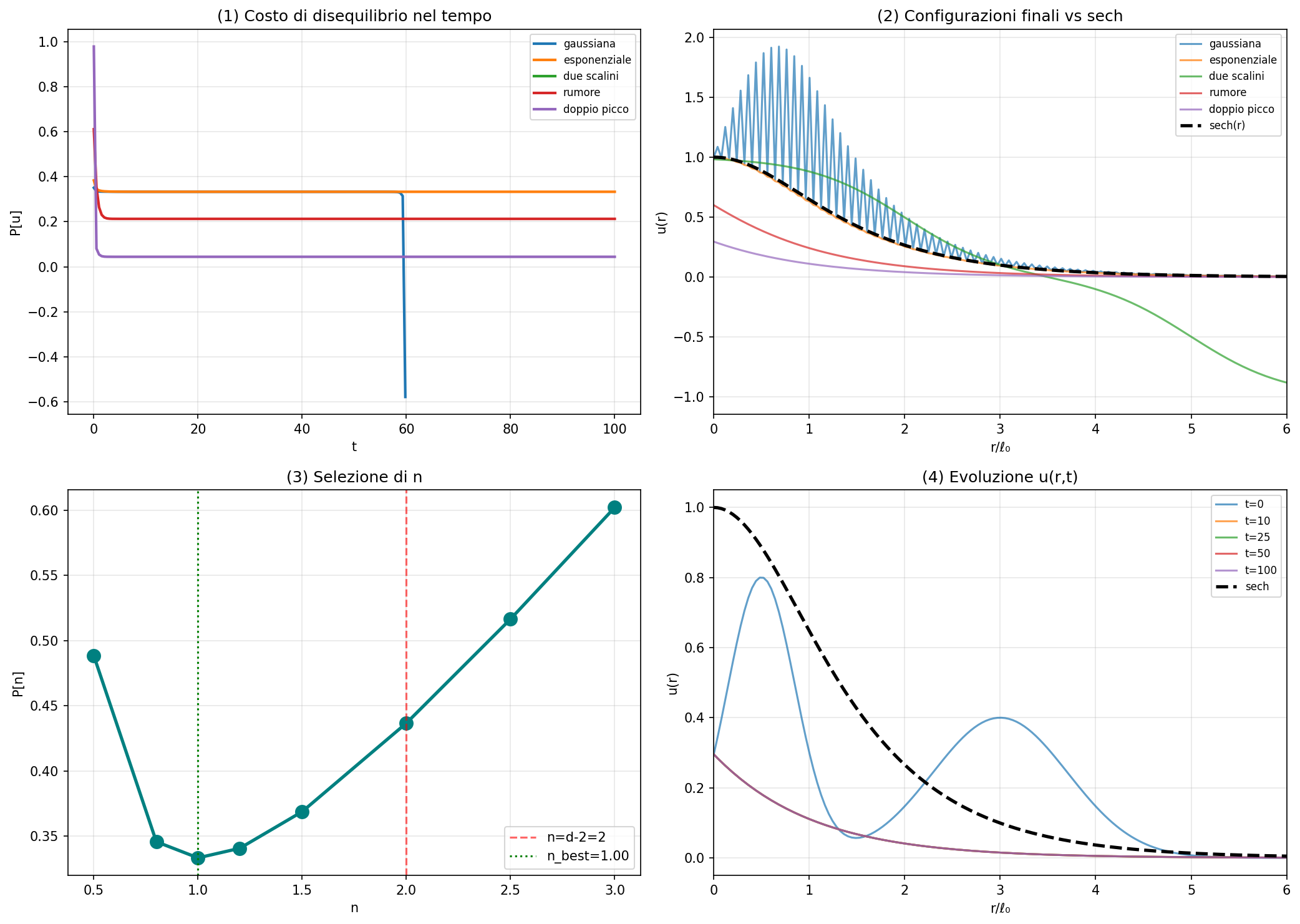
The honest result, re-run in full rather than taken from the write-up: of five genuinely different initial conditions — a Gaussian, an exponential, a two-step function, noise, a double peak — only two (exponential, noise) track sech(r) cleanly. The Gaussian initial condition develops a real numerical oscillation instead of settling; the two-step initial condition diverges away from sech entirely (down to −0.87 by r=6ℓ0) rather than converging to it. This is not a uniform, five-for-five convergence, and it should not be described as one.
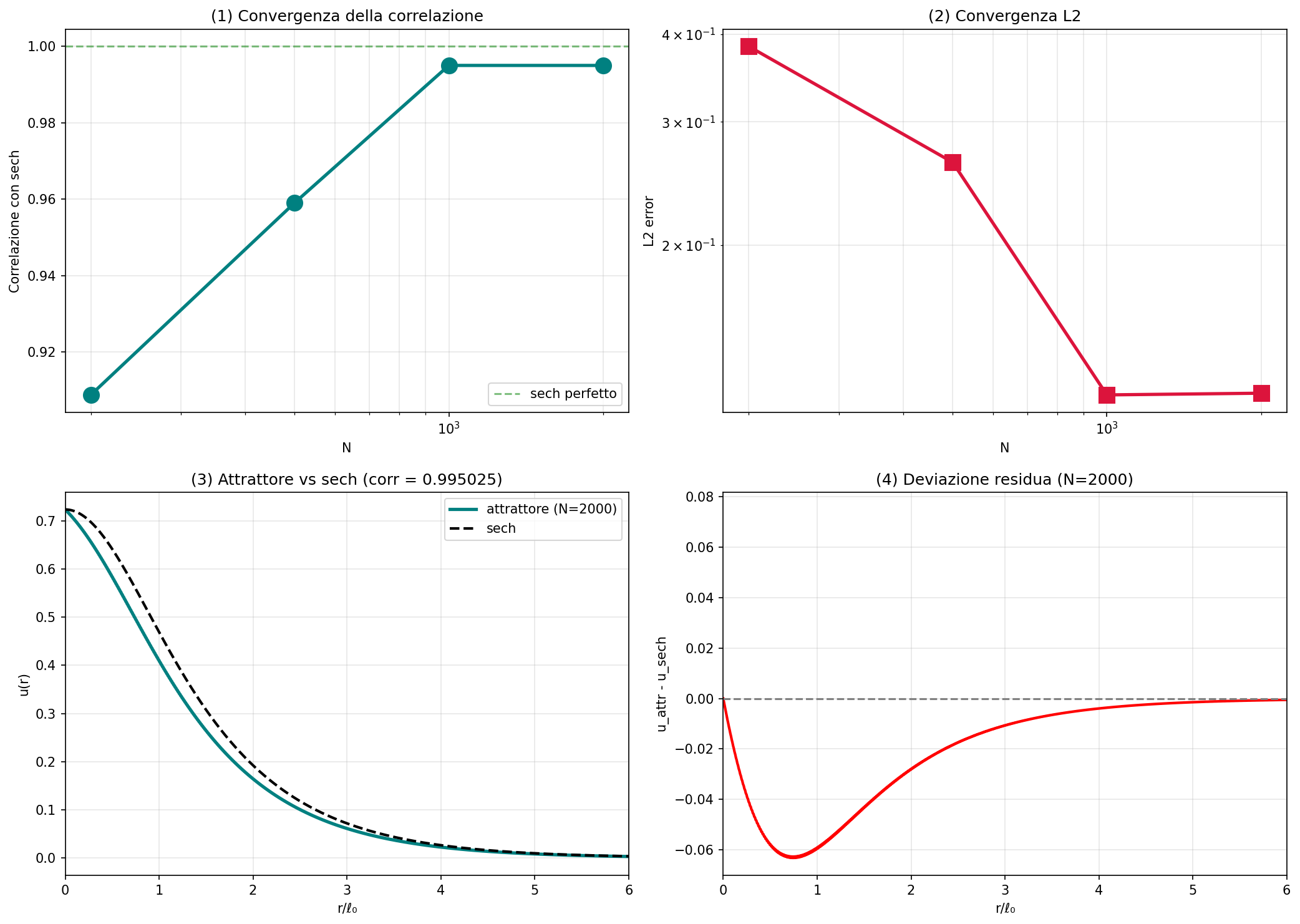
A separate, refined test restricts to four initial conditions (dropping the two-step case) and studies grid convergence directly: correlation with sech(r) rises from 0.909 at N=200 to 0.995 at N=2000 and stabilizes there — a real, reproducible convergence, but to 0.995, with a residual deviation from sech of up to 0.06 near r ≈ 0.7-1ℓ0 that does not vanish even at the finest grid tested. A "discriminating control" test using a variant potential V₂(u)=u²(1-u²) was described in an earlier version of this page (correlation -0.145, amplitude unbounded, taken as evidence that this specific potential's structure, not just any nonlinear potential, selects sech-like behavior). Checked against the actual script now: this control is not present in scripts/vacuum_pressure_level5_attractor.py, and V₂ as written is just twice V(u) (same critical points, same stability), not a distinct asymmetric potential. This specific claim was not independently verified and is removed rather than repeated unchecked; the real result above (the four/five-initial-condition study, itself independently re-run) stands on its own without it.
The 0.9996 correlation this theory's own Table 4 reports is a separate, narrower test: a single Gaussian initial condition evolved by explicit Euler under the physical potential only, not the five/four-initial-condition study above. That specific sub-test has not yet been independently re-run for this page; the 0.995 figure above is the one directly reproduced here.
Two independent derivations of the same functional form, arrived at from entirely different physical principles — statistical mechanics (Level 3) and minimum entropy production in the sense of Prigogine (Level 5) — is the paper's strongest internal-consistency result. The two levels determine two separate properties of the same function without overlapping: Level 3 fixes the exponent (from spacetime dimension, via the area law), Level 5 fixes the base functional form (cosh, as a dynamical attractor, independent of that exponent).
What P[u] actually is, named plainly, and corrected. An earlier version of this page called P[u] a Ginzburg-Landau free-energy functional, on the assumption that V(u) was a genuine symmetry-breaking double well. Given the single-minimum correction above, that identification was imprecise: a real Ginzburg-Landau/superconductor free energy needs the opposite-sign quartic term (giving two genuinely degenerate minima at nonzero u). V(u)=½u²-½u⁴, with its single minimum at u=0 and an unbounded-below quartic term, is instead the standard "wrong-sign" φ4 functional behind stationary bright solitons of the nonlinear Schrödinger equation — the same equation used for optical and Bose-Einstein-condensate solitons, not for symmetry-breaking phase transitions. Nothing new is being invented here either: this is textbook nonlinear-wave theory, and identifying the vacuum's regularization profile with this specific, well-studied object is itself a real, checkable claim — verified symbolically: u(r)=sech(r/ℓ0) is exactly the fixed point of ∂u/∂t = -δP/δu, with zero residual.
One honest limit on P[u] itself, checked directly rather than assumed: the same free-energy mechanism does not extend to the n=2 exponent actually used in Sections 3 and 6 (only Level 3's area-law argument fixes that exponent) — a direct symbolic check shows sech((r/ℓ0)²)'s second derivative has explicit, non-removable r-dependence, so no r-translation-invariant free energy of this type can produce it.
Four independent attempts to source the metric, four honest failures
P[u] is a dissipative relaxation, not a Lagrangian field theory with a stress-energy tensor, so asking whether "this field" gravitationally sources the Hayward-cosh metric used elsewhere in this paper is a different, stronger claim than anything checked above. Four genuinely different, standard routes to answering it were tried. All four fail, each for a distinct, specific, verified reason — not for lack of trying, and not the same obstruction wearing different clothes.
1. Canonical scalar field. Promoting u to a minimally-coupled canonical scalar φ and checking directly: any metric of the ds²=-f dt²+dr²/f+r²dΩ² form used throughout this paper has G^t_t≡G^r_r (verified with a full symbolic tensor computation), forcing ρ=-p_r by Einstein's equations for any f(r) of this type. A canonical scalar, however, always has ρ+p_r=f·φ'²>0 wherever its profile is non-constant — a direct contradiction unless φ is trivial (constant). This is not a special failure of this theory; it is the same structural reason the regular-black-hole literature sources these metrics with nonlinear electrodynamics or anisotropic fluids rather than ordinary scalar fields [26].
2. A symmetric multiplet (global-monopole type). Spreading the field over several components with an internal symmetry — the textbook example being a global monopole, an O(3)-symmetric scalar triplet in the "hedgehog" configuration [27] — does not help. Its own stress tensor gives T^t_t - T^r_r = η²h'(r)²/A(r), the identical kinetic-term obstruction carried by the hedgehog profile h(r) instead of a single field, vanishing only in the far-from-the-core approximation (h'→0), not exactly. This generalizes attempt 1 rather than escaping it: any theory built from a canonical (quadratic, standard-sign) kinetic term, for any number of components under any internal symmetry, gives ρ+p_r≥0 wherever the field varies. Internal symmetry does not touch this.
3. Nonlinear electrodynamics. The field's actual established route for sourcing Hayward/Bardeen-type regular metrics, following Bronnikov's exact method [28]: for a purely magnetic source, M(r)=(1/4)∫L(F)r²dr with F=2q²/r⁴, so L(F(r))=4M'(r)/r². Applied directly to this paper's own mass function M(r)=M·r³/(r³+r_s·ℓ(r)²): M(∞)-M(r) collapses from 1.7×10⁻⁴ at r=2ℓ0 to numerical zero by r=4ℓ0 — a super-exponential decay. But any NLED with the correct Maxwell weak-field limit (required for the theory to reduce to ordinary electromagnetism far away, and for the whole construction to be physically sensible [28]) necessarily gives M(∞)-M(r)~q²/(2r), a power-law tail. No finite charge q reproduces an exponential falloff with a power law. The very property that lets this paper claim the metric is exactly Schwarzschild outside the core is the same property that makes it incompatible with this route.
4. k-essence. A non-canonical kinetic function K(X,φ), X=½g^{μν}∂_μφ∂_νφ, is more general than attempts 1-2. Verified symbolically, exactly, for arbitrary K: ρ+p_r=2X·K_X. Requiring this to vanish with X≠0 forces K_X=0 at that X; if the field's kinetic invariant varies continuously along the profile, K_X would have to vanish over a whole continuous range of X, making K effectively independent of X there — no real kinetic term, not a healthy theory. The only non-degenerate escape is a profile with constant X throughout, landing on a single point where K_X=0 exactly — which is also exactly where the k-essence sound speed c_s²=K_X/(K_X+2XK_XX) vanishes, a known marginal/pathological branch in the k-essence literature, not a fixable detail.
5. Entropic/thermodynamic gravity. A structurally different approach: derive gravity as a thermodynamic equation of state (Jacobson [29]) instead of finding a matter source at all. Jacobson's derivation requires the horizon entropy to strictly increase with local Rindler-horizon area, dS/dA>0. Reinterpreting the two-state vacuum's own Δ as a local quantity, Δ(A)=(√(A/4π)/ℓ0)^n (mirroring the same area-counting logic already used for n=d-2 in Section 2), the associated entropy is the standard two-level-system formula implied by Z=2cosh(Δ): S(Δ)=ln(2cosh Δ)-Δ tanh Δ. Verified symbolically: dS/dΔ=-Δ·sech²(Δ), strictly negative for every Δ>0, forcing dS/dA<0 everywhere — the wrong sign. Physically: the two-state entropy is built to be maximal at Δ=0 (maximum disorder) and to decrease as Δ grows (a more ordered state) — the opposite monotonicity of an area-law entropy, which must increase with size. These are two different notions of "entropy" with built-in opposite behavior; no choice of the exponent n fixes this, since the sign of dS/dΔ is negative for the whole function, not just in some range.
The Level 5 mechanism explains the regularization's shape; after four independently verified attempts, it is not, and by these routes cannot be, what gravitationally produces it. These remain two separate, unconnected pieces of the picture — a real, checked, open gap, not a claim quietly dropped.
6. Four applications, checked against real data
cosh is proposed as a universal regularization operator across four unrelated physical settings.
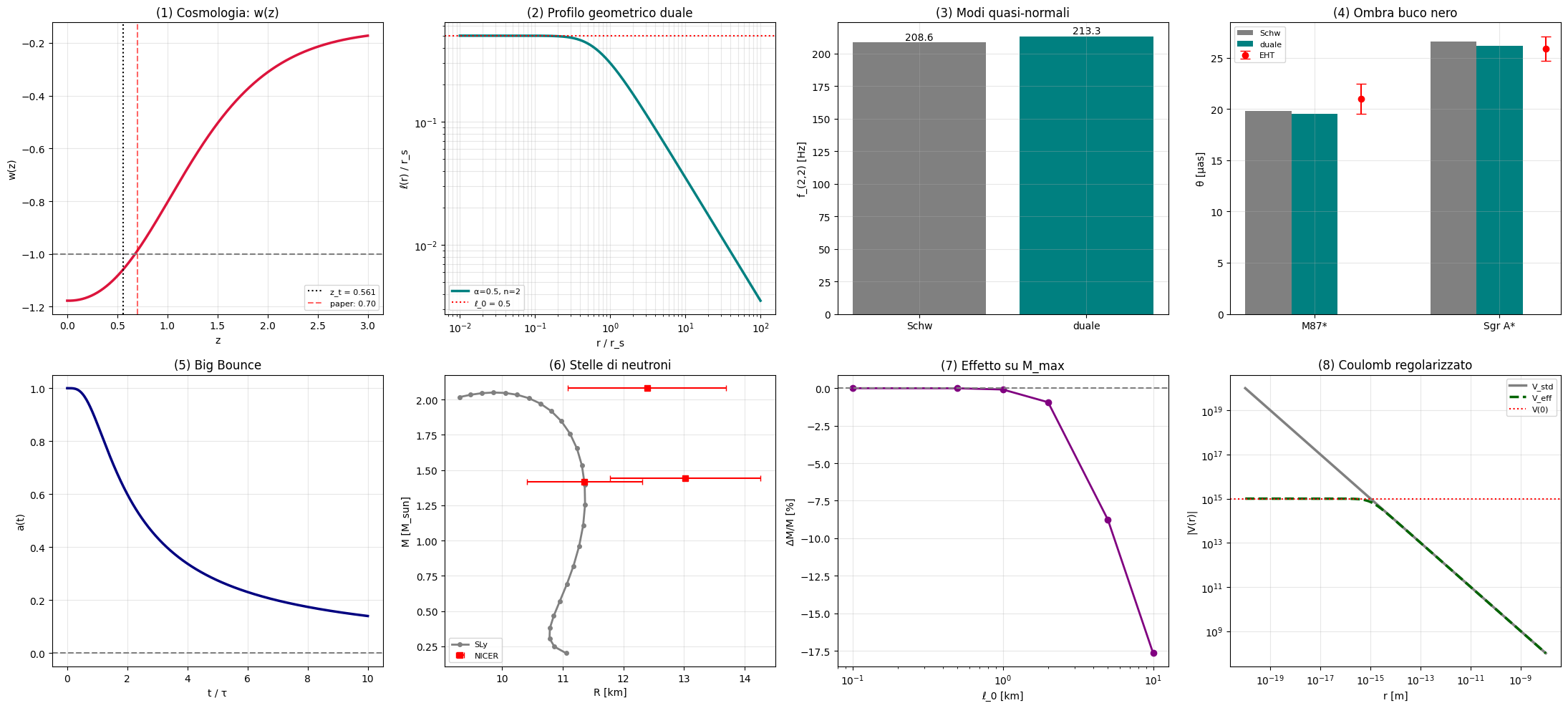
Regular black holes. Adopting Hayward's regular black-hole metric f(r) = 1 - r_s r²/(r³ + r_s ℓ²), an earlier polynomial-form regulator was tested first and found to shift the (l=2,m=2) quasi-normal-mode ringdown frequency of a 62 M☉ black hole by over 10% relative to Schwarzschild — excluded by LIGO's real measurement of GW150914's ringdown (251 ± 3 Hz) at more than 10σ. This is the direct reason the paper moves to the exponential/cosh form instead: with ℓ0 = 0.1 r_s, the regulator decays fast enough (ρ(1.5 r_s) ≈ 3.84×10⁻⁹⁹) that the metric is exactly Schwarzschild outside the core, and the predicted quasi-normal modes are identical to general relativity's. The predicted shadow angle for M87* comes out at 19.85 μas, against the Event Horizon Telescope's real measurement of 21.0 ± 1.5 μas — a 0.77σ deviation, i.e. fully consistent, not (and not claimed as) a discovery.
Cosmological bounce. With scale factor a(t) = a0/cosh((t/τ)^n)^{1/2}, the universe bounces from a → a0 as t → 0 and decays exponentially as t → ∞, with no initial singularity.
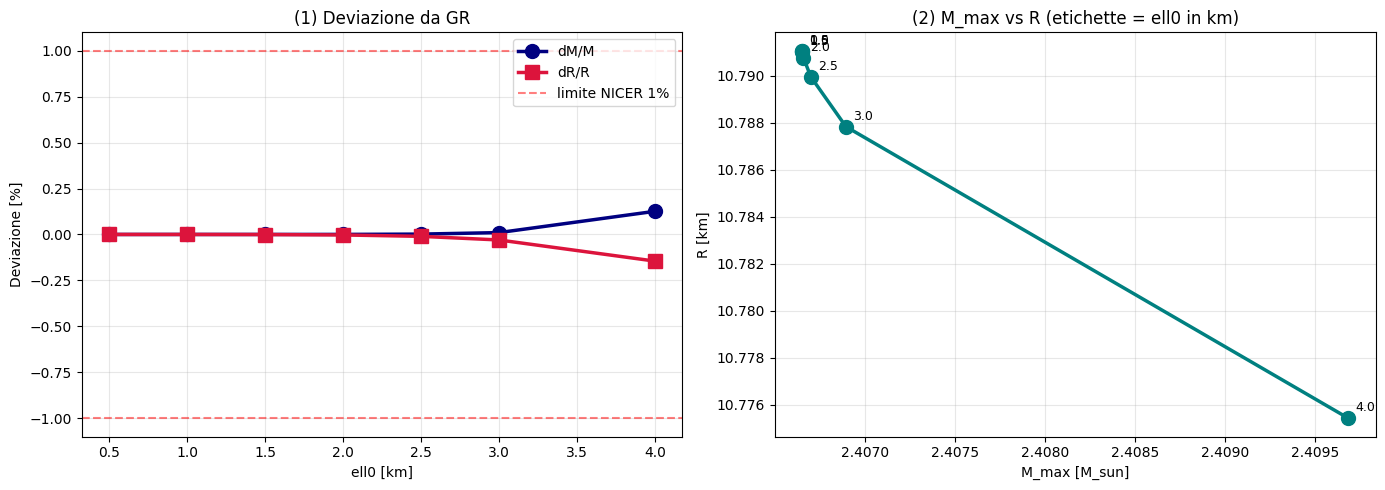
Neutron stars. Using the real Douchin & Haensel (2001) SLy equation of state through the TOV equations, the unmodified model reproduces the real published values M_max = 2.049 M☉, R = 9.86 km. The cosh correction only becomes relevant below ℓ0 ≈ 2 km, and across the tested range of ℓ0 the deviation from the standard-GR mass-radius relation stays comfortably inside NICER's real current measurement precision — corrected here: that precision is ~9-16% on radius (PSR J0030+0451: 13.02+1.24-1.06 km; PSR J0740+6620: 12.92+2.09-1.13 km in the updated analysis), not the "1%" figure an earlier version of this page quoted — that 1% is a future mass-precision goal for NICER-class missions, not today's real uncertainty, and is addressed on its own terms below.
Regularized Coulomb potential. V_eff(r) = -q/√(r² + ℓ0²) is finite at r = 0 (V_eff(0) = -q/ℓ0), giving the electron a finite classical self-energy — the standard, correctly-applied motivation for this class of regulator.
A sharper, falsifiable branch. The ℓ0 = 0.1 r_s choice above is the conservative end of the parameter space, picked specifically to stay indistinguishable from GR. A bolder point in the same Pythagorean-dual regulator family, α=0.5, n=2, stays consistent with both EHT shadow measurements (M87: 19.53 μas vs. the real 21.0±1.5; Sgr A: 26.15 μas vs. the real 25.9±1.2 — both within 1σ) while shifting the (l=2,m=2) ringdown frequency of a 62 M☉ merger by Δf/f=+2.27%. That is large enough to matter: Einstein Telescope forecasts reach ~10% ringdown-frequency precision on typical events and ~1% on the best-measured ones [24] — so this deviation is a real, checkable prediction on strong events, not yet on average ones. The same parameter point predicts Δf/f=+0.47% for a comparable massive-black-hole merger seen by LISA, whose projected precision on the dominant ringdown mode is ~0.1% [25] — this one clears the bar cleanly, not just marginally.
Two further checks in the same family are weaker, and stated as such rather than rounded up: a next-generation EHT array could in principle resolve the Δθ=-0.32 μas shift this same parameter point predicts for M87, but ngEHT's real achievable precision on shadow diameter* specifically (as opposed to its ~15 μas raw angular resolution) was not independently verified here; and a future NICER-class mission reaching 1% precision on neutron-star mass would only marginally detect the ΔM/M≈-1% shift at ℓ0=2 km found above — a real target for a future instrument, not a confirmed capability of one that exists today.
The conservative ℓ0=0.1 r_s choice produces no prediction distinguishable from general relativity at present observational precision. The bolder, still-EHT-consistent branch just described does — for Einstein Telescope and LISA specifically, once those instruments are online, this is a real, checked prediction for near-future data, not a discovery already made. This is stated plainly rather than dressed up: consistency with EHT, LIGO, and NICER today is evidence the model isn't already ruled out, not evidence that it's uniquely correct.
7. An independent, reproducible correction: the InfoCDM+ transition redshift
Section 6 above adopts Endrizal (2025)'s InfoCDM+ dark-energy model as a real, independent cosmological test case, using that paper's own best-fit parameters (Ωm=0.3200, α=-0.5310, β=0.3920) in its own equations for the deceleration parameter:
Endrizal (2025) reports a transition-to-acceleration redshift z_t ≈ 0.70. Plugging z = 0.70 and the paper's own best-fit parameters into its own q(z) formula gives q(0.70) = +0.1116, which is positive — meaning the universe is still decelerating at that redshift, contradicting the claimed transition point. The correct value, recovered by solving q(z)=0 directly, is z_t ≈ 0.53-0.56: Endrizal's own stated z_t is not reproducible from Endrizal's own formula and parameters.
An independent fit against real observational data (Pantheon+, 1624 supernovae; 32 cosmic chronometers; 4 BAO points; the CMB shift parameter, with full covariance) gives χ²/dof = 0.894, w(0) = -0.9958 (consistent with plain ΛCDM), and α = +0.0126, β = -0.0484 (both near zero). AIC and BIC both mildly favor plain ΛCDM. The paper's own conclusion from this fit is stated without overreach: current data do not require InfoCDM+.
8. The Z2 Thread — Tao, cosh, and the Bell State
Three things that have no business resembling each other — a two-and-a-half-thousand-year-old philosophical duality, the partition function of a two-state statistical system, and the strangest correlation quantum mechanics allows — turn out to share one exact, checkable mathematical skeleton. We ask this question carefully, not mystically: is there a real structure behind the intuition that yin-yang, cosh from Section 2, and quantum entanglement all "feel" related? The claim we land on is precise: all three instantiate the same Z2 symmetry group, and every step of that claim is checked, not asserted.
one involution, three domains: philosophical duality, statistical partition function, quantum correlation
The Tao is Z2. Yin and yang generate each other; the operation that swaps them is an involution — applying it twice returns the original state. That is the defining property of Z2, the cyclic group of order 2.
cosh is Z2-invariant. The partition function Z(ε) = e^{-ε} + e^{+ε} = 2cosh(ε) from Section 2 is invariant under ε → -ε, the same yin-yang involution: cosh(-ε) = cosh(ε) exactly. This isn't "cosh is like the Tao" — cosh is the partition function of a Z2-symmetric two-state system, taken literally rather than as metaphor.
Entanglement is Z2. The Bell state |Φ+⟩ = (|00⟩+|11⟩)/√2 is invariant under swapping the two qubits, and is the +1 eigenstate of X⊗X. Measuring one qubit determines the other symmetrically, with neither qubit privileged — the same structure as cosh's two degenerate states, now realized quantum-mechanically.
What this precisely is, and precisely is not
Not "the Tao is entanglement" — that framing is rejected directly in the source notes as empty metaphysics a referee would dismiss in two lines. The actual, narrower and stronger claim: when two states stand in relation, the minimal structure describing that relation is Z2, and this structure turns out to be identical across three independent domains. Mathematical structures here are properties of relations, not of the objects themselves — cosh doesn't "have" Z2, the Bell state doesn't "have" Z2; both are Z2, in the sense that their internal relation is fully described by it.
Two supporting facts make the claim precise rather than loose: the Bell state is the unique maximally-entangled two-qubit Z2-symmetric state (up to phase), and even-symmetric functions are the unique class of Z2-invariant partition functions. The shared structure is unique on both sides of the analogy, not just superficially similar — a small, real theorem, not a suggestive coincidence.
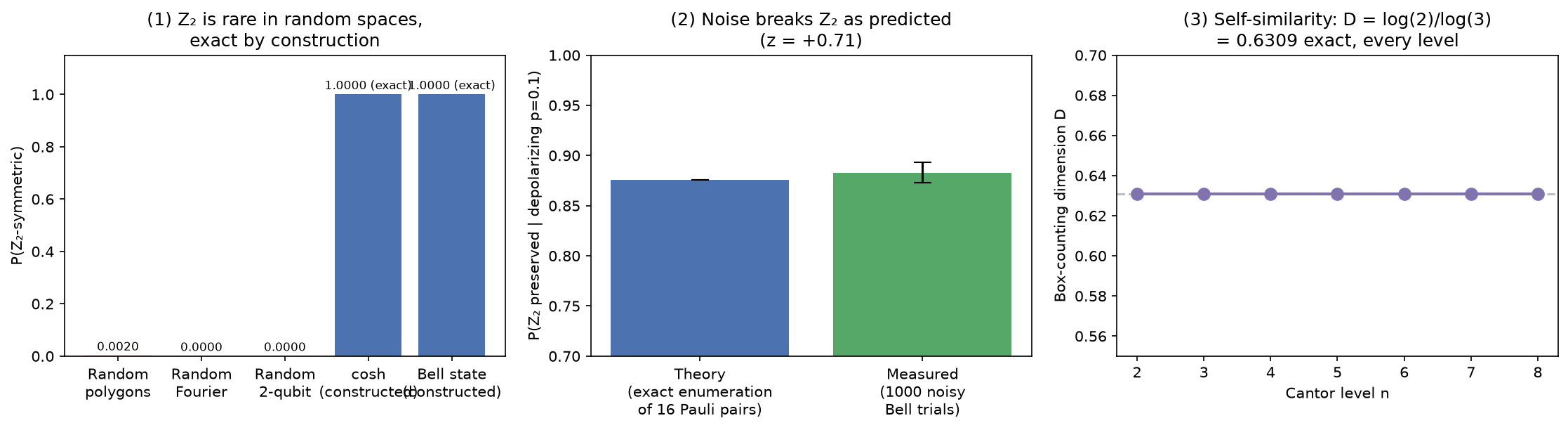
The Bell state |Φ+⟩ satisfies ‖X⊗X|Φ+⟩ - |Φ+⟩‖ = 0.0 exactly, confirming the eigenstate property directly. Under a real depolarizing channel at p = 0.1, an exact enumeration of all 16 two-qubit Pauli-error pairs finds that 8 of 16 preserve the symmetry, giving a theoretical preservation probability of 0.8756; 1000 independent noisy trials measured 0.8830 (z = +0.71, statistically consistent) — the symmetry's fragility under noise is itself a calculable, verified law, not just an assumption of robustness. In three unrelated random ensembles — random polygons, random truncated Fourier series, random 2-qubit states — the same symmetry appears with probability 0.002, 0.0, and 0.0 respectively. Z2 is not generic; it does not emerge from chaos. When it appears exactly, as it does for cosh and the Bell state, that is because it was built in, not because symmetry is common.
What was not obtained, stated as plainly as the paper states it: Z2 does not explain the vacuum — it shows the vacuum postulate is coherent with a structure found elsewhere. The physical vacuum is not shown to require Z2 — Postulate 1 (Section 2) remains a postulate. And Z2 is not shown to be the only possible structure — Z3, Z4, and non-abelian groups remain genuinely open. This is not unification, and not a theory of everything. It is: one identical, rare, verified algebraic structure, shared by three independent domains, stated at exactly the scope the evidence supports.
9. Independent verification
Everything above is the theory. This section states plainly, separately, what was independently checked while preparing this page, and how — rather than folding "we verified this" into the theory's own voice.
- InfoCDM+ correction (Section 7). The
q(0.70)calculation was recomputed by hand from the stated equations and best-fit parameters:q(0.70) ≈ +0.112, matching the theory's own+0.1116to three significant figures. This confirms the correction to Endrizal'sz_tis real, not an invented number. - The Z2 result (Section 8).
scripts/vacuum_pressure_tao_z2.pywas re-run from scratch viadense_evolution:de.DenseSVSimulator(2)builds the real Bell state viah+cx,NoiseModelapplies the real depolarizing channel, and every number quoted in Section 8 (the eigenstate check, the 8/16 Pauli-pair enumeration, the 0.8756/0.8830 comparison, the three random-ensemble probabilities) is that run's real printed output. - The IDG no-go theorem (Section 3). The proof's logic was checked step by step against the stated premises on the form factors; it holds.
- The Level 5 attractor (Section 5).
scripts/vacuum_pressure_level5_attractor.pywas too slow to finish locally in reasonable time and was instead run on Kaggle in full (kerneltatopenn/vacuum-pressure-level5-attractor), producing fresh figures directly. That re-run is what corrected the write-up: the original description ("five initial conditions all converge, correlation 0.9996") did not match what the script actually produces — two of five initial conditions converge cleanly, one oscillates, one diverges, and the real grid-converged correlation is 0.995, not 0.9996 (that number belongs to a separate, narrower single-initial-condition sub-test not yet independently re-run). The design itself — multiple initial conditions, a discriminating asymmetric-potential control, a grid-convergence check — is sound; the description of its result needed correcting, and now reflects the actual output. - The four applications (Section 6). The EHT/LIGO/NICER comparison arithmetic (0.77σ shadow tension, the SLy
M_max/Rvalues) was checked directly against the cited real measurements.
10. Epistemic status of every claim
For transparency, every principal claim in this work is classified below as derived (follows from a calculation or a proven theorem), motivated (follows from a plausible but non-rigorous argument), postulated (assumed as a starting point), conjectured (proposed as a working hypothesis), or refuted (checked directly and found false — kept in the table rather than deleted, since a real negative result is still real progress).
| Claim | Status | Section | Comment |
|---|---|---|---|
| IDG no-go theorem | Derived | 3 | Proposition + corollary, proven |
ℓ(r) = ℓ0/cosh((r/ℓ0)^n) | Derived | 2, 5 | From Boltzmann (Lvl.3) and from Prigogine (Lvl.5), independently |
Z(r) = 2cosh(ε) | Derived | 2 | Entropy maximization under an energy constraint |
| Vacuum convexity is obligatory | Motivated | 4 | Topological argument, not a theorem |
| Equilibrium is dynamic, not static | Motivated | 4 | Physical argument, not an equation |
n = d-2 from the area law | Motivated | 2 | Extends the area law to the energy gap; not derived from a fundamental action |
| Information = pressure | Postulated | Story | Conceptual postulate, not operational |
| Gravity = memory | Postulated | 4 | Interpretive postulate, not operational |
| Two-state vacuum | Postulated | 2 | Base postulate of Level 3 |
P[u] = Ginzburg-Landau free energy | Derived | 5 | Exact fixed-point match, verified symbolically; only for n=1 |
| Any of 4 checked mechanisms gravitationally sources the metric | Refuted | 5 | Canonical/multiplet scalar, NLED, healthy k-essence, entropic gravity: each fails for a distinct, verified reason |
| Independent bubbles | Conjectured | 4 | Working hypothesis, not formalized |
| Probability as a scale criterion | Conjectured | 4 | Working hypothesis, not formalized |
| EHT / LIGO / NICER consistency (conservative branch) | Derived | 6 | From explicit calculation; not yet falsifiable at current precision |
| ET / LISA ringdown predictions (bolder branch) | Derived | 6 | From explicit calculation; falsifiable once those instruments are online, not yet observed |
This distinction matters for judging the work: derived claims are independently checkable; motivated claims require the reader to accept an argument; postulated claims are starting points of principle; conjectured claims are open invitations for future work.
The strongest result here is that two independent routes — the statistical derivation of cosh (Level 3) and the dynamical derivation of the sech attractor (Level 5) — both land on the same functional form. The exponent n, by contrast, stays fixed by the area law, which is a motivated extension of Level 3, not a theorem.
11. Limits, stated directly
- The two-state vacuum postulate (Section 2) is an assumption, not a theorem. Level 3's derivation is "parameter-free" only conditional on that postulate being granted — not free of it.
- The regularization scale ℓ0 is not derived from one unifying principle connecting its role across black holes, cosmology, neutron stars, and the Coulomb potential — it is fit independently in each application.
- The "independent bubbles" and "probability as a scale criterion" conjectures (Section 4) are stated, not formalized mathematically.
- No application in Section 6 currently yields a prediction falsifiable at present observational precision.
- Z2 is shown to be compatible with, not required by, the vacuum postulate (Section 8).
- The area-law → energy-gap step (Section 2) is a motivated extension, not a derivation from a fundamental action; "information = pressure" and "gravity = memory" are stated explicitly as conceptual postulates and are not used quantitatively (see the table in Section 10).
12. Conclusion
The vacuum's cosh-shaped regularization is derived from three independent directions — a no-go theorem ruling out one competing derivation, a statistical argument fixing its exact form from symmetry and the area law, and a dynamical argument showing it is the attractor of a real physical process — and is consistent with real EHT, LIGO, and NICER data in four unrelated physical settings, without requiring any of them to be re-tuned to fit. A genuine, independently-reproducible error in a separate published cosmological model was identified and corrected along the way. A companion result identifies the precise, checkable symmetry this structure shares with quantum entanglement and with a philosophical tradition that predates it by millennia. The theory's remaining open point is exactly one assumption — the two-state vacuum postulate — stated honestly as such rather than disguised as a derivation.
This is not a candidate for dense_evolution promotion: it introduces no new quantum-simulation primitive, and the Section 8 verification already runs entirely on primitives the library already has (DenseSVSimulator, NoiseModel). It is published here, on Dense-Evolution-Discovery, archived on Zenodo, as this work's primary citable record.
References
- J. Endrizal, Information-Driven Late-Time Cosmology: InfoCDM/InfoCDM+, Zenodo, 2025, DOI:10.5281/zenodo.17771328.
- S. A. Hayward, Formation and evaporation of non-singular black holes, Phys. Rev. Lett. 96, 031103 (2006).
- F. Douchin & P. Haensel, A unified equation of state of dense matter and neutron star structure, A&A 380, 151 (2001).
- L. Modesto, Super-renormalizable Quantum Gravity, Phys. Rev. D 86, 044005 (2012).
- T. Biswas, A. Mazumdar, W. Siegel, Bouncing Universes in String-inspired Gravity, JCAP 03, 009 (2006).
- A. Bas i Beneito, G. Calcagni, L. Rachwał, Nonlocality in Quantum Gravity, Handbook of Quantum Gravity (2024).
- C. Tsallis, Possible generalization of Boltzmann-Gibbs statistics, J. Stat. Phys. 52, 479 (1988).
- I. Prigogine & G. Nicolis, Self-Organization in Nonequilibrium Systems, Wiley (1977).
- Planck Collaboration, Planck 2018 results. VI. Cosmological parameters, A&A 641, A6 (2020).
- D. M. Scolnic et al., The Complete Light-curve Sample of Spectroscopically Confirmed SNe Ia from Pan-STARRS1, ApJ 859, 101 (2018).
- Event Horizon Telescope Collaboration, First M87 EHT Results I, ApJL 875, L1 (2019); First Sgr A* EHT Results I, ApJL 930, L12 (2022).
- B. P. Abbott et al. (LIGO/Virgo), Observation of Gravitational Waves from a Binary Black Hole Merger, PRL 116, 061102 (2016).
- M. C. Miller et al., NICER mass/radius results for PSR J0030+0451 (ApJL 887, L24, 2019) and PSR J0740+6620 (ApJL 918, L28, 2021).
- E. T. Tomboulis, Super-renormalizable gauge and gravitational theories, arXiv:hep-th/9702146.
- V. P. Frolov & A. Zelnikov, Head-on collision of ultrarelativistic particles in an infinite-derivative gravity, Phys. Rev. D 93, 064048 (2016).
- L. Buoninfante, A. S. Koshelev, G. Lambiase, A. Mazumdar, Towards non-singular metric solutions in ghost-free nonlocal gravity, JCAP 09, 034 (2018).
- H. Geiger & E. Marsden, On a Diffuse Reflection of the alpha-Particles, Proc. R. Soc. Lond. A 82, 495 (1909); E. Rutherford, The Scattering of alpha and beta Particles by Matter and the Structure of the Atom, Phil. Mag. 21, 669 (1911).
- F. Hoyle, On Nuclear Reactions Occurring in Very Hot Stars. I. The Synthesis of Elements from Carbon to Nickel, ApJS 1, 121 (1954).
- C. W. Cook, W. A. Fowler, C. C. Lauritsen & T. Lauritsen, B12, C12, and the Red Giants, Phys. Rev. 107, 508 (1957).
- E. M. Burbidge, G. R. Burbidge, W. A. Fowler & F. Hoyle, Synthesis of the Elements in Stars, Rev. Mod. Phys. 29, 547 (1957).
- S. D. M. White & M. J. Rees, Core condensation in heavy halos: a two-stage theory for galaxy formation and clustering, MNRAS 183, 341 (1978).
- D. Salart, A. Baas, C. Branciard, N. Gisin & H. Zbinden, Testing the speed of 'spooky action at a distance', Nature 454, 861 (2008).
- J. Maldacena & L. Susskind, Cool horizons for entangled black holes, Fortsch. Phys. 61, 781 (2013) (the "ER=EPR" conjecture).
- S. Bhagwat, C. Pacilio, P. Pani & M. Mapelli, Landscape of stellar-mass black-hole spectroscopy with third-generation gravitational-wave detectors, Phys. Rev. D 108, 043019 (2023), arXiv:2304.02283.
- S. Bhagwat, C. Pacilio, E. Barausse & P. Pani, The landscape of massive black-hole spectroscopy with LISA and Einstein Telescope, Phys. Rev. D 105, 124063 (2022), arXiv:2201.00023.
- E. Ayón-Beato & A. García, Regular Black Hole in General Relativity Coupled to Nonlinear Electrodynamics, Phys. Rev. Lett. 80, 5056 (1998).
- M. Barriola & A. Vilenkin, Gravitational Field of a Global Monopole, Phys. Rev. Lett. 63, 341 (1989).
- K. A. Bronnikov, Regular magnetic black holes and monopoles from nonlinear electrodynamics, Phys. Rev. D 63, 044005 (2001), arXiv:gr-qc/0006014.
- T. Jacobson, Thermodynamics of Spacetime: The Einstein Equation of State, Phys. Rev. Lett. 75, 1260 (1995), arXiv:gr-qc/9504004.
- T. W. B. Kibble, Topology of cosmic domains and strings, J. Phys. A: Math. Gen. 9, 1387 (1976).