Gauge-safe spectral-function gradients at exact eigenvalue degeneracy
A Hermitian matrix H has real eigenvalues lambda and orthonormal
eigenvectors V. Many physics quantities are built from H through its
eigendecomposition, e.g. time evolution exp(-iHt) = V exp(-i*lambda*t) V^dagger.
When two eigenvalues happen to be exactly equal ("degenerate"), the pair
of eigenvectors spanning that subspace is not unique -- any orthonormal
basis of the subspace is an equally valid answer. jnp.linalg.eigh
still returns a correct value in that case, but its gradient silently
breaks: differentiating divides by lambda_i - lambda_j, which is zero
for a degenerate pair. This gives a finite, wrong number, not an error.
Step 1: build a Hamiltonian with an exact degeneracy
H0 has two exact ties: the first pair of eigenvalues is 1.0, the
second pair is 2.0.
Step 2: check for the problem before it bites
from dense_evolution.physics.spectral import has_exact_degeneracy

is_degenerate = has_exact_degeneracy(H0)
has_exact_degeneracy is a pure diagnostic: it returns True here
because two pairs of eigenvalues are closer than its tolerance. It
changes nothing about H0 -- it only tells you whether the next step
matters for this particular matrix.
Step 3: evolve it with a gauge-safe gradient
spectral_evolve(H, t) returns exp(-iHt), identical to what plain
jnp.linalg.eigh-based code would compute. The difference only shows up
under jax.grad: spectral_evolve uses Kato's divided-difference
formula for the derivative, so jax.grad of anything built from U0
stays correct even though H0 is degenerate.
Step 4: differentiate through it
import jax

A0 = jnp.eye(4, dtype=jnp.complex128)

def loss0(H):
    return jnp.real(jnp.sum(A0 * spectral_evolve(H, t0)))

grad0 = jax.grad(loss0)(H0)
grad0 is the gradient of loss0 with respect to every entry of H0.
Replacing spectral_evolve with a plain jnp.linalg.eigh-based
exp(-iHt) in loss0 would silently corrupt grad0 here, since H0
is exactly degenerate -- see the measured comparison below.
Measured, not assumed
| method | gradient error vs. central finite differences (real degenerate H, 4 exact pairs) |
|---|---|
plain jnp.linalg.eigh |
0.98 |
spectral_evolve |
4e-10 |
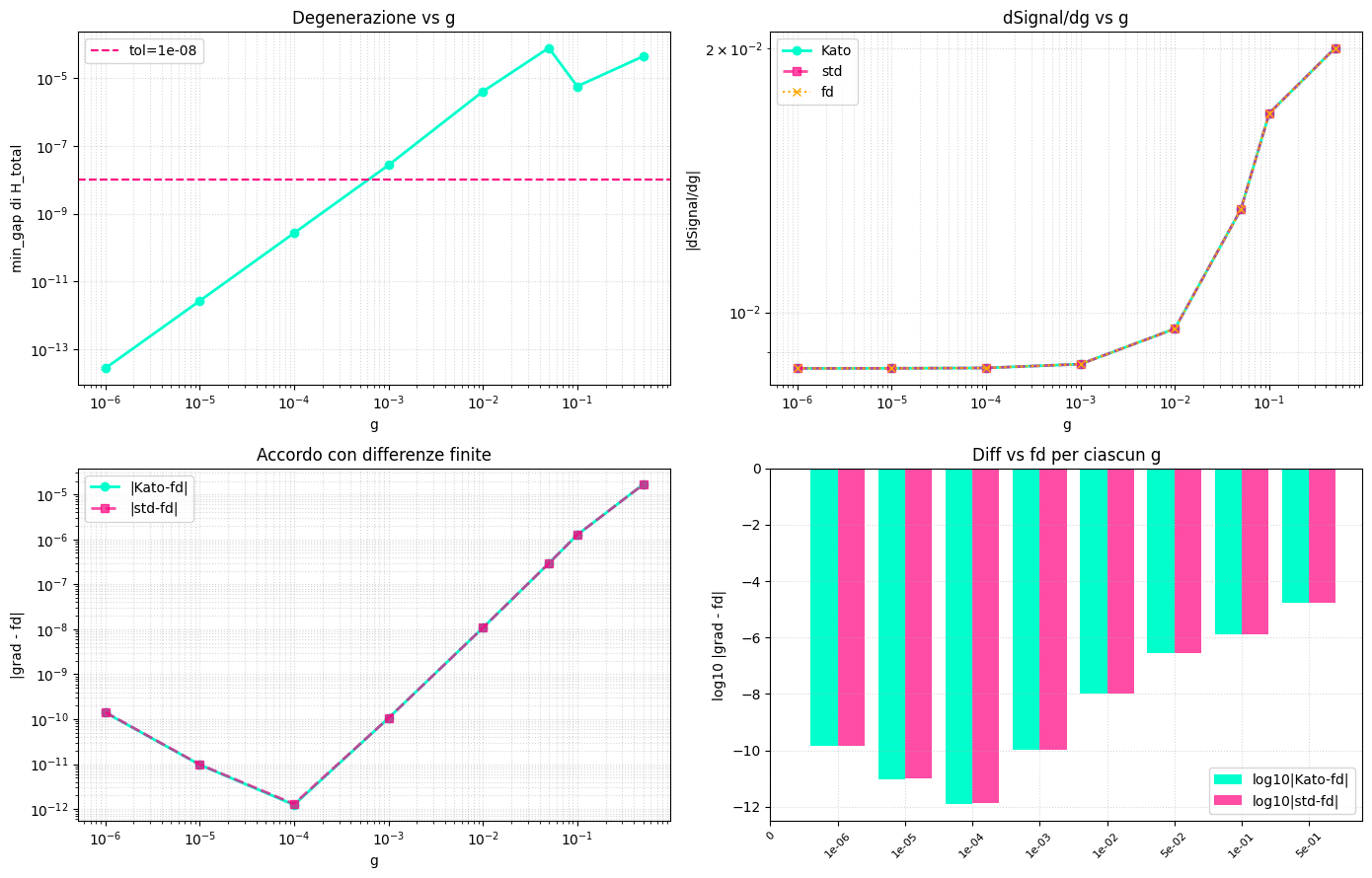
On a real Discovery Hamiltonian (wormhole/SYK teleportation signal,
scanned toward exact degeneracy as coupling g -> 0), spectral_evolve
and plain eigh stay in agreement across the whole scan -- SYK's random
disorder never produces a mathematically exact tie, only a numerically
small one, so plain eigh's gradient doesn't break there. spectral_evolve
is validated and correct for the case it targets; it is not automatically
a win for every real physics Hamiltonian.
Details
Citations, verified against the source, not assumed: Kato's
divided-difference formula for matrix function derivatives (Kato,
Perturbation Theory for Linear Operators, 1995, Ch. II.5.6), following
Kasim (arXiv:2011.04366, 2020) -- the PDF was downloaded and read
directly; Kasim's Eq. 4.72 (a compatibility condition an earlier,
discarded custom_vjp-based attempt needed, which the divided-difference
approach avoids) was confirmed present in the real paper text at that
exact equation number.
Verification history: 7/7 checks pass, including a guard test
(test_std_eigh_fails_at_degeneracy) that fails loudly if plain eigh's
gradient ever becomes correct at degeneracy -- first checked on the
Colab draft, then re-verified independently on a real Kaggle CPU kernel.
A real bug surfaced only by running the code, not by reading it: the
first draft passed f/f_prime (Python closures) as ordinary positional
arguments to a @jax.custom_jvp-decorated function, which crashes
(TypeError: ... is not a valid JAX type) since JAX traces every
positional argument by default -- fixed with nondiff_argnums=(1, 2).
Usage gotcha: spectral_evolve calls ensure_x64() internally, but
that can't retroactively upcast arrays a caller already built in
float32/complex64. A caller building its own Hamiltonian before calling
spectral_evolve still needs jax.config.update("jax_enable_x64", True)
up front -- omitting it produced a spurious NaN on the first (JIT-tracing)
call in the real Hamiltonian test above.
Status: promoted to Dense-Evolution as dense_evolution.physics.spectral
(has_exact_degeneracy, matrix_function_eigh, spectral_evolve).
Scripts: scripts/spectral_evolve_kato_degeneracy.py,
scripts/kato_syk_wormhole_real_usecase.py.