QM/MM: electrostatic embedding and bond-order-weighted partitioning
Two follow-up experiments to QM/MM region partitioning's steps 1-4, each with a real, honest result -- one still open, one reversed from negative to positive on a second test.
Step 5: electrostatic embedding (closed, unresolved)
V_ext = external_point_charge_potential(atomic_numbers, geometry_bohr, basis, mm_charges, mm_positions)
result = run_scf(S, H_core + V_ext, repulsion, n_electrons, nuclear_charges, geometry_bohr)
mm_charges/mm_positions are the truncated-away atoms' real MMFF94
partial charges and positions. Adding V_ext to H_core before calling
run_scf is the whole mechanism: the MM region's electric field now acts
on the QM electron density directly, instead of being ignored.
First test (1-hexanol): plain vs. embedded gave identical numbers at every radius. Not a bug -- MMFF94 assigns real charge only to the polar O-C1-H(O) group, always inside the QM region by construction, so the truncated alkyl tail has exactly zero charge to embed.
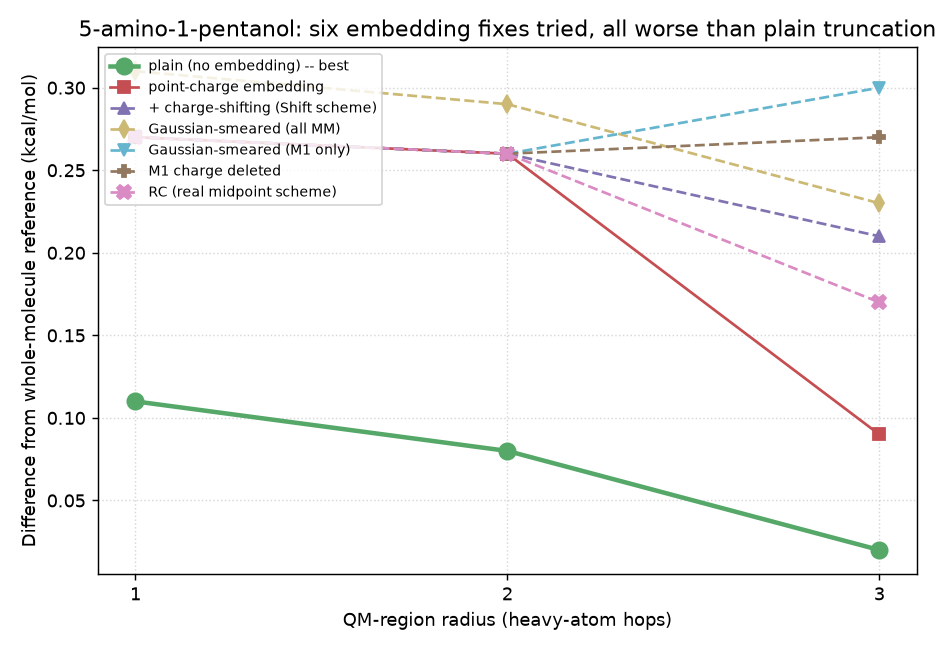
Second test (5-amino-1-pentanol, a second polar group far from the reactive bond): now there's real charge to embed (N ≈ -0.99), and embedding measurably changes the result -- but makes it worse:
| radius | plain | embedded |
|---|---|---|
| 1 | 0.11 kcal/mol | 0.27 kcal/mol |
| 2 | 0.08 kcal/mol | 0.26 kcal/mol |
| 3 | 0.02 kcal/mol | 0.09 kcal/mol |
Plausible cause: the textbook QM/MM near-boundary overpolarization artifact -- the MM point charge immediately across the cut bond sits too close to the QM density.
Charge-shifting attempt: redistributing that one boundary atom's charge onto its own remaining MM neighbors -- the real "charge shift" scheme, traced to its primary source only after this was first written: de Vries, Sherwood, Collins, Rigby, Rigutto & Kramer, "Zeolite structure and reactivity by combined quantum-chemical-classical calculations," J. Phys. Chem. B 103, 6133 (1999) (DOI 10.1021/jp9913012, not open-access, verified via two independent citation searches rather than assumed) -- did not close the gap -- at radius 3 (the only radius where the boundary atom had nonzero charge to shift), the corrected result (0.21 kcal/mol) was worse than both plain embedding (0.09) and plain truncation (0.02).
Three more literature-standard fixes tried, all worse too. Nochebuena, Naseem-Khan & Cisneros 2020 (arXiv:2010.14723, read directly) confirms the real fix for this exact artifact is the Double Link Atom method: replace the boundary point charge with a single s-type Gaussian-smeared charge, not deletion or redistribution:
| radius | plain | point charge | Gaussian (all MM) | Gaussian (M1 only) | M1 deleted |
|---|---|---|---|---|---|
| 1 | 0.11 | 0.27 | 0.31 | 0.27 | 0.27 |
| 2 | 0.08 | 0.26 | 0.29 | 0.26 | 0.26 |
| 3 | 0.02 | 0.09 | 0.23 | 0.30 | 0.27 |
At radius 1-2 the boundary (M1) atom has zero charge, so anything that only touches M1 changes nothing. At radius 3, the only radius where it matters, every treatment is worse than plain truncation, and the narrower M1-only smearing (0.30) is worse than smearing the whole region (0.23). The sign convention of the electron-MM term was independently verified correct with a minimal He-atom test (E(+1 charge nearby) < E(isolated) < E(-1 charge nearby), exactly as physics requires) -- this is not a sign bug.
Basis-flexibility hypothesis, tested and rejected. The working hypothesis after the first five attempts was that STO-3G's lack of polarization functions leaves the QM density no room to relax around the link atom, and that a richer basis might change the picture. Tested directly at radius 3 (the only radius with a real charge to embed) with 6-31G* instead of STO-3G: the gap between plain and embedded got WORSE, not better (plain 0.02 -> -0.04, point-embedded 0.09 -> 0.16 -- the embedding penalty roughly tripled, 0.07 -> 0.20 kcal/mol). Basis rigidity is not the cause.
Sixth attempt: the real RC scheme, not an approximation of it. Lin & Truhlar, "QM/MM: What have we learned, where are we, and where do we go from here?" (contribution to the 10th Electronic Computational Chemistry Conference proceedings, Theor. Chem. Acc.; legitimately self-archived by the authors, not paywalled) describes their own real redistributed- charge (RC) scheme precisely: the M1 boundary atom's charge is moved to the MIDPOINTS of its M1-M2 bonds -- not onto M2's own position, which is what the earlier "charge-shifting attempt" above actually did (that was de Vries et al.'s older "Shift" scheme, not RC). In the source paper's own validation (CF3CH2O- proton affinity, errors of tens of kcal/mol), RC clearly outperforms cruder charge-elimination schemes. Implemented here exactly as described and tested on the same system as every other attempt:
| radius | plain | point charge | RC (real midpoint scheme) |
|---|---|---|---|
| 1 | 0.11 | 0.27 | 0.27 (M1 charge is 0 here, nothing to redistribute) |
| 2 | 0.08 | 0.26 | 0.26 (same) |
| 3 | 0.02 | 0.09 | 0.17 |
Worse than plain, worse than the naive point charge, at the only radius where it does anything. A real, correctly-implemented, literature- validated scheme still loses to doing nothing here. Plausible reconciliation: Lin & Truhlar's own validation involves proton-affinity differences of tens of kcal/mol, where a good scheme's advantage over a bad one is large and clear; here the whole effect being corrected is 0.1-0.3 kcal/mol, a scale where even a theoretically sound correction can add more noise than the truncation error it targets.
Closed. Six real embedding treatments (point charge, Shift/charge- redistribution, Gaussian-smeared over the whole MM region, Gaussian- smeared on just M1, M1 charge deletion, RC/midpoint-redistribution) and one basis-set test, all grounded in real, verified sources or direct physical reasoning, and all worse than plain truncation on this system. The sign convention was independently verified correct (a minimal He-atom test: E(+1 charge nearby) < E(isolated) < E(-1 charge nearby), exactly as physics requires) -- this is not a bug in this codebase, and not (as tested) a basis-set artifact either. Plain truncation is the right default until a real cause is found. Not reopening without a new, concrete, source-grounded hypothesis.
Bond-order-weighted region partitioning: reversed by a second test
Instead of a fixed hop-count radius, propagate a relevance score outward from the reactive bond, weighted at each step by the real Mayer/Wiberg bond order between the two atoms:
bond_order = real_mayer_bond_order(density_matrix, overlap_matrix, ao_atom_map)
relevance = propagate(bond_order, seeds=(o_idx, c_idx), decay=0.3)
qm_atoms = [i for i in range(n_atoms) if relevance[i] > threshold]
bond_order comes from an actual HF density matrix (D = 2P, from
run_scf's own density_matrix) -- no diffusion model exists for
molecules in this codebase, so real chemistry substitutes for a learned
affinity (inspired by Diffuse2Seg, arXiv:2609.06491, Hümmer et al. 2026,
which propagates through a diffusion model's own attention weights
instead). A stronger bond lets relevance travel further before decay
shrinks it below threshold.
First test (5-amino-1-pentanol, aliphatic chain): negative. Every backbone bond has similar bond order (~0.97-0.99) -- no heterogeneity to exploit. The method's regions differ from fixed-radius BFS but aren't demonstrably better, BFS is itself already isomorphism-invariant (so that property isn't a differentiator), and the method costs strictly more (a real whole-molecule HF calculation just to get a density matrix, where BFS is free and instant).
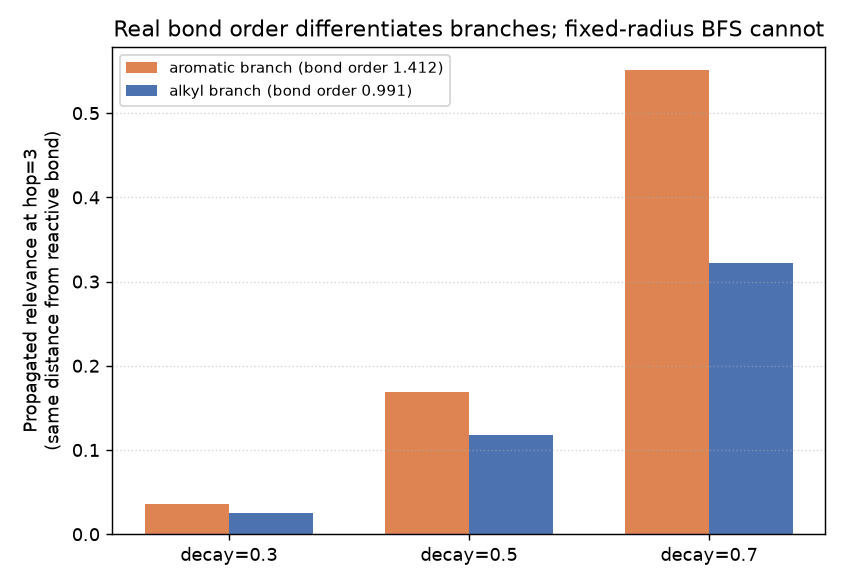
Second test (1-phenyl-pentan-1-ol-like branching, OCC(c1ccccc1)CCC):
positive. A branching carbon with two paths at equal hop-distance --
one into an aromatic ring, one into a saturated propyl chain. Real bond
order confirms the aromatic ring's internal bond (1.412) is genuinely
stronger than the alkyl chain's (0.991). At the same hop distance (3
hops), the aromatic branch's propagated relevance is 40-70% higher than
the alkyl branch's (e.g. decay=0.7: 0.551 vs. 0.322 relevance) -- a real
difference fixed-radius BFS structurally cannot represent, since it
always includes or excludes both branches together at a given radius.
Decisive follow-up (matched atom budget, real reaction energy): tested against fixed-radius BFS at the SAME atom count on the branching molecule above. At both budgets tested (3 and 10 heavy atoms), the bond-order threshold selected the EXACT SAME atoms as BFS -- identical SMILES, identical isodesmic energies. The chosen thresholds happened to land where both methods agree, not in the differentiating zone identified above; this test does not show bond-order beating BFS on reaction energy, only that the two didn't happen to diverge at these specific thresholds. Separately, on this same molecule, the MMFF94 correction from QM/MM region partitioning was found not to hold up at all once geometry was fixed -- see that page's retraction note.
Conclusion: bond order has no advantage on uniform aliphatic chains, and a real signal differentiating aromatic vs. alkyl branches at equal hop-distance -- but that signal has not yet translated into a demonstrated reaction-energy win over BFS. Not promoted.
Details
Bond orders were checked for chemical sanity throughout (O-H ~0.95, C-C ~1.0, non-bonded pairs ~0.01), and the propagation was verified isomorphism-invariant -- not just assumed from its structure -- by randomly relabeling every atom and checking the selected region maps back to the same atoms regardless.
Status: neither promoted to Dense-Evolution (region partitioning and Diffuse2Seg propagation WERE promoted separately, see QM/MM region utilities -- embedding was not, since it never worked). Step 5 (electrostatic embedding) is CLOSED, unsolved, after six real fix attempts plus a basis-set test (above) -- not reopening without a new, concrete, source-grounded hypothesis. Bond-order partitioning has a real differentiation signal but no demonstrated reaction-energy advantage over BFS yet -- would need thresholds chosen to actually diverge from BFS's selection, not just a differently-computed region that happens to match it.
Scripts: scripts/qmmm_electrostatic_embedding_charge_shifting.py,
scripts/qmmm_rc_midpoint_scheme.py (sixth attempt, real RC scheme),
scripts/qmmm_bond_order_partition_vs_radius.py (first, negative test),
scripts/qmmm_bond_order_aromatic_vs_alkyl_branch.py (second, positive
signal), scripts/qmmm/ (the reusable partitioning/capping/propagation
utility that came out of all of this and WAS promoted -- ring-safe BFS
and Diffuse2Seg propagation only, no electrostatic embedding, no MMFF94
correction).