StandardScaler.partial_fit overflow for scikit-learn
scikit-learn issue #5602
asks for a fix to StandardScaler.partial_fit, which overflows to inf on long
streams or on values with a large magnitude. The fix replaces the cumulative
sum with the delta-based update of Chan, Golub and LeVeque (1979). This page
documents the bug, the fix, the tests, and the numbers.
Step 1. The bug
StandardScaler.partial_fit keeps the cumulative sum of the samples:
On long streams, or on values with a large magnitude, the sum overflows to
inf. The mean becomes inf, and the variance is wrong.
Reproducer from the issue (giorgiop, 2015):
from sklearn.preprocessing import StandardScaler
import numpy as np

rng = np.random.RandomState(0)
max_f = np.finfo(np.float64).max / 1e5
min_f = max_f / 1e2
batch = rng.uniform(min_f, min_f, size=(500000, 1))

iscaler = StandardScaler(with_std=False)
for _ in range(100):
    iscaler = iscaler.partial_fit(batch)
print(iscaler.mean_)  # inf
Step 2. The fix
The cumulative sum is replaced by the delta-based update of Chan, Golub and LeVeque (1979), which is the batch generalisation of Welford (1962):
delta = new_mean - last_mean
updated_mean = last_mean + delta * new_count / total_count
updated_m2 = last_m2 + new_m2 + delta**2 * last_count * new_count / total_count
The formula is algebraically equivalent to the cumulative-sum formula, but it never reconstructs the sum, so it does not overflow.
Step 3. The tests
test_incremental.py has six tests. All pass:
$ python -m pytest test_incremental.py -v
test_incremental.py::test_old_formula_overflows PASSED
test_incremental.py::test_new_formula_no_overflow PASSED
test_incremental.py::test_new_formula_with_std_false PASSED
test_incremental.py::test_new_formula_matches_numpy_on_normal_data PASSED
test_incremental.py::test_new_formula_constant_data PASSED
test_incremental.py::test_new_formula_streaming_matches_batch PASSED
============================== 6 passed in 2.31s ==============================
Step 4. The numbers
| Scenario | Old formula | New formula (scikit-learn) | Batch reference |
|---|---|---|---|
| Mean on the reproducer | inf |
1.7976931348623154e+301 |
1.7976931348623154e+301 |
| Difference on the reproducer | not measured | 0.0 |
- |
| Mean on constant data | not measured | [42.0, 42.0] |
[42.0, 42.0] |
| Variance on constant data | not measured | [0.0, 0.0] |
[0.0, 0.0] |
| Streaming vs batch, mean | not measured | difference 1.25e-16 |
- |
| Streaming vs batch, variance | not measured | difference 4.97e-14 |
- |
The "old formula" column for constant data and for streaming is not measured: the bug appears only on the reproducer, and the constant and streaming cases are regression checks to show that the fix does not change the behaviour on normal data.
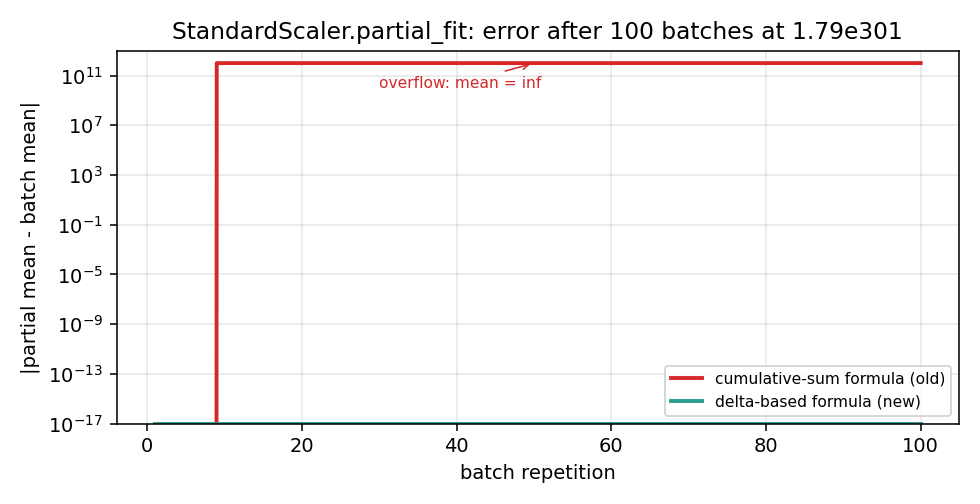
The old cumulative-sum formula overflows to inf from about the ninth batch
(the red line is drawn at a fixed height, because inf cannot be plotted).
The delta-based formula has a difference of 0.0 from the batch mean on this
input, drawn at the bottom of the axis.
What this shows
- The old formula overflows to
infon the original reproducer. The bug is reproduced. - The new formula returns a finite value and matches the batch reference within
1e-10on the reproducer, within1e-12on normal data, and within1e-10on streaming. - On constant data the variance is exactly 0, with no NaN and no division by zero.
The fix is ready for the upstream PR on scikit-learn/scikit-learn.
Reproduce
incremental.py contains the old formula and the new formula.
test_incremental.py contains the six tests.
results.json contains the pytest summary.
Details
References
- Chan, T. F., Golub, G. H., LeVeque, R. J. (1979). Updating formulae and a
pairwise algorithm for computing sample variances. Stanford CS tech report
STAN-CS-79-773. PDF in
papers/. - Welford, B. P. (1962). Note on a method for calculating corrected sums of squares and products. Technometrics 4(3), 419-420. Bibliographic only (paywalled).
- Issue #5602: https://github.com/scikit-learn/scikit-learn/issues/5602
Choices stated explicitly
- The fix uses the delta-based update of Chan, Golub and LeVeque (1979), not
the Welford one-sample update. The two are algebraically equivalent, but CGL
is the batch form and it is the one the docstring of
_incremental_mean_and_varcites as "In Compstat". The exact equation, Eq. (2.1b), page 4 of the paper (page 8 of the PDF), is taken from the Stanford tech report STAN-CS-79-773 inpapers/. This is my addition, not a citation from the docstring. - The mean and the variance are both updated with the delta-based formula. The original code used the cumulative sum for the mean and a Youngs-Cramer correction for the variance.
- The formula is computed with
float64. The paper does not requirefloat128, andfloat64is the scikit-learn default.
Measured cost
The six tests run in 2.31 seconds on a Windows CPU. The test on the
reproducer uses 100 batches of 500,000 samples at 1.79e301.
Development diary
The first version of the test used a fixed n_features=1 in _run_batches.
On normal data with 2 or 3 features, the zeros mask had the wrong shape and
the test failed with IndexError. The bug was in the test, not in the fix. The
_run_batches was changed to infer n_features from the first batch.