Active learning: ask for the label only when unsure
A robot observes a stream but the true label of a sample is expensive. Active learning decides which samples to label, so a classifier can learn with a limited labelling budget. The library provides four strategies, from the naive (label at random) to the one that balances the budget while asking the most uncertain samples.
1. The budget
A labelling budget B in (0, 1]: B = 0.1 means at most 10 % of the incoming samples can be labelled. The strategies differ in which 10 % to pick.
import numpy as np
from dense_armor.utility.active import RandomStrategy
rng = np.random.default_rng(0)
strategy = RandomStrategy(budget=0.1, seed=0)
for _ in range(1000):
    strategy.should_label({"x": float(rng.random())}, None)
print(round(strategy.n_labelled_ / strategy.n_seen_, 3))
2. Fixed threshold: label when the classifier is unsure
import numpy as np
from dense_armor.utility.active import FixedUncertainty

class Fixed:
    def predict_proba_one(self, x):
        return {0: 1.0 - x["conf"], 1: x["conf"]}

rng = np.random.default_rng(0)
confs = [float(rng.uniform(0.5, 1.0)) for _ in range(1000)]
strategy = FixedUncertainty(theta=0.7)
for c in confs:
    strategy.should_label({"conf": c}, Fixed())
print(round(strategy.n_labelled_ / strategy.n_seen_, 3))
The threshold ignores the budget: 37 % labelled against a budget of 10 %. The paper describes this failure mode; the theta = 0.7 here is a choice.
3. Variable threshold: spend the budget evenly over time
The threshold starts at 1 and adjusts after every sample: when a sample is labelled it shrinks by (1 - s), when it is not it grows by (1 + s). The adjustment keeps the labelling rate at the budget over time.
import numpy as np
from dense_armor.utility.active import VariableUncertainty

class Fixed:
    def predict_proba_one(self, x):
        return {0: 1.0 - x["conf"], 1: x["conf"]}

rng = np.random.default_rng(0)
confs = [float(rng.uniform(0.5, 1.0)) for _ in range(1000)]
strategy = VariableUncertainty(budget=0.1, s=0.001, seed=0)
for c in confs:
    strategy.should_label({"conf": c}, Fixed())
print(round(strategy.n_labelled_ / strategy.n_seen_, 3))
4. Randomised threshold: do not ignore the confident samples
The randomised variant multiplies the threshold by eta ~ Normal(1, delta) before the comparison, so occasionally a confident sample is labelled too.
import numpy as np
from dense_armor.utility.active import VariableRandomizedUncertainty

class Fixed:
    def predict_proba_one(self, x):
        return {0: 1.0 - x["conf"], 1: x["conf"]}

rng = np.random.default_rng(0)
confs = [float(rng.uniform(0.5, 1.0)) for _ in range(1000)]
strategy = VariableRandomizedUncertainty(budget=0.1, s=0.001, delta=0.05, seed=0)
for c in confs:
    strategy.should_label({"conf": c}, Fixed())
print(round(strategy.n_labelled_ / strategy.n_seen_, 3))
5. What the numbers say
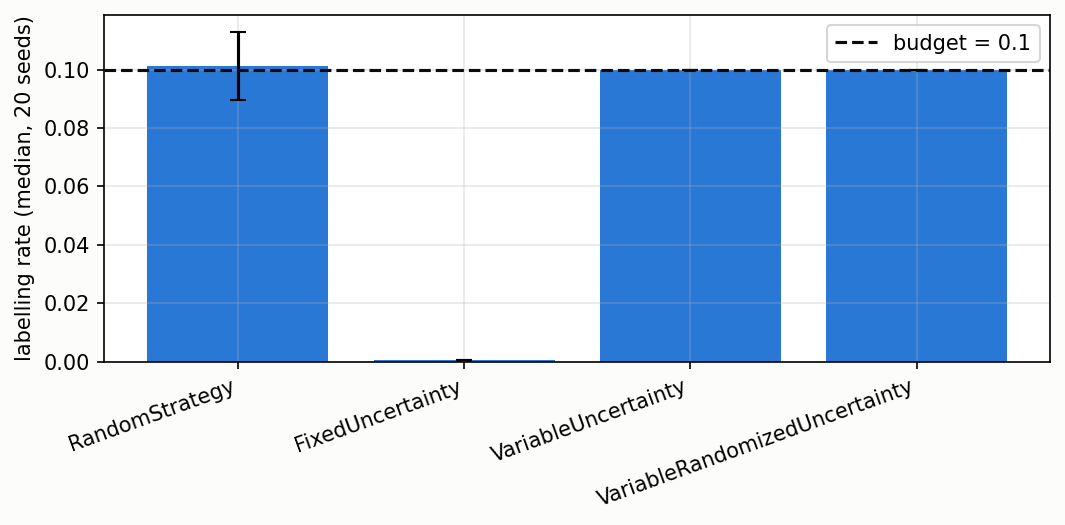
| strategy | median rate | IQR |
|---|---|---|
| RandomStrategy | 0.101 | 0.005 |
| FixedUncertainty | 0.001 | 0.001 |
| VariableUncertainty | 0.100 | 0.000 |
| VariableRandomizedUncertainty | 0.100 | 0.000 |
FixedUncertainty labels 0.05 % of the stream: the classifier is almost always above the threshold, so the strategy starves and the budget is unused. The two variable strategies land on the budget exactly.
Details
- Benchmark: benchmarks/bandit_quality.py, JSON: benchmarks/bandit_quality.json.
- Papers: Zliobaite, Bifet, Holmes and Pfahringer (2011) Machine Learning 100(1). Algorithm 2 page 3, Algorithm 3 page 4, Algorithm 4 page 5, Algorithm 5 page 5. Settles (2009) is background only.
- Machine: Intel Xeon 2.20 GHz, 2 cores, Python 3.13.16.
- The classifier is OnlineGaussianNB. The choice matters for the fixed threshold, not for the variable strategies whose rate is at the budget by construction.