Cycle residual
When a robot repeats the same movement, its signals repeat too. This tool learns the usual shape of one repeat and tells you how much the current reading differs from it: small when all is normal, large when something breaks the pattern.
CycleResidual returns the difference between the current sample of a
periodic signal and the value the template predicts for the current phase.
When the motion repeats, the residual is small; when something breaks the
pattern, the residual jumps. Until the template exists the residual is nan
and the key ready is 0.0.
1. What a cycle residual is
A robot that repeats the same motion every second produces signals that repeat with it. If the joint torque during a pick-and-place cycle looks the same every cycle, then the shape of the torque is the normal, and any difference from that shape is worth watching.
CycleResidual builds the shape in two steps. First it finds the period of
the stream, in samples, by autocorrelation of its first 2 * max_period
samples (or takes the period you give). Then it keeps the last n_cycles
complete cycles and takes, at each phase inside the cycle, the median of
the samples seen at that phase. For every new sample the residual is
r[t] = x[t] - template[phase of t]
The template is recomputed every time a cycle is complete: the oldest cycle
leaves and the new one enters. A single outlier does not corrupt the median,
and the template follows a signal whose shape changes. With search > 0 each
complete cycle is compared with the template shifted by up to search
samples and stored back aligned, so a motion that starts a few samples late
keeps the same template.
2. Finding the period of a sine
A sine with a true period of 50 samples. period=None lets the estimator
find the period from the stream; it looks at the first 2 * max_period
samples, here 400.
import numpy as np
from dense_armor.utility.timeseries import CycleResidual

cr = CycleResidual(period=None, max_period=200, n_cycles=3)
for i in range(1000):
    cr.transform_one({"x": float(np.sin(2 * np.pi * i / 50))})
print(cr.period)
Once the period is known and the template is filled, the residual on a stream that repeats exactly is zero:
import numpy as np
from dense_armor.utility.timeseries import CycleResidual

cr = CycleResidual(period=50, n_cycles=3)
res = []
for i in range(500):
    out = cr.transform_one({"x": float(np.sin(2 * np.pi * i / 50))})
    res.append(out["residual"])
print(round(float(np.mean(np.abs(res[-100:]))), 4))
The residual is zero because the signal is the same every cycle. On a real joint the residual is not zero even when healthy: it is a small number that reflects the noise of the sensor and the small variation between cycles. The change in the residual is what matters.
3. On a real arm
A SyntheticArm from a real Panda URDF gives q, qd, and tau at 50 Hz.
The arm repeats its motion every second, and a payload of 5 kg appears on
the last link at t = 12 s. The period of the joint-1 torque on this stream
is 200 samples (4 base cycles of 50 samples each), so period=200 and
n_cycles=2 build the template from the first two periods.
import numpy as np
from pathlib import Path
from dense_armor.utility.datasets import SyntheticArm
from dense_armor.utility.timeseries import CycleResidual

ds = SyntheticArm(
    Path("test/fixtures/urdf/panda.urdf"),
    period_s=1.0, rate_hz=50.0, n_cycles=16,
    fault_at_s=12.0, fault="payload", payload_mass=5.0, seed=0,
)
cr = CycleResidual(period=200, n_cycles=2)
res = []
for sig, _ in ds.stream():
    out = cr.transform_one({"x": float(sig["tau_1"])})
    res.append(out["residual"])
before = float(np.mean(np.abs(np.asarray(res[400:590]))))
after = float(np.mean(np.abs(np.asarray(res[700:800]))))
print(round(before, 4))
print(round(after, 4))
print(round(after / before, 1))
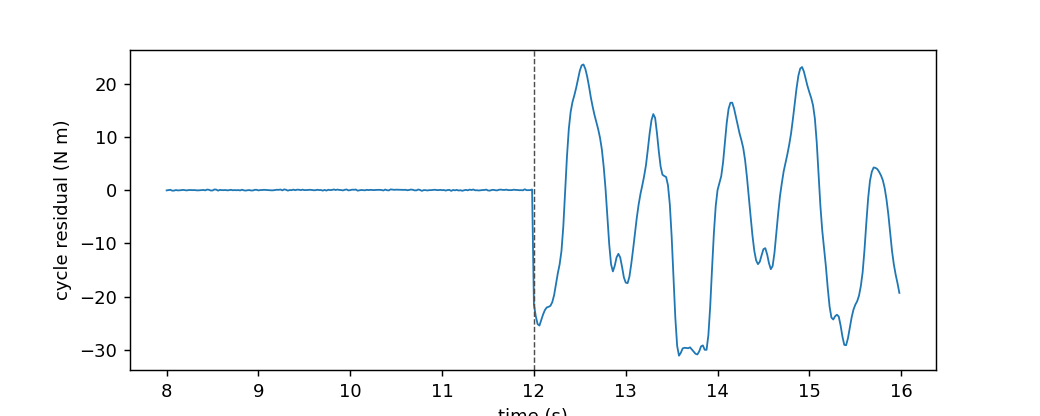
Before the fault the mean absolute residual is 0.048 N m: the healthy
cycle repeats within the sensor noise. After the fault it is 12.68 N m,
a factor of 266. A control loop that watches this residual sees the
change at once, without knowing the payload model.
Details
References
The estimator is not taken from a single paper. The median-template idea
comes from the benchmarks/anomaly_streaming.py script that used a cycle
residual on the CASPER dataset, and the period detection by autocorrelation
is the standard approach for a periodic signal.
The median (instead of the mean) for the template is the choice from the original benchmark script, kept because it resists a single bad sample inside a cycle.
Choices stated explicitly
- The period can be given or found.
period=200fixes it at construction.period=Nonefinds it after2 * max_periodsamples by autocorrelation; the defaultmax_period = 1000therefore needs 2000 samples, and on the 800-sample stream of section 3 it finds no period (withmax_period = 250it finds exactly200, at sample 499). - The template is the median of the last
n_cyclescomplete cycles, not the mean. One outlier in one cycle does not corrupt the template. - Before the template exists the residual is
nan, withready = 0.0;readyis1.0on every sample whose residual is a number. The first residual appears aftern_cycles * periodsamples when the period is given. - Memory is one array of
n_cycles * periodvalues. The raw samples held to find the period are dropped as soon as the period is known. - The phase shift is searched once per complete cycle and applied to the
next one; it is off by default (
search = 0). - The residual is the raw difference, not a score. A downstream detector (CUSUM, threshold) decides whether the residual is an anomaly.
Measured cost
Per-sample latency is 3 microseconds median and 40 microseconds at the
99th percentile (budget_s = 1e-3 s), for period=50, n_cycles=2, over 3000
samples on a Windows desktop CPU. Memory is n_cycles * period floats
(400 for period=200, n_cycles=2) plus the template of period floats,
constant after the period is known.
Development diary
The first delivery appended every sample to a buffer and never pruned it.
The second capped the buffer but built the template once and never updated
it, returned 0.0 before the template existed (a CUSUM on the residual rang
three times before the fault, at samples 444, 447 and 453), and had no phase
search. A review replaced it with the cycle store of this page: a rolling
median, nan plus ready before the template, and the search argument.
On the stream of section 3, with the period found, there are no alarms
before the fault and the first alarm is at sample 600, 12.0 s.