Motion in time: energy, global shift, scene changes
Motion in time
Two frames in a row carry the movement that a single frame does not.
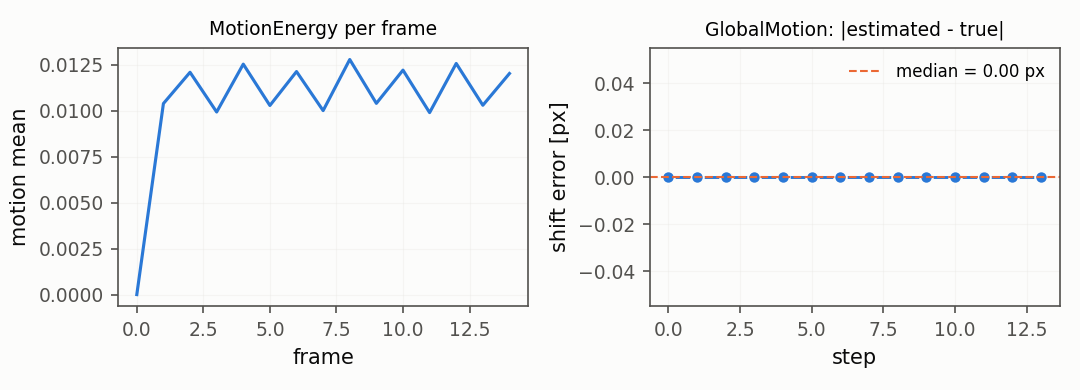
MotionEnergy measures the
amount of change (a filtered difference, summarised per frame) and
GlobalMotion estimates the
global shift of the scene with phase correlation, which separates the
motion of the camera from the motion of the objects. On a pure
translation the shift is exact to the tenth of a pixel.
Scene changes and temporal anomalies
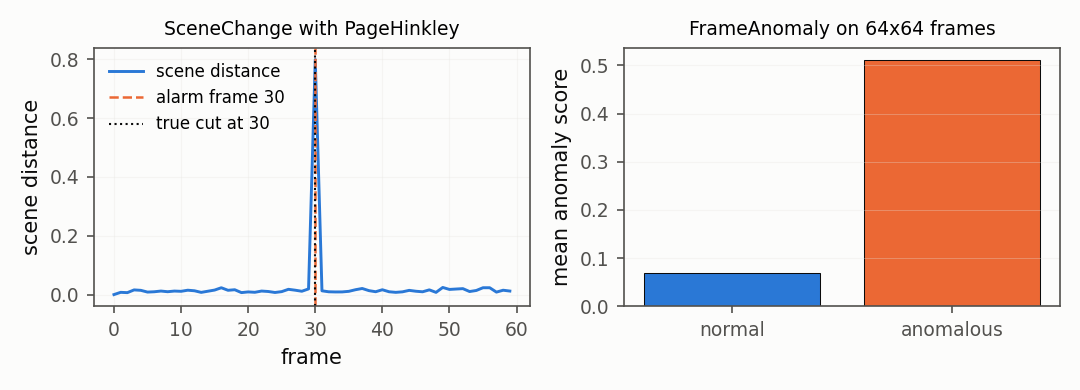
A hard cut in a video is a level shift in the difference between
consecutive frames, which is what a drift detector for a scalar stream
was built for. SceneChange
turns a frame into a scalar distance (histogram distance plus mean
absolute difference) and feeds it to a
ADWIN or to any other drift
detector of the library. FrameAnomaly
scores a frame against a memory of the patches the library has already
seen, following the PatchCore idea.
Sliding window
FrameWindow keeps the last
n frames, or the last s seconds, in a ring buffer, and
summarises them with streaming mean, standard deviation, motion energy
and quantiles of the DDSketch sketch. The memory is O(n), so a
stream of any length keeps the same footprint.