Protection
When a reading looks wrong, what should you do with it? This section explains the cases (a single glitch, a real change, a slow drift) and which tool handles each.
Once a sample looks wrong, what do you do with it?
There are three honest answers, and they are not the same:
- It is a spike — an isolated impulse, one sample that got corrupted. Replace it with the local baseline and move on.
- It is a regime change — the signal has genuinely moved to a new level. Pass it through, unchanged. The robot is doing something different now.
- It is a slow drift — neither a spike nor a level change, but a sustained movement of the average. The CUSUM on Drift detection is the right tool.
An anomaly detector cannot tell these apart. From a single sample's point of view, a spike and the first sample of a regime change look identical: both are far from the recent window. Only the run of deviating samples, and what happens after the run, distinguishes them.
The signal
Same 100 Hz joint velocity throughout the batch: a collision spike at 15 s and a slow gear drift from 20 s.
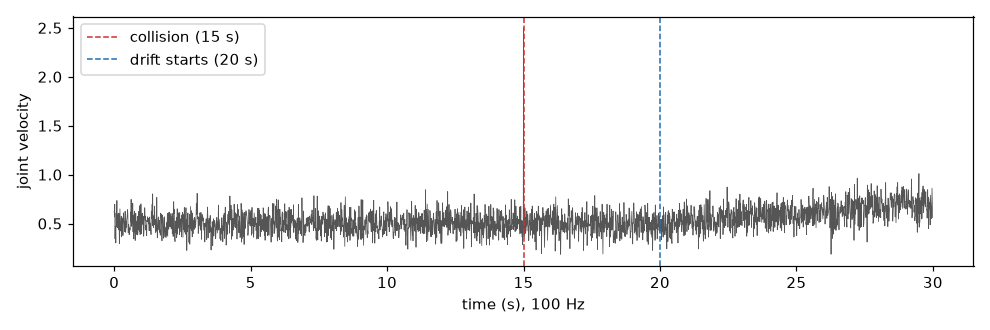
The spike is one sample; the drift is a run. The Arbiter decides which is which.
Pages
- Arbiter — labels each point clean, spike or regime change, and
routes it to the correct corrector. Both a batch version (
classify_segments+route_and_correct) and a streaming version (StreamingArbiter) with bounded delay. Also wired intoOrca(use_arbiter=True).