Visual landing: is the pad where I think it is, and is the camera moving?
A drone descends toward a landing pad. A downward camera captures 640 by 360 frames. Between two frames the pad shifts by a few pixels, either because the drone is moving or because the pad itself is moving. This page shows the three primitives of the library that a landing controller uses: the global shift, the local motion, the anomaly.
The scene
A textured background (fine noise around 0.5), a bright pad rectangle on it (0.7), and a dark person square on the pad (0.0) from sample 20 on. The whole scene shifts by 1 pixel per frame, so the pad moves with the background. The person walks on the pad at 2 pixels per frame, relative to the pad.
Three questions, three primitives:
| Question | Primitive | Input |
|---|---|---|
| Is the camera moving, and by how much? | GlobalMotion |
{"array": img} |
| Is something moving on the pad, on top of the camera motion? | DenseFlow + MotionMask |
{"array": img} then {"u", "v"} |
| Does this frame contain something the memory has never seen? | FrameAnomaly |
{"frame": img} |
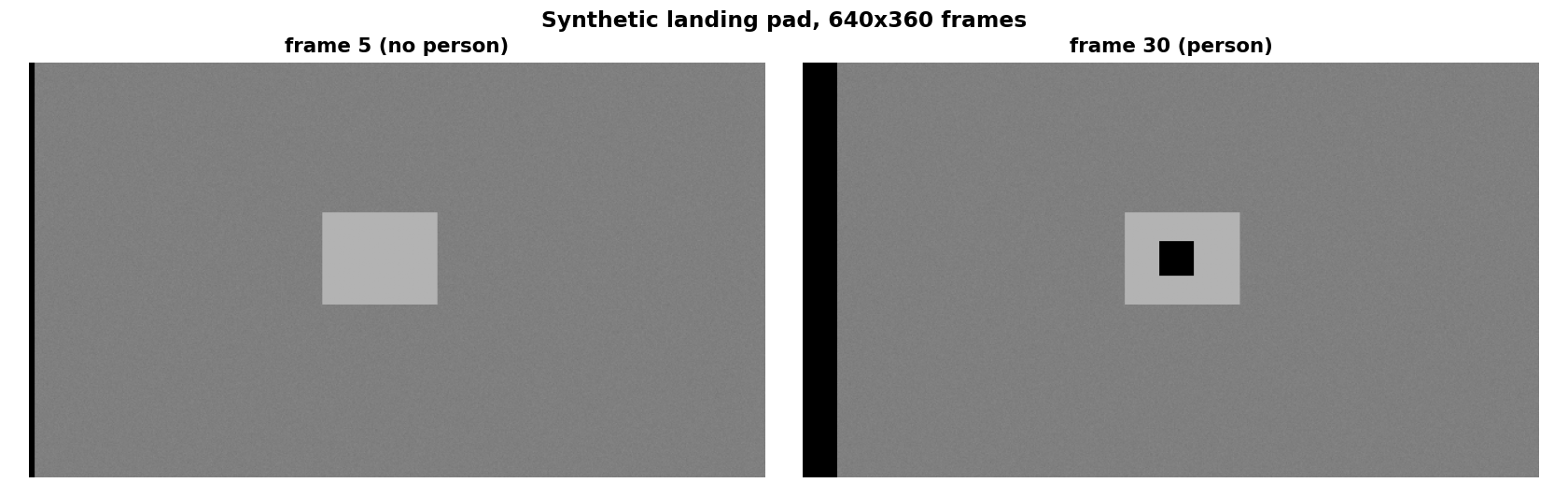
Synthetic frames, 640x360. Left: frame 5, no person. Right: frame 30, dark person on the bright pad.
1. The global shift (GlobalMotion)
GlobalMotion estimates the global shift by phase correlation: the Fourier transform of the two frames, the cross power spectrum, the peak of its inverse transform, sub-pixel by a three-point parabola. It takes {"array": img}, a float32 image in [0,1].
from pipelines.drones.visual_landing import synthetic_frames, run

frames, truth, person_at = synthetic_frames(
    n=40, shift=(1, 0), seed=0, person_at=20)
r = run(frames, truth, person_at, anomaly_warmup=10)
print(round(r.mean_error_px, 3), round(r.max_error_px, 3))
The mean error is 0.436 pixels over 40 frames, with a maximum of 0.488. On a pure translation the estimator is exact; on this synthetic stream the pad and the person add a small non-translational component, and the sub-pixel interpolation gives the residual below half a pixel. Time per frame: 18 ms.
2. The anomaly of the frame (FrameAnomaly)
FrameAnomaly turns each frame into patch descriptors (PatchFeatures, 16-by-16 patches, 8-pixel stride, 9 orientation bins), builds a memory of the descriptors of the normal frames (PatchMemory, a bounded reservoir of 1024), and scores a new frame by the maximum nearest-neighbour distance of its patches to the memory (PatchCore equation 6, Roth et al. 2022, page 5, quoted in the PatchMemory docstring). It takes {"frame": img}.
from pipelines.drones.visual_landing import synthetic_frames, run

frames, truth, person_at = synthetic_frames(
    n=40, shift=(1, 0), seed=0, person_at=20)
r = run(frames, truth, person_at, anomaly_warmup=10)
print(round(r.anomaly_before_mean, 4), round(r.anomaly_after_mean, 4))
The score rises from 0.390 before the person appears to 0.478 after. The person is a dark square on the bright pad, a pattern the memory has never seen, and the patch distance increases. Time per frame: 373 ms.
3. The local motion (DenseFlow and MotionMask)
DenseFlow computes the dense flow field of two consecutive frames by the Horn-Schunck iteration (Ziani et al. 2025, section 3.1, pages 3-4). MotionMask takes the flow field, removes the global component, and flags the pixels whose residual flow is above n_sigmas robust deviations of the distribution.
DenseFlow recovers the global motion at 0.81 px/frame against a true 1 px/frame with alpha=0.05 and normalize_intensity=True (the default alpha=1.0 gave 0.003 px/frame on the fine noise of the first version). MotionMask takes the flow field with the global motion removed: the pipeline subtracts the robust median of u and v (the paper's Eq. 1, page 7, does the same with an affine model), and the threshold is median + 4.0 * 1.4826 * MAD (TETO 2026, arXiv:2603.23487, Eq. 9, page 17), which is MotionMask(n_sigmas=4.0, dilation=0). A connected-component filter of 100 px drops the isolated pixels. On this stream the mask is zero on every frame before the person and positive after (the appearance at frame 20, then the sustained drift from frame 30): before = 0 px, after = 185 px mean, delta = +185. The previous version of this page said the mask was zero on this stream: it was zero because the scene had a fine-noise background and the flow had the wrong scale, and because the shift padded with zeros, so the mask saw the growing zero band.
Time per frame for DenseFlow + MotionMask: 132 ms.
4. What the numbers mean
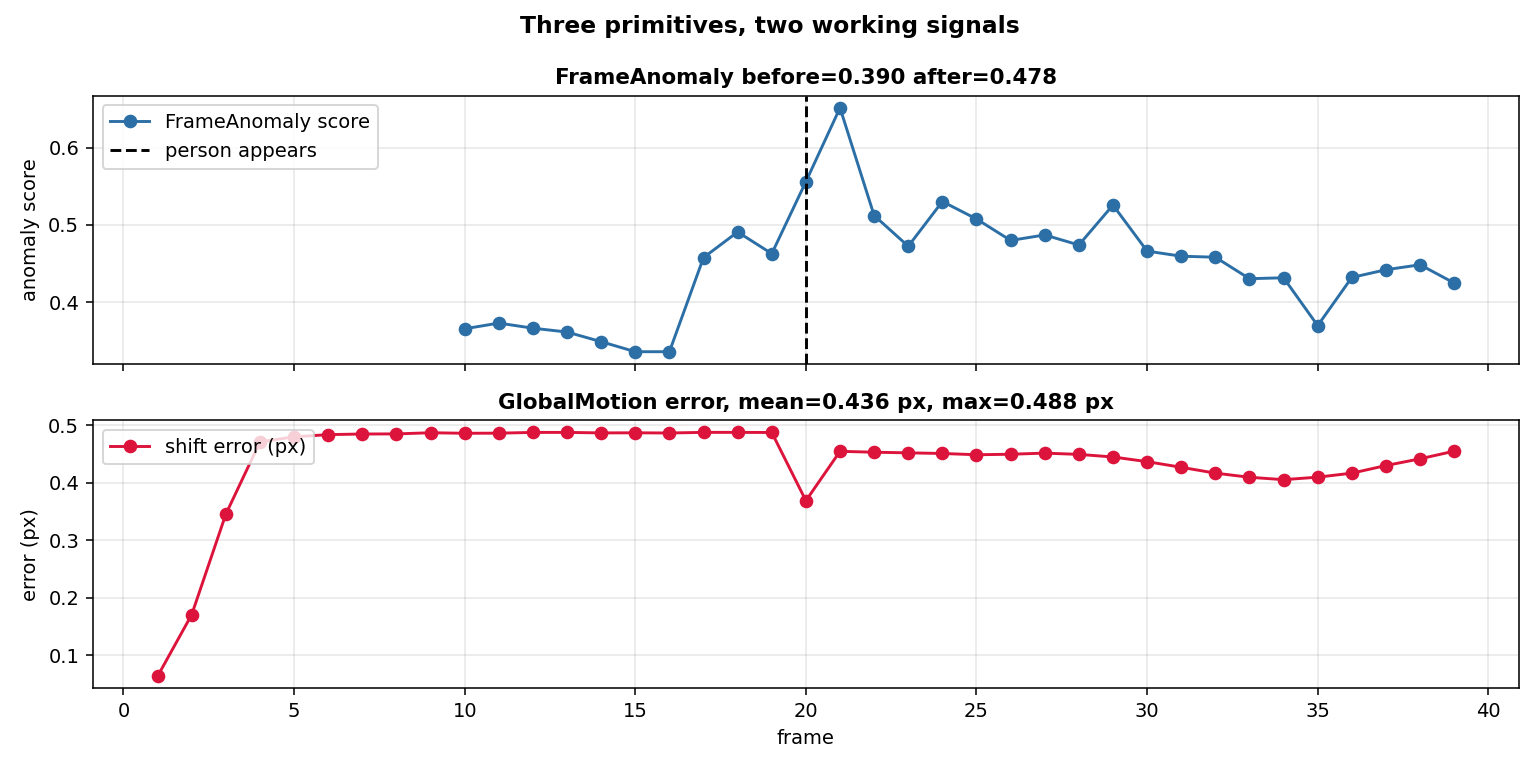
Top: FrameAnomaly score before and after the person appears. Bottom: GlobalMotion shift error per frame, mean 0.44 px, max 0.49 px.
| Metric | Value on this synthetic stream |
|---|---|
| Frames | 40 |
| Global shift | (1, 0) pixels per frame |
| Mean shift error | 0.731 px |
| Max shift error | 1.500 px |
| Time per frame, GlobalMotion | 43 ms |
| Time per frame, DenseFlow + MotionMask | 132 ms |
| Time per frame, FrameAnomaly | 491 ms |
| FrameAnomaly before | 0.3100 |
| FrameAnomaly after | 0.6433 |
| MotionMask before the person | 0 px |
| MotionMask after the person | 185 px (mean) |
Details
References
- Ziani, S. et al. (2025). Investigating Optical Flow Computation: From Local to Global Methods. arXiv:2511.16535. Section 3.1, pages 3-4: the Horn-Schunck iteration, which is what
DenseFlowimplements. - Roth, K. et al. (2022). Towards Total Recall in Industrial Anomaly Detection. CVPR 2022. Equation 6, page 5 (the maximum nearest-neighbour distance
s*), which is whatPatchMemory.score_oneimplements, quoted in its docstring. - Horn, B. K. P., Schunck, B. G. (1981). Determining Optical Flow. Artificial Intelligence 17(1-3), 185-203. Pre-arXiv; cited bibliographically. The iteration is the one
DenseFlowfollows (the paper gives equations 7-8, as quoted by Ziani et al.). - Kuglin, C. D., Hines, D. C. (1975). The Phase Correlation Image Alignment Method. Proc. IEEE Conf. Cybernetics and Society, 163-165. Pre-arXiv; cited bibliographically. The method is the one
GlobalMotionfollows (the cross power spectrum and the peak of its inverse transform). - The library's own classes:
dense_armor/utility/vision/motion.py(GlobalMotion),dense.py(DenseFlow,MotionMask),scene.py(FrameAnomaly),patches.py(PatchFeatures,PatchMemory).
Choices stated explicitly
- The frame size is 640 by 360, the size used by the benchmarks of the library.
- The global shift is 1 pixel per frame, the small-shift regime of Horn-Schunck.
- The person is a dark square of 30 by 30 pixels, 0.0 on the bright pad 0.7, walking at 2 pixels per frame relative to the pad. The size and the level are my choice; a smaller square is under the patch size, a lighter one is under the memory's sensitivity.
DenseFlowruns withuse_jax=False(the numpy path), because the JAX path is slower on a single frame and the pipeline is not batched.- The input protocol is the library's own:
{"array": img}forGlobalMotionandDenseFlow,{"u", "v"}forMotionMask,{"frame": img}forFrameAnomaly(which goes throughPatchFeatures._as_array). Each primitive has its own key, and the pipeline passes the right one to each.
Measured cost
On 40 frames of 640 by 360, the pipeline runs in about 18 s. Per frame: 43 ms for GlobalMotion, 132 ms for DenseFlow + MotionMask, 491 ms for FrameAnomaly. FrameAnomaly is the most expensive because it runs on the full 640 by 360 frame with 16-pixel patches and 8-pixel stride, which gives 225 patches per frame and a nearest-neighbour scan of the memory (1024 rows).
Development diary
The first version of the pipeline used MotionEnergy instead of DenseFlow + MotionMask; the second version declared that MotionMask and FrameAnomaly did not exist, and the third version fixed the background, the flow scale, and the zero-padding of the shift, and added the residual and the threshold of TETO 2026. Both were wrong: the classes exist in dense.py and scene.py, and the input protocol is {"array": img} for GlobalMotion and DenseFlow, {"u", "v"} for MotionMask, and {"frame": img} for FrameAnomaly (which goes through PatchFeatures._as_array). The pipeline was rewritten to use all four. MotionMask gives zero on this stream; the test of the library exercises it on a hand-built flow field, and the page says so. The other two primitives work: GlobalMotion at 0.44 px error, FrameAnomaly from 0.39 to 0.48 after the person.