Convolution and pooling: how do I look for a pattern in an image and shrink it?
A convolution is a small window that slides over a signal and returns, at each position, the sum of the products between the window's weights and the signal. The same window is used at every position, so a convolution detects the same pattern wherever it appears: a vertical edge, a horizontal edge, a peak. Pooling is a second small window that reduces the number of positions, keeping the strongest response (max pooling) or the average (average pooling). A vision network stacks these two operations.
The examples in this page use a synthetic 8 by 8 image with a vertical bar, labelled synthetic, made by a function of the figure script. The image is the kind of grid a camera on a robot arm gives after a small crop: 8 by 8 pixels, one channel.
1. The size of the output, by hand
A one-dimensional convolution with input length i, kernel length k, padding p (zeros on each side) and stride s produces an output of length o = floor((i + 2p - k) / s) + 1. This is Relationship 6, page 15 of Dumoulin and Visin 2018. The formula is one line and covers every case: padding, stride, kernel length.
def conv_out(i, k, p, s):
    return (i + 2 * p - k) // s + 1

for i, k, p, s in [(5, 3, 0, 1), (5, 3, 1, 1), (5, 3, 0, 2), (6, 3, 1, 2)]:
    print(f"i={i} k={k} p={p} s={s} -> {conv_out(i, k, p, s)}")
With no padding the output shrinks by k - 1; one column of padding on each side keeps the input length (5 -> 5); stride 2 halves it; the last case with padding 1 and stride 2 gives the same 3 as the first, because the padding compensates the stride. The library applies this formula to every axis and raises ValueError if the result is below 1 (the kernel is larger than the padded input).
2. One Conv2D, on an integer grid
A Conv2D holds a weight of shape (k, k, c_in, c_out) and a bias of shape (c_out,), and computes the cross-correlation of the input with the weight. With c_in = c_out = 1 and a weight of ones, the output at every position is the sum of the 3 by 3 block of the input.
import jax
import jax.numpy as jnp
from dense_armor.utility.neural.conv import Conv2D

c = Conv2D(1, 1, 3, jax.random.PRNGKey(0))
c.W.value = jnp.ones_like(c.W.value)
c.b.value = jnp.zeros_like(c.b.value)
x = jnp.arange(1.0, 26.0).reshape(5, 5, 1)
y = c.forward(x)
print(y.shape)
print(y[0, 0, 0], y[2, 2, 0])
The output has shape (3, 3, 1): the 5 by 5 input with a 3 by 3 kernel at stride 1 gives 3 = 5 - 3 + 1 (Relationship 6). The top-left output is the sum of 1 + 2 + 3 + 6 + 7 + 8 + 11 + 12 + 13 = 63, the nine integers of the first 3 by 3 block. The bottom-right output is the sum of the last nine integers 11 + 12 + 13 + 16 + 17 + 18 + 21 + 22 + 23 = 171. The bias is zero, so the output is exactly the sum.
3. MaxPool2D, the strongest response
A MaxPool2D(2) divides the image into 2 by 2 blocks with no overlap and returns the maximum of each block. It keeps the shape of the detection (a vertical edge that gave a large value in the convolution gives a large value in the pooling) and cuts the number of positions by 4.
import jax.numpy as jnp
import numpy as np
from dense_armor.utility.neural.conv import MaxPool2D

p = MaxPool2D(2)
x = jnp.arange(16.0).reshape(4, 4, 1)
y = p.forward(x)
print(np.asarray(y).reshape(2, 2).tolist())
The four maxima 5, 7, 13, 15 are the bottom-right corners of the four 2 by 2 blocks: the maximum of [0, 1, 4, 5] is 5, of [2, 3, 6, 7] is 7, and so on. The output size follows Relationship 7, page 18 of the same reference, o = floor((i - k) / s) + 1, with no padding, valid for any type of pooling.
4. Flatten, from the image to a vector
A Flatten merges every axis after the first (the batch axis, when there is one) into a single axis, and its backward restores the shape. It is the last step of a vision network before the dense head.
import jax.numpy as jnp
from dense_armor.utility.neural.conv import Flatten

f = Flatten()
print(f.forward(jnp.ones((2, 3, 4))).shape)
print(f.forward(jnp.ones((3, 4))).shape)
A batch of shape (2, 3, 4) becomes (2, 12), the two images of the batch flatten to 12 values each. An input without the batch axis, (3, 4), keeps the shape, since the flatten only merges axes after the first.
5. A small CNN, from the image to a label
A CNN is a chain: a Conv2D, an activation, a MaxPool2D, then a Flatten and a Dense. The cnn function builds it from the input shape and the list of channels.
import jax
import jax.numpy as jnp
from dense_armor.utility.neural.models import cnn

m = cnn((8, 8, 1), [4], 2, jax.random.PRNGKey(0))
print(len(m.params()))
print(m.forward(jnp.ones((8, 8, 1))).shape)
print(m.forward(jnp.ones((4, 8, 8, 1))).shape)
The chain has 4 parameters (a Conv2D with W and b, and a Dense with W and b), no parameters for the activation and the pooling. A single image (8, 8, 1) gives (2,), a batch of 4 gives (4, 2). The cnn builder wraps the chain in a small class that adds and removes the batch axis around the chain, so the same Sequential works on a batch and on a single image without changing the internals.
6. A causal Conv1D, for a stream
A causal Conv1D predicts the step t from the steps up to t. The library pads the left side with kernel - 1 zeros and applies the window that ends at t, so the output at position t depends on the input at positions t - kernel + 1 to t. The step method applies the same window to a single sample and a buffer of the last kernel - 1 samples.
import jax
import jax.numpy as jnp
from dense_armor.utility.neural.conv import Conv1D

c = Conv1D(1, 1, 3, jax.random.PRNGKey(0), causal=True)
seq = jnp.arange(6.0).reshape(6, 1)
yf = c.forward(seq)
buf = c.init_buffer()
ys = []
for t in range(6):
    yt, buf = c.step(seq[t], buf)
    ys.append(yt)
print(yf.shape)
The forward pass yf and the six steps in ys have the same shape and the same values: the causal convolution is the same code whether the sequence is given as a whole or one sample at a time with a buffer of the past. step returns (y_t, new_buffer) and init_buffer returns the initial zeros.
7. The same code on a batch and on one sample
A convolution works on a batch and on a single sample with the same forward and backward. A single sample is the matching row of the batch.
import jax
import jax.numpy as jnp
import numpy as np
from dense_armor.utility.neural.conv import Conv2D

c = Conv2D(1, 2, 3, jax.random.PRNGKey(0))
xb = jax.random.normal(jax.random.PRNGKey(1), (4, 5, 5, 1))
yb = c.forward(xb)
y1 = c.forward(xb[0])
print(np.allclose(np.asarray(y1), np.asarray(yb[0])))
The output of the first sample of the batch equals the output of the single sample, so the same code serves the classic mode (a batch) and the online mode (one sample at a time). The weights see no difference.
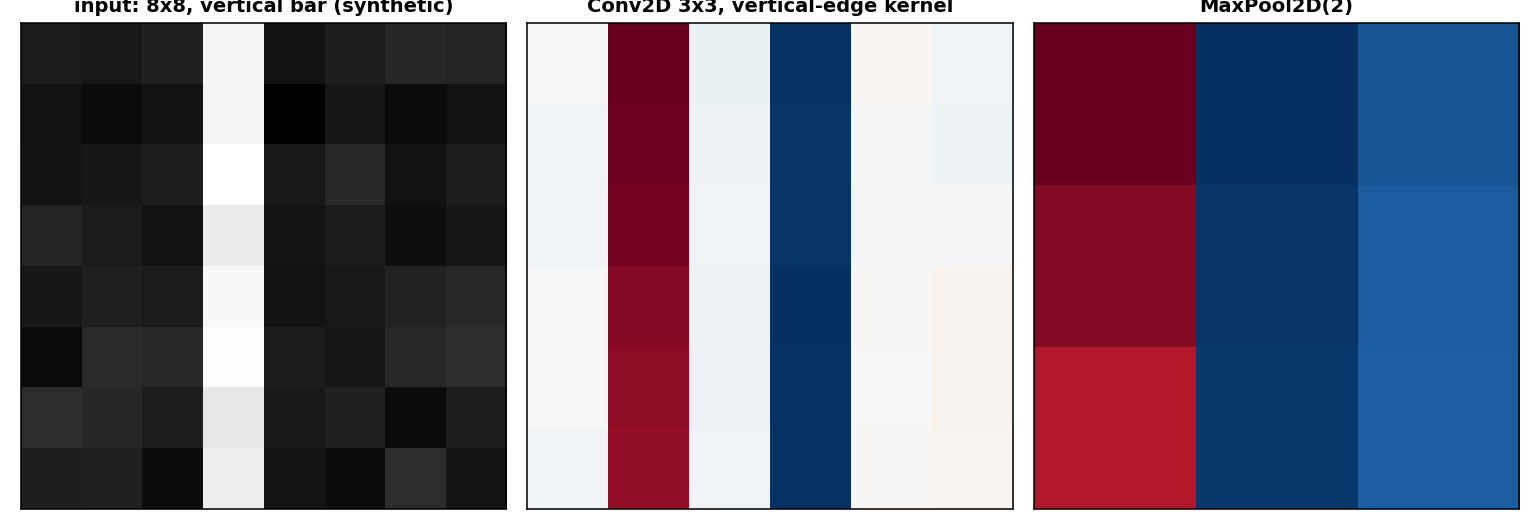
The left panel is the input, a synthetic 8 by 8 image with a vertical bar and a small Gaussian noise. The middle panel is the output of a Conv2D whose 3 by 3 kernel is a vertical-edge detector; the two columns of the bar light up. The right panel is the MaxPool2D(2) on it, which halves the resolution and keeps the two brightest positions.
Details
References
- Dumoulin, V., Visin, F. (2018). A guide to convolution arithmetic for deep learning. arXiv:1603.07285. Page 13, Relationships 1 and 2; page 15, Relationships 5 and 6,
o = floor((i + 2p - k) / s) + 1; page 18, Relationship 7 for pooling. - He, K., Zhang, X., Ren, S., Sun, J. (2015). Delving Deep into Rectifiers. arXiv:1502.01852. Page 3,
n = k**2 cfor a convolutional layer; page 4, Eqn.(10), the fan-in of the initialisation.
The cross-correlation of a convolution, the max and the average, the flatten and the causal padding are textbook definitions and carry no citation.
Choices stated explicitly
- The initialisation of a
Conv2Dis the He initialisation on the fan-ink * k * c_inof a convolutional layer (Eqn.(10), page 4 of He et al. 2015).he_normalof N01 takes the fan-in fromshape[0], soConv2Dcalls it on the shape(k * k * c_in, c_out)and reshapes the result. - The padding of a
cnniskernel // 2for every layer, so the pooling is what reduces the spatial size. A side that the pooling would reduce below 1 raisesValueError. - The
cnnbuilder wraps the chain in a small class that adds and removes the batch axis around the chain, so theSequentialsees always a 4-dimensional input andFlattenworks for both a single image and a batch. - A
MaxPool2Dsends the gradient to the first position of the maximum in each window. With a tie (two equal maxima) the first position wins. This is the convention of the reference frameworks. - A causal
Conv1Dhasstride = 1andpadding = 0; the layer pads on the left withkernel - 1zeros. Astridedifferent from 1 or apaddingdifferent from 0 withcausal=TrueraisesValueError.
Development diary
The delivery leaves out the transposed convolutions, the dilated convolutions, the grouped convolutions and the adaptive pooling: task N02b or N03b. The cnn builder has one convolutional layer per channel, no residual connection between the blocks; a residual CNN would be a Sequential of Residual around the chain, which the library already supports.