Separating sources
This page splits a sound into parts. The method is the non-negative matrix factorisation of Lee and Seung (2001), applied to the magnitude of the short-time Fourier transform.
1. Factorise a matrix
nmf(V, rank, n_iter, cost, seed) writes a non-negative matrix V as the product W H of two non-negative matrices with rank columns and rows, by multiplicative updates: each update multiplies the matrix by a ratio, so a value that starts positive stays positive. With cost="euclidean" it follows Eq. (4) of the paper and with cost="divergence" Eq. (5); by the theorems of the paper the cost does not increase at any update. It returns W, H and the cost after every iteration.
import numpy as np
from dense_armor.core.audio import nmf

rng = np.random.default_rng(1)
V = rng.random((12, 3)) @ rng.random((3, 20))
W, H, cost = nmf(V, 3, 300, "euclidean", seed=1)
print(all(cost[i + 1] <= cost[i] + 1e-9 for i in range(len(cost) - 1)))
print(bool(np.linalg.norm(V - W @ H) / np.linalg.norm(V) < 0.05))
A denominator is floored at 1e-12 so that it never divides by zero, which the paper does not discuss.
2. Split a sound
separate(audio, rank, n_fft, hop, n_iter) takes the magnitude spectrogram of a mono sound, factorises it, and rebuilds each component with the phase of the mixture. The parts add back to the mixture only up to the error of the factorisation, because the phase is the one of the mixture.
import numpy as np
from dense_armor.core.audio import Audio, separate

sr = 8000
t = np.arange(sr * 2) / sr
x = np.where(t < 1, np.sin(2 * np.pi * 440 * t), np.sin(2 * np.pi * 1000 * t))
parts = separate(Audio(x, sr), 2, 512, 256, 200)
peaks = sorted(round(float(np.abs(np.fft.rfft(c)).argmax() * sr / len(c))) for c in parts)
print(len(parts), peaks)
A tone of 440 Hz in the first second and a tone of 1000 Hz in the second: the two parts have their spectral peaks at 440 and 1000 Hz.
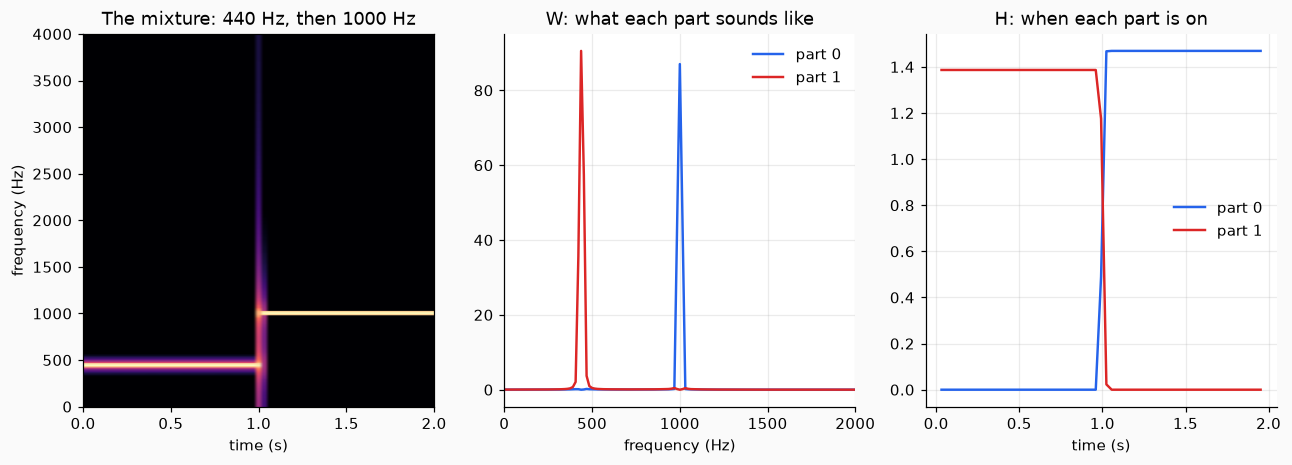
The factorisation of the example. Left, the spectrogram of the mixture. Middle, the columns of W: each part has one spectral peak, at 440 Hz and at 1000 Hz. Right, the rows of H: each part is on in one of the two seconds.