Rule synthesis
What it is
Some tasks of the ARC-AGI benchmark repeat the same change on the objects of a grid: recolour every object of colour 1 to colour 3, or move every object that touches the border one cell down. A program of transformations does not say "every object"; it says "this grid". A rule says "every object that matches this predicate".
The library ships one function for this: synthesize(task). It reads the
training pairs, compares input and output object by object, and returns a
short list of rules. A rule is a pair (selector, effector).
- A selector is a list of predicates on
ArcObject. An empty list selects every object.has_color(1),is_largest,is_smallest,area_gt(2)are examples. - An effector is a change applied to the objects the selector matches:
recolour,delete,translate,fill_holes,fill_bg, and the global changesrot90,hmirror,upscale, etc. - A rule list is a list of rules, applied to the grid in order.
Why use it: a rule on objects generalises better than a program that acts on
the whole grid. A program rot90 says "the whole grid turns"; a rule
has_color(1) -> recolour(3) says "every shape of colour 1 becomes colour 3",
which is the right rule even if the grid has a shape of colour 2 that does
not change.
The example on this page is a task whose rule is recolour every object of colour 1 to colour 3.
1. Compare two grids
diff_graphs(grid_in, grid_out) matches the objects of the two grids, and
returns four things: matched (pairs (i, j) of objects that are the same
object in the two grids), created (objects of the output with no
correspondent in the input), deleted (objects of the input with no
correspondent in the output), and the two Level 2 node sets. The matching is
a Linear Assignment Problem on a cost matrix of shapes, colours and
positions.
from dense_armor.core.graph import Grid, extract_objects
from dense_armor.core.graph.graph_diff import diff_graphs

g_in = Grid.from_list([[1, 1, 0], [1, 0, 0], [0, 0, 2]])
g_out = Grid.from_list([[3, 3, 0], [3, 0, 0], [0, 0, 2]])
for tag, g in (("in", g_in), ("out", g_out)):
    for o in extract_objects(g):
        print(tag, o.color, o.area, o.bbox)
print(diff_graphs(g_in, g_out)["matched"])
in 1 3 (0, 0, 2, 2)
in 0 5 (0, 0, 3, 3)
in 2 1 (2, 2, 3, 3)
out 3 3 (0, 0, 2, 2)
out 0 5 (0, 0, 3, 3)
out 2 1 (2, 2, 3, 3)
[(0, 0), (1, 1), (2, 2)]
The input has three objects: a shape of colour 1 (3 cells), the background of colour 0 (5 cells), and a single cell of colour 2. The output has the same three objects, with the first one recoloured. The matching pairs them in the obvious way: object 0 with object 0, object 1 with object 1, object 2 with object 2. Nothing created, nothing deleted.
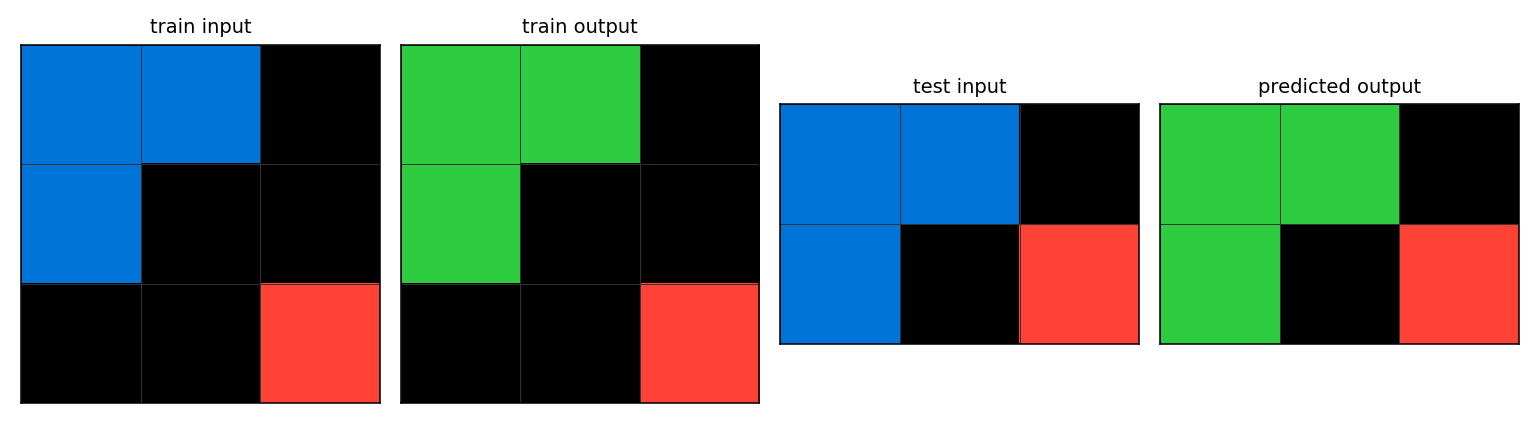
Left: the training pair. Right: the test input and the output that
synthesize predicts.
2. Synthesise the rules
synthesize(task) takes the whole task and returns the shortest list of
rules that reproduces every training output exactly. If no such list exists,
it returns None.
from dense_armor.core.graph import synthesize

task = {"train": [{"input": [[1, 1, 0], [1, 0, 0], [0, 0, 2]],
                   "output": [[3, 3, 0], [3, 0, 0], [0, 0, 2]]}],
        "test": [{"input": [[1, 1, 0], [1, 0, 2]]}]}
rules = synthesize(task)
print(len(rules), rules[0].selector, rules[0].effector.kind.value)
One rule, with a single predicate has_color(1) and the effector recolor.
The rule says "every object of colour 1 is recoloured". The target colour is
in rules[0].effector.to_color, which is 3.
3. Render the rules on a grid
render(grid, rules, L2) applies a list of rules to a grid. The third
argument is the Level 2 node set of the grid, computed by level2_nodes; the
rules that act on Level 2 nodes need it, the others ignore it.
from dense_armor.core.graph import Grid, extract_objects, render, synthesize
from dense_armor.core.graph.graph_diff import level2_nodes

task = {"train": [{"input": [[1, 1, 0], [1, 0, 0], [0, 0, 2]],
                   "output": [[3, 3, 0], [3, 0, 0], [0, 0, 2]]}],
        "test": [{"input": [[1, 1, 0], [1, 0, 2]]}]}
g = Grid.from_list(task["train"][0]["input"])
L2 = level2_nodes(g, extract_objects(g))
print(render(g, synthesize(task), L2).to_list())
The input is the same of step 1; the output is the training output, because the rule says "recolour colour 1 to colour 3". A different grid goes through the same rule and produces a different output that follows the same rule.
4. Write the submission
apply_to_test(rules, task) keeps the "train" list as it is and fills
each "test" entry with the output of render on the test input.
from dense_armor.core.graph import apply_to_test, synthesize

task = {"train": [{"input": [[1, 1, 0], [1, 0, 0], [0, 0, 2]],
                   "output": [[3, 3, 0], [3, 0, 0], [0, 0, 2]]}],
        "test": [{"input": [[1, 1, 0], [1, 0, 2]]}]}
sub = apply_to_test(synthesize(task), task)
print(sub["test"][0]["output"])
The test input has an object of colour 1 (the three cells top-left), an object of colour 2 (one cell), and background. The rule recolours the first object from 1 to 3, and leaves the second alone.
Details
synthesize has three stages. First, extract_positives compares the
objects of every training pair and finds, for each effector, the objects the
effector was applied to. Second, synthesize_selector_global finds a
predicate list of at most three atoms that selects exactly those objects and
no others, on every training pair. Third, synthesize chooses the shortest
combination of rules (by Minimum Description Length) that reproduces every
training output exactly.
diff_graphs uses a Linear Assignment Problem (LAP) on a cost matrix that
combines shape, area, holes, centroid distance and colour. The cost of an
unmatched object is TAU_NULL, a constant larger than any real pair; the
matrix is square, with one row and one column added per object of each
grid. The matching is the scipy.optimize.linear_sum_assignment solution.
level2_nodes produces the four kinds of Level 2 nodes: background (one
node with the colour of the background), frame (one node per object that
touches all four borders of the grid), alignment_group (one node per group
of at least two objects with the same row or column of the centroid), and
cavity (one node per hole of an object). A rule whose effector is
fill_l2 reads one of these nodes.
render applies the rules in order. Global effectors (rot90, hmirror,
upscale, downscale, dmirror, vmirror, rot180, rot270) are
applied first, on the whole grid. Object effectors are applied one at a
time on the result: the grid is rebuilt after each rule, and the objects are
re-extracted, so a later rule sees the effect of an earlier one.
apply_to_test does not check that the rules solve the training pairs; a
user who wants to check calls render on every training pair, as step 3
does.
The Predicate and Effector classes are the two halves of a rule. A
Predicate is a (kind, arg) pair, where kind is one of ten predicate
types (has_color, area_gt, is_largest, is_smallest, has_hole,
is_rectangular, is_square, touches_border, area_lt, rank). An
Effector is a (kind, ...) tuple with more fields: recolor has a
to_color, translate has a dr and dc, clone has a source_idx, and
so on.
References
The Minimum Description Length (MDL) criterion for choosing between
programs is the one of DreamCoder (Ellis and others, arXiv:2006.08381,
Section 3): a program that is shorter to describe is more likely to be the
right one. synthesize chooses the combination of rules with the smallest
total mdl_bits(), which is the MDL of the rule set.
The rule list as a sequence of (selector, effector) pairs, and the
preference for short selectors, is the style of the arc-dsl writeup (Hodel,
"The ARC-DSL", Section 2.3): a rule that applies to many objects with few
predicates generalises better.
The idea of a global effector (rotate the whole grid) and an object effector
(recolour one object) as two separate kinds is the one of Joffe and
Eliasmith (2025), arXiv:2511.08747, Table 1: the operations IDENTITY,
EXTRACT, RECOLOUR, RECENTRE, RESHAPE, MOVE, GRAVITY, GROW,
FILL, HOLLOW, GENERATE are object-level; here the same distinction is
used in EffectorType.
Choices stated explicitly
TAU_NULLis 1000.0. The cost of a real pair is bounded by the sum of the weights (shape 10, area 5, holes 5, centroid 1, colour 3), which is below 100.TAU_NULL = 1000is well above any real pair, so the LAP never chooses a "null" match when a real one is available. A user who changes the weights of_pair_costmust keep them belowTAU_NULL.- The L2 nodes are a dict, not part of the
TypedGraph. The four kinds of Level 2 nodes (background,frame,alignment_group,cavity) are not in theTypedGraphschema, because they are not needed by the typed-graph machinery (they have no constraints). They are a plain dict returned bylevel2_nodes, andrenderreads them by name. synthesizechooses the shortest rule list. When several lists reproduce the training outputs, the one with the smallest sum ofmdl_bits()wins. On ties, the shorter list wins.synthesizedoes not go beyond three predicates. The selectors insynthesize_selector_globalare lists of at most three atoms. A rule with four or more predicates is not considered, even if it would be the only one to separate the positives from the negatives.renderre-extracts the objects after each rule. This is why a later rule can see the effect of an earlier one. It also means the order of the rules matters:recolour(1, 3)thenrecolour(3, 5)gives a different grid fromrecolour(3, 5)thenrecolour(1, 3).- The
PredicateandEffectorclasses are not exported from the package. The two classes are inrule_synthesis.py, and onlyRule,synthesize,renderare in the package__all__. A user who wants to build a rule by hand importsPredicateandEffectorfromdense_armor.core.graph.rule_synthesis.