Resampling
This page changes the sample rate of a sound, and then makes the pitch glide without a click. The algorithm is the one of Falkenberg (2026), a preprint by one author.
1. A constant ratio
The Resampler reads the input at a step q per output sample. q = 2 reads at twice the speed: half as many output samples, an octave up. q = Fin / Fout converts a sample rate. Between two input samples it interpolates linearly (Algorithm 3), so the stopband is not that of a windowed FIR filter.
import numpy as np
from dense_armor.core.audio import Audio, Resampler, resample

t = np.arange(8000) / 8000
a = Audio(np.sin(2 * np.pi * 1000 * t), 8000)
y = resample(a, 2.0)
print(y.sr, y.n, round(y.duration, 3))
print(Resampler(1.5).update_many(np.arange(7.0)).round(2).tolist())
resample(audio, ratio) converts a whole mono Audio. Resampler(q) takes input in blocks, keeps the read position between calls, and gives the same output as the whole signal at once. Resampler(q, gain=G) multiplies the output by the gain G of Algorithm 3.
2. A ratio that changes
set_ratio(q) changes the step at any time and the read position stays continuous, so there is no click. Algorithm 4 gives the path of a pitch change: pitch_ratio_transition(p_start, p_target, fin, fout, steps, mode) returns the steps q, linear in the ratio ("ratio-linear") or linear in cents ("cents-linear", which is how the ear hears an interval). Give each step to set_ratio.
from dense_armor.core.audio import pitch_ratio_transition, rational_ratio

q = pitch_ratio_transition(1.0, 2.0, 8000, 8000, 4, "cents-linear")
print(q.round(4).tolist(), rational_ratio(1.5, 4))
An octave in four equal steps of 300 cents. rational_ratio(q, b) writes the step as a fraction of two integers D / U (page 3 of the paper): A = round(b q), then divide A and b by their greatest common divisor. Here (3, 2) is D and U with D / U = 1.5.
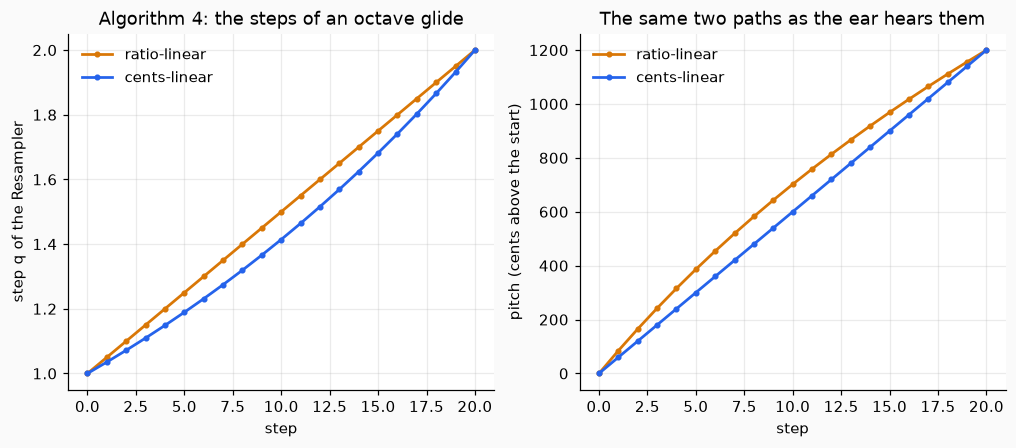
An octave in 20 steps. Left, the step q given to set_ratio; right, the pitch it gives, in cents: the cents-linear path is a straight line, the ratio-linear one rises faster at the start.