Sound, files and frequency
This page holds a sound in a value, saves and reads it as a WAV file, and looks at it by frequency.
1. A sound is an Audio
Audio(x, sr, t0) holds the samples x (one channel, shape (n,), or several, shape (n, channels)), the sample rate sr in Hz and the time t0 of the first sample in seconds. It checks that sr is positive and that x has one or two dimensions.
import numpy as np
from dense_armor.core.audio import Audio

a = Audio(np.zeros(8000), 8000)
print(a.n, a.channels, a.duration)
print(Audio(np.zeros((8000, 2)), 8000).to_mono().channels)
to_mono() returns the mean of the channels.
2. Make a sound and save it
A plucked string is the simplest sound that needs no input file: a burst of random values that dies away. plucked_string(440.0, 8000, 0.5) makes half a second of it at 440 Hz with 8000 samples per second.
from dense_armor.core.audio import plucked_string, read_wav, write_wav

a = plucked_string(440.0, 8000, 0.5)
write_wav("pluck.wav", a)
b = read_wav("pluck.wav")
print(b.sr, b.n, round(b.duration, 2))
write_wav writes 16-bit PCM by default (pcm24, pcm32 and float32 are also available). read_wav returns an Audio with the samples as floats in [-1, 1). A file it cannot decode raises ValueError and the message names the format found.
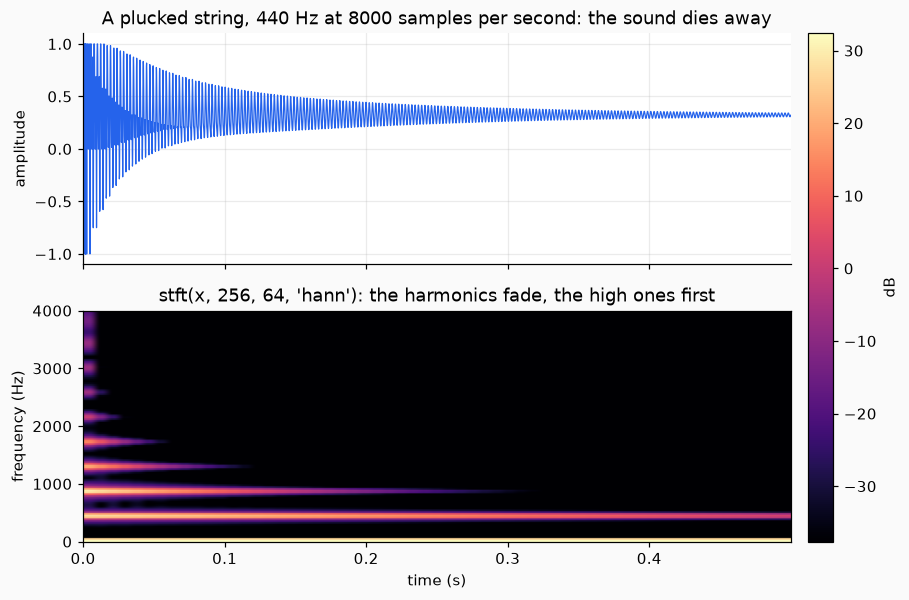
Above, the waveform of the plucked string: it dies away, but not to zero. The random burst does not average to zero, and Karplus and Strong note that the tone decays to a constant value, which is the bright line at 0 Hz below. Below, the harmonics of 440 Hz fade, the high ones first; the spectrogram is explained in the next step.
3. Look at it by frequency, and go back
The short-time Fourier transform cuts the sound into overlapping frames, multiplies each by a window and takes its spectrum. The windows are rectangular, hann, hamming and blackman, each in a periodic and a symmetric form (Harris 1978). With a Hann window and a hop of half the frame, adding the inverse of the frames gives the sound back exactly in the middle of the signal (overlap-add, Allen and Rabiner 1977).
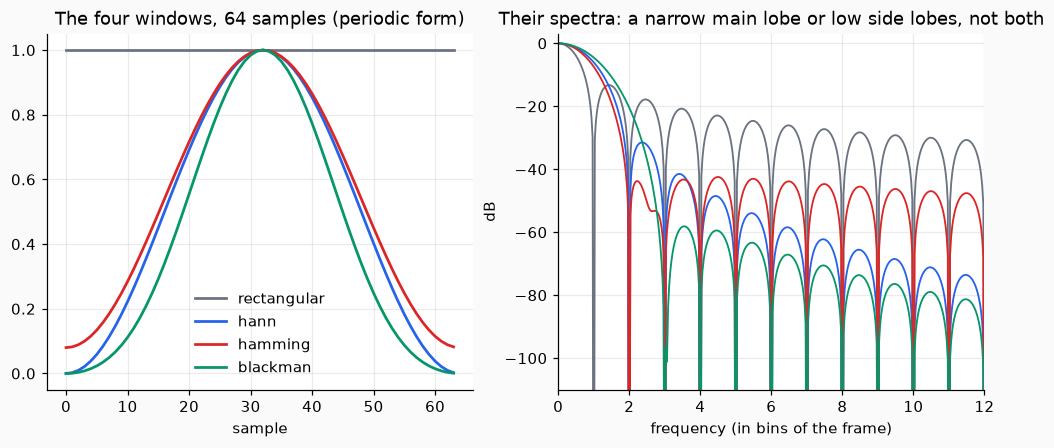
Left, the shape of each window. Right, how much each lets leak into the other frequencies: the rectangular window has the narrowest main lobe and the highest side lobes, the Blackman window the lowest side lobes and the widest lobe.
import numpy as np
from dense_armor.core.audio import istft, read_wav, stft

b = read_wav("pluck.wav")
S = stft(b.x, 256, 128, "hann")
y = istft(S, 128, "hann", 256)
print(S.shape, bool(np.max(np.abs(y[128:-128] - b.x[128:len(y) - 128])) < 1e-9))
There are 30 frames of 129 frequencies each. The first and last frames do not have all the overlaps, so they are not rebuilt exactly; istft says so in its docstring.
cola_ok(window, hop) tells you whether a window and a hop can be inverted this way. istft raises ValueError if they cannot.
4. One sample at a time
StreamingSTFT(n_fft, hop, window) gives the same spectra from a stream: push samples, and a spectrum is ready after the first n_fft samples and then every hop samples. Dense-Armor also has SDFT, the sliding DFT of the last N samples with a rectangular window, in dense_armor.core.signals.stats; StreamingSTFT adds the hop and the other windows.