Events and streams
This page reads sound from a file or a live input, turns each block into a few numbers, and finds the moment something happens. Everything here uses estimators that Dense-Armor already had.
1. Blocks from a file
AudioFileStream(path, block, hop) yields blocks of block samples every hop samples from a WAV file (hop defaults to block). The t0 of a block is the index of its first sample divided by the sample rate. A last block shorter than block is not yielded.
from dense_armor.core.audio import AudioFileStream, plucked_string, write_wav

write_wav("pluck.wav", plucked_string(440.0, 8000, 0.5))
blocks = list(AudioFileStream("pluck.wav", 1024))
print(len(blocks), [round(b.t0, 3) for b in blocks])
2. Blocks from a live input
AudioLiveStream(sr, block, queue_size, device) takes blocks from a sound card through the library sounddevice (the extra audio), imported only when you build the stream. A callback puts each block in a bounded queue; when the queue is full the block is dropped and dropped grows by one, so a slow reader never blocks the input. read(timeout) returns the next block, or None. Any object with start(), stop() and close() can replace the sound card through the backend argument, which is how the tests run it without one.
3. A block becomes a few numbers
AudioFeatures(n_bands) takes the magnitude of the spectrum of a block (windowed, as in the short-time Fourier transform) and averages it in n_bands groups of nearly equal size. The keys are b0 .. b{n_bands-1}, always the same, so the dict goes straight into learn_one of any estimator. This grouping is a choice made here: no source defines it. A block with fewer frequency bins than bands raises ValueError.
4. The moment something happens
detect_events(blocks) scores the first band of each block against the blocks before it with HampelScorer (the score of a value against the median and the spread of the values that precede it) and gives the score to a CUSUMDriftDetector. It returns the start time and score of each block where the detector fires. Here is noise for three seconds with a 440 Hz tone that starts at two seconds:
import numpy as np
from dense_armor.core.audio import Audio, detect_events, white_noise

t = np.arange(24000) / 8000
x = 0.1 * white_noise(24000, 1) + np.where(t >= 2.0, np.sin(2 * np.pi * 440 * t), 0.0)
bl = [Audio(x[i:i + 512], 8000, i / 8000) for i in range(0, 24000 - 511, 512)]
print(detect_events(bl)[0][0])
The first alarm is at 1.984 s: the block that starts at 1.984 s ends at 2.048 s and contains the start of the tone. The same function takes the blocks of AudioFileStream (a file) or AudioLiveStream (a live input), and gives the same alarms for the same samples.
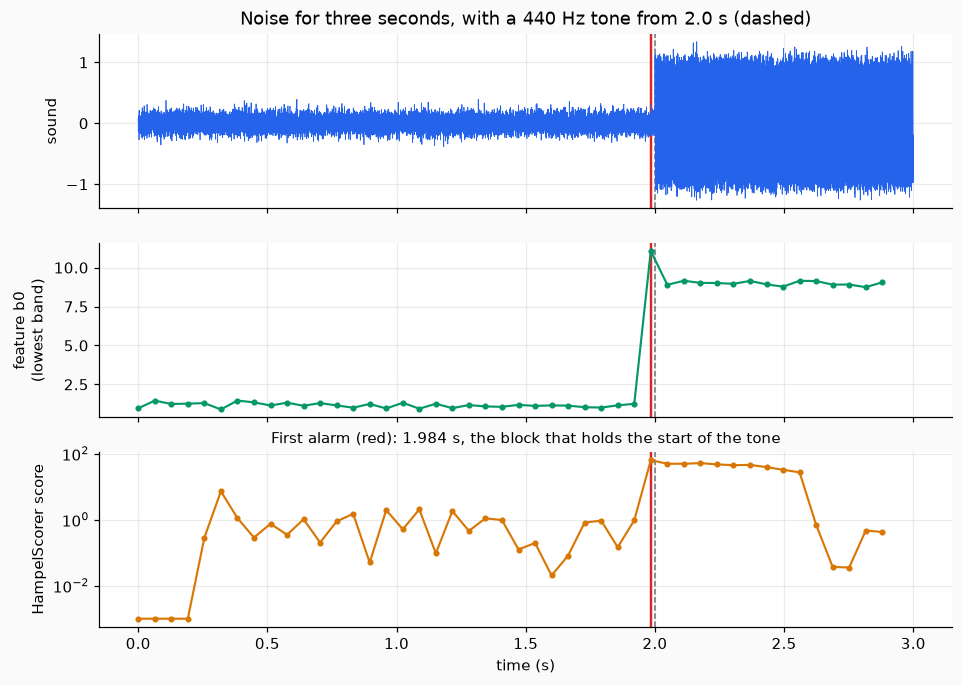
From the top: the sound; the feature b0 of each block, which jumps when the tone starts; the score of HampelScorer, which is 0 for the first blocks (the window is not full) and then high while the tone is new, and falls when the median of the window catches up; and the first alarm (red line), a little before the dashed start of the tone because the block that contains it starts at 1.984 s.
5. Any estimator, in the form it takes
detect_events is one path built by hand. AudioInput(primitive) is the general one: it gives a block of sound to any primitive of Dense-Armor, in the form the primitive takes (the table is in the overview), and run(blocks, label) feeds every block of a stream. When a primitive raises on the dict, the adapter tries again with one number, and from then on gives it the number.
run_estimators(blocks, {"name": primitive, ...}, label=...) does the same for several primitives at once and computes the features of each block one time. It returns, for each name, the mode, the number of blocks n, the last answer, the alarms, the error if the primitive raised (it is then not called again) and scalar. The tests run it with 27 estimators of the online anomaly, drift, cluster, classifier, regressor, tree, neighbour, time-series, scaler and statistics groups, on a synthetic signal.
import numpy as np
from dense_armor.core.audio import Audio, run_estimators
from dense_armor.core.online.anomaly.filters import HampelScorer
from dense_armor.core.online.drift.detector import CUSUMDriftDetector
from dense_armor.core.signals.preprocessing.scale import StandardScaler

rng = np.random.default_rng(1)
blocks = [Audio(rng.standard_normal(256), 8000, k * 256 / 8000) for k in range(12)]
rep = run_estimators(blocks, {"hampel": HampelScorer(), "cusum": CUSUMDriftDetector(), "scaler": StandardScaler()})
print({k: (v["mode"], v["n"], v["error"]) for k, v in rep.items()})