Vector Symbolic Algebras¶
What it is¶
A Vector Symbolic Algebra (VSA) is a way to represent structured data as high-dimensional vectors, with operations that compose and decompose the vectors. Two ideas are used on this page:
- HRR (Holographic Reduced Representations): an object is a vector, two
objects compose with
bind, decompose withunbind, and several objects sit together inbundle. - SSP (Spatial Semantic Pointers): a point of a 2D plane is encoded as a vector, and the similarity of two SSPs is high when the two points are close.
A VSA solver uses the two to solve a task of the ARC-AGI benchmark: the objects of a grid are encoded as vectors, a rule on objects becomes an operation on vectors, and the rule is found by comparing the vectors of the input and output objects.
Why use it: a rule on vectors is independent of the cell positions, and similarity is a cheap comparison. The two properties are what the paper of this page (Joffe and Eliasmith 2025, arXiv:2511.08747) uses to search over the space of rules.
The example on this page is the task "recolour every object of colour 1 to colour 3", solved by the VSA solver of this library.
1. HRR: bind, unbind, bundle¶
bind(a, b) combines two vectors into one. unbind(c, a) recovers b from
c = bind(a, b), up to noise. bundle(a, b, c) puts several vectors
together; the result is similar to each of the inputs, and the order of the
inputs does not matter.
import numpy as np
from dense_armor.core.graph import bind, bundle, random_unit_vector, similarity, unbind

rng = np.random.default_rng(0)
a = random_unit_vector(rng, 256)
b = random_unit_vector(rng, 256)
print(f"{similarity(unbind(bind(a, b), a), b):.4f}")
print(f"{similarity(bind(a, a), a):.4f}")
print(f"{similarity(bundle(a, b), a):.4f}")
bind is not its own inverse (the same vector bound twice is close to
orthogonal to the original: 0.0153), so unbind recovers the original only
approximately (0.7221). bundle keeps a memory of its inputs (0.7210 for
each), which is how a set of objects is stored as one vector. The numbers are
noisy on purpose: a VSA is a distributed representation, not a lookup table.
2. SSP: encode a point¶
SSPSpace(n, length_scale, seed) encodes a point (x, y) as a vector. Two
points that are close in the plane give vectors with high similarity; points
far apart give vectors that are nearly orthogonal.
import numpy as np
from dense_armor.core.graph import SSPSpace, similarity

ssp = SSPSpace(n=1024, length_scale=0.25, seed=0)
p00 = ssp.encode(np.array([0.0, 0.0]))
p05 = ssp.encode(np.array([0.5, 0.5]))
p10 = ssp.encode(np.array([10.0, 0.0]))
print(f"{similarity(p00, p00):.4f}")
print(f"{similarity(p00, p05):.4f}")
print(f"{similarity(p00, p10):.4f}")
A point is similar to itself (1.0). Two points half a unit apart have a
similarity of 0.016, indistinguishable from noise with this length_scale:
the kernel is narrow. Two points ten units apart are uncorrelated (-0.015).
The length_scale is the width of the kernel; it is a parameter of the
encoding, not a fixed constant.
3. Encode an object¶
ObjectEncoder encodes an object of a grid as a single vector, which combines
three properties: the colour, the centre and the shape.
from dense_armor.core.graph import ObjectEncoder

enc = ObjectEncoder(n=1024)
cells = [(0, 0), (0, 1), (1, 0)]
sp = enc.encode_object(cells, colour=2, grid_h=3, grid_w=3)
print(len(sp))
print(enc.decode_colour(sp))
The encoded vector has n components (1024 in this example). The colour of
the object can be recovered: decode_colour(sp) returns 2. The same works
for every colour of the grid (0 to 9), from 0 to 9.
4. Six object hypotheses¶
A grid can be cut into objects in more than one way. perceive(grid,
hypothesis, encoder) returns the objects under one of six hypotheses: 8- or
4-connected cells of the same colour, vertical or horizontal runs, all cells
of the same colour, or every non-zero cell as its own object.
from dense_armor.core.graph import Grid, ObjectEncoder, ObjectHypothesis, perceive

g = Grid.from_list([[1, 1, 0], [1, 0, 0], [0, 0, 2]])
enc = ObjectEncoder(n=1024)
for hyp in ObjectHypothesis:
    print(hyp.value, len(perceive(g, hyp, enc)))
On this grid, 8-connected and 4-connected find the same three objects
(the shape of colour 1, the background, the shape of colour 2).
vertical and horizontal cut the background into stripes, so they find
six. colour merges cells of the same colour regardless of position, so it
finds three. pixel ignores the background, so it finds four.
5. Eleven operations¶
execute_action(cells, colour, op_type, params, grid, encoder) applies one
of eleven operations (recolour, delete, translate, ...) to one object and
returns the resulting object, encoded as a vector.
from dense_armor.core.graph import Grid, ObjectEncoder, ObjectHypothesis, OperationParams, OperationType, execute_action, perceive

g = Grid.from_list([[1, 1, 0], [1, 0, 0], [0, 0, 2]])
enc = ObjectEncoder(n=1024)
o = [x for x in perceive(g, ObjectHypothesis.FOUR_CONNECTED, enc)
     if x.colour == 1][0]
r = execute_action(o.cells, o.colour, OperationType.RECOLOUR,
                   OperationParams(colour=7), g, enc)
print(sorted(r[0].cells), r[0].colour)
The cells are the same, the colour is 7. The eleven operations of this
library are IDENTITY, EXTRACT, RECOLOUR, RECENTRE, RESHAPE,
MOVE, GRAVITY, GROW, FILL, HOLLOW, GENERATE.
6. Solve¶
vsa_solve(task, encoder) runs the whole solver: it chooses an object
hypothesis, finds an action set that maps every input object to its
corresponding output object, and stores one rule per action. vsa_apply
applies the rules to a test grid.
from dense_armor.core.graph import Grid, ObjectEncoder, vsa_apply, vsa_solve

enc = ObjectEncoder(n=1024)
task = {"train": [{"input": [[1, 1, 0], [1, 0, 0], [0, 0, 2]],
                   "output": [[3, 3, 0], [3, 0, 0], [0, 0, 2]]}],
        "test": [{"input": [[1, 1, 0], [1, 0, 2]]}]}
program = vsa_solve(task, enc)
print(program.hypothesis.value, len(program.rules))
pred = vsa_apply(program, Grid.from_list(task["test"][0]["input"]), enc)
print(pred.to_list())
The solver picks 8-connected as the object hypothesis, finds two rules
(a recolour and an identity), and applies them to the test input. The test
input has a shape of colour 1 in the top-left; the rule recolours it to 3
and leaves the rest alone.
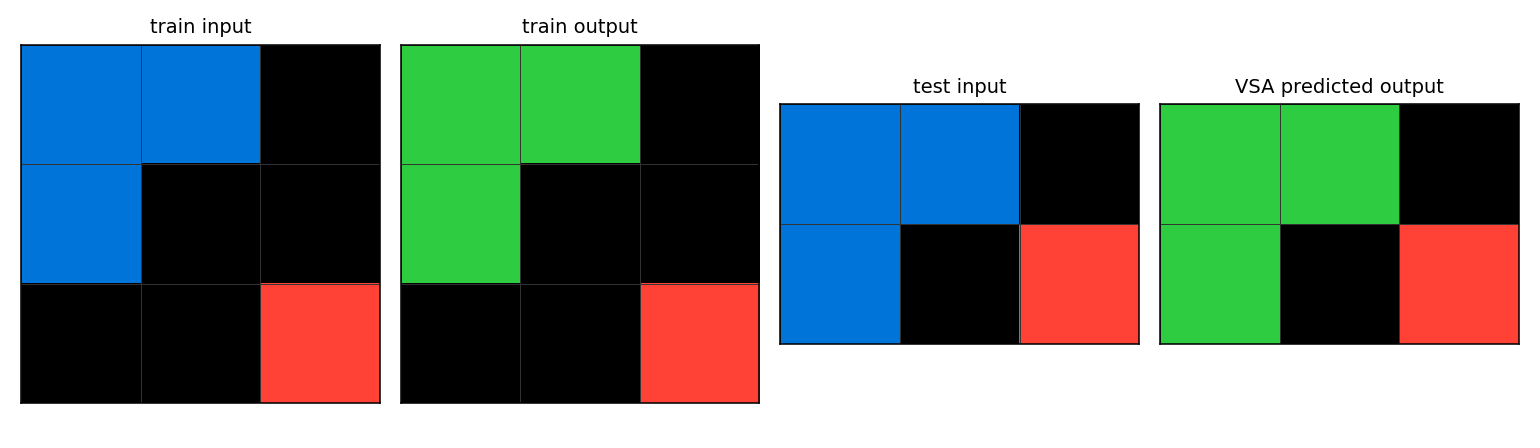
Left: the training pair. Right: the test input and the output that
vsa_solve predicts.
Details¶
vsa.py implements the two primitives, HRR and SSP. The HRR operations are
bind (circular convolution via FFT), unbind (circular correlation),
bundle (normalised sum), invert (reverse and roll), similarity (dot
product of unit-length vectors) and random_unit_vector. The SSPSpace
class implements equation 4 of the paper: φ(x) = F⁻¹ {exp(i Θᵀ x / l)}, with
a random phase matrix Θ and a length scale l.
vsa_objects.py implements ObjectEncoder, which encodes an object as the
bundle of three bindings: COLOUR * colour_SP, CENTRE * centre_SSP,
SHAPE * shape_SSP, with three fixed random role vectors. The three
properties are encoded in three subspaces and read back with unbind and a
similarity comparison.
vsa_hypotheses.py implements the six object hypotheses of Table 3 of the
paper (8-connected, 4-connected, vertical, horizontal, colour, pixel) and the
perceive function. vsa_operations.py implements the eleven operations of
Table 1 (IDENTITY, EXTRACT, RECOLOUR, RECENTRE, RESHAPE, MOVE, GRAVITY, GROW,
FILL, HOLLOW, GENERATE). vsa_abduction.py implements Algorithm 1 of the
paper (demonstration abduction): it ranks the object hypotheses with a VSA
heuristic, tries each in order, and for each finds the minimum set of actions
that covers the training pairs. vsa_solver.py implements Algorithm 2 (rule
learning) with a prototype per action, and Algorithm 3 (answer deduction).
The N_DIMENSIONS = 4096, LENGTH_SCALE = 0.25, MAX_GRID_SIZE = 30 and
SEED = 0 of vsa.py are the constants of the paper. A user who instantiates
SSPSpace or ObjectEncoder with a different n or length_scale gets a
different encoding, and the solver may work differently.
References¶
Joffe, I., Eliasmith, C. (2025), "Vector Symbolic Algebras for the Abstraction and Reasoning Corpus", arXiv:2511.08747. The sections used are §2.1.1 (HRR), §2.1.2, equation 4 (SSP), §3.1.1 (object encoding), §3.2.1, Algorithm 1 (demonstration abduction), §3.2.2 (rule learning), Algorithm 2, §3.2.3, Algorithm 3 (answer deduction), Table 1 (eleven operations), Table 2 (grid size hypotheses), Table 3 (six object hypotheses).
The paper reports, on its Table 4, page 17: 57.5% demonstration accuracy and 12.7% query accuracy on ARC-AGI-1 training, which is 10.8% task accuracy on the training split. The solver of this library is a variant of the paper: it keeps the encodings, the six object hypotheses, the eleven operations, the demonstration abduction and the answer deduction, but the rule learning uses a prototype per action instead of the NN predictor of §3.2.2. The prototype is the zero-parameter limit of the paper's initialisation; without the NN, the solver does not reach the 10.8% of the paper.
Choices stated explicitly¶
- The
length_scaleis 0.25. This is the value of the paper. With this value the kernel is narrow: two points half a unit apart have a similarity of 0.016. Thedecode_centremethod relies on the kernel to be wider, and does not work with this value. See Limits. - The rule learning uses a prototype, not a NN. The paper uses a
single-layer
Densepredictor for the condition and one for each parameter, initialised with the outcome-weighted superposition of positive objects and trained with SGD. This library uses the initial superposition directly, as the prototype of the rule, and a fixed threshold of 0.3 on the cosine similarity to decide when the rule applies. The prototype is the zero-parameter limit of the paper; the threshold is a choice of this implementation. - The Level 2 nodes are not part of the
TypedGraph. The four kinds (background,frame,alignment_group,cavity) are computed separately, bylevel2_nodes. The VSA solver does not use them. - The eleven operations work on cells, not on vectors. Each operation computes a new set of cells from the input cells and the parameters; the resulting object is then re-encoded as a vector. This keeps the output grid real, cell by cell, and the encoding is used only to score the candidates.
Limits¶
decode_centreanddecode_shapedo not work with the defaultlength_scale. The kernel is narrow (similarity 0.016 between two points half a unit apart), soargmaxon the similarity does not find the centre of an object. The paper uses an NN for the centre (§3.2.2), notargmax. This implementation is missing that NN. The VSA solver does not call these two methods during solving; they are available for a user who wants to inspect the encoding, but the result is not accurate.- The rule learning is a prototype, not a NN. The threshold of 0.3 is a choice, not the paper's. Without the NN, the solver does not reach the paper's 10.8% task accuracy on ARC-AGI-1 training.
- Property selection is not implemented. The paper (§3.2.2) selects
which object properties (
colour,centre,shape) are relevant to each rule with a leave-one-out cross-validation on the demonstrations. This implementation does not have that step. - The action cost is a reading of the paper's prose. The paper says
the minimum hitting set is "minimal cost according to some function f",
and the function "penalises each additional operation and parameter";
the formula is not given. This implementation uses one point per distinct
operation plus one point per distinct
(operation, parameter)pair. - GRAVITY and GROW are executable but never proposed by abduction.
The abduction's candidate generation (
_candidate_actions) does not propose them; they are available for a user who builds a program by hand. - GENERATE constructs only rectangles, and is always available as a candidate. A rule that needs a non-rectangular generated object is not expressible.
- Multiple rules can match the same object. The paper restricts the program to one rule per operation; this implementation does not.
- The comparison between objects is not in Table 1. The paper itself (§5.2) declares that the solver cannot conceptualise many-to-one or many-to-many mappings, multi-coloured objects, chained operations on the same object, and high-level object properties. A task that needs any of these is not solved.