Program search
What it is
A task of the ARC-AGI benchmark gives a few (input, output) pairs and asks
for the rule. One way to answer is to search for a program that matches
all the pairs, then apply that program to the test input.
The library ships three functions and one for the submission:
exploredoes a breadth-first search over short programs, keeping a beam of the best candidates at every depth.refinetakes one program and tries local changes (add, remove or replace a step), keeping the ones that improve the verification score.solvecombines the two:explorefirst, thenrefineon every candidate in the beam.to_submissionfills the test outputs with the program's predictions.
Why use it: a program that is a list of pure functions is easy to score, and
the score (Program.verify) is the same number a search needs to compare
candidates. The pieces are separate, so you can use only the search, only the
refinement, or both.
The example on this page is a task whose rule is rot90, with one training
pair and one test input.
1. Explore
explore(primitives, pairs, max_depth, beam_width) builds programs by
composing the given primitives up to max_depth, and keeps the
beam_width candidates of every depth with the highest verification score.
from dense_armor.core.graph import Grid, explore, hmirror, rot90

g_in = Grid.from_list([[1, 2, 3], [4, 5, 6]])
pairs = [(g_in, rot90(g_in))]
for p in explore([rot90, hmirror], pairs, max_depth=2, beam_width=3):
    print(repr(p), p.verify(pairs))
Three programs come out: rot90 solves the pair, the empty program and
hmirror do not. The candidates of every depth end up in the same pool, so a
short program that solves the task wins over a longer one that only gets
close. On ties, the shorter program comes first.
2. Refine
refine(program, primitives, pairs, iterations, seed) starts from one
program and tries iterations random mutations. Each mutation is an add, a
remove or a replace of one step; a candidate is kept only if its verification
score is strictly greater than the current best.
from dense_armor.core.graph import Grid, Program, hmirror, refine, rot90

g_in = Grid.from_list([[1, 2, 3], [4, 5, 6]])
pairs = [(g_in, rot90(g_in))]
start = Program([hmirror])
best = refine(start, [rot90, hmirror], pairs, iterations=20, seed=0)
print(repr(start), start.verify(pairs))
print(repr(best), best.verify(pairs))
The starting program solves nothing, refine reaches rot90 and stops there
because no neighbour improves a score of 1.0. The seed fixes the sequence of
mutations, so the same call gives the same result.
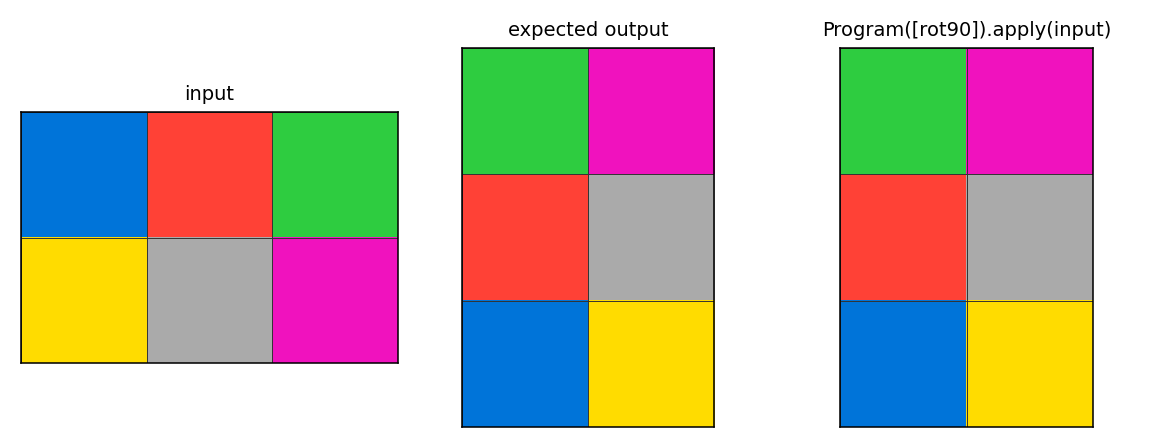
Left: the input of the training pair. Middle: the expected output. Right:
the output of Program([rot90]), which solve finds on this task.
3. Solve
solve(task, primitives, ...) reads the "train" list, calls explore, and
then calls refine on every candidate of the beam. Each candidate gets its
own seed (seed + i), so they explore different neighbourhoods. The best of
the refined programs is returned.
from dense_armor.core.graph import hmirror, rot90, solve

task = {"train": [{"input": [[1, 2, 3], [4, 5, 6]],
                   "output": [[3, 6], [2, 5], [1, 4]]}],
        "test": [{"input": [[7, 8], [9, 1]]}]}
program = solve(task, [rot90, hmirror], max_depth=2, beam_width=3,
                refine_iterations=10, seed=0)
print(repr(program))
The task is a Python dict with the format of the benchmark: "train" is a
list of {"input": ..., "output": ...}, "test" is a list of {"input":
...}. solve sees only the training pairs. The test inputs are not part of
the search; they are used only by to_submission.
4. Submit
to_submission(program, task) keeps the "train" list as it is and fills
each "test" entry with the program's output.
from dense_armor.core.graph import hmirror, rot90, solve, to_submission

task = {"train": [{"input": [[1, 2, 3], [4, 5, 6]],
                   "output": [[3, 6], [2, 5], [1, 4]]}],
        "test": [{"input": [[7, 8], [9, 1]]}]}
program = solve(task, [rot90, hmirror], max_depth=2, beam_width=3,
                refine_iterations=10, seed=0)
sub = to_submission(program, task)
print(sub["train"] == task["train"])
print(sub["test"][0]["output"])
The result is a dict in the same format as the input, with the "output" of
each test entry filled. to_submission does not check that the program is
correct on the training pairs; that is the caller's job, with
program.verify(pairs).
Details
explore is a breadth-first search with a beam. The candidates are the
compositions of the primitives up to max_depth; after each depth, the
beam_width best are kept, and the beam of every depth is collected into a
single pool at the end. The pool is sorted by (-verify, len(steps)): highest
score first, shorter program on a tie. This is why Program() (the empty
program) can come out: it is the only candidate of depth 0, and it stays in
the pool even if a longer program solves the task.
refine is a hill climb with three mutations: add a random step at a random
position, remove a random step, or replace a random step. It uses a
random.Random(seed) so a call is reproducible. It accepts a candidate only
if the score is strictly greater: a plateau of equal scores is not climbed.
The return value's score is never below the starting program's.
solve first runs explore with the given max_depth and beam_width, then
runs refine on each candidate of the beam with seed + i. The best program
by (verify, -len(steps)) is returned. If the training list is empty, solve
returns the empty program; the same for the search finding no candidates.
to_submission reads only the "test" list and writes only the "output" of
each entry. The "train" list is copied unchanged. The test inputs are not
inspected by solve.
The four functions are pure: they read their arguments and return a value.
solve and refine use a seeded random source; the same seed gives the
same result. explore and to_submission are deterministic.
References
The refinement loop is the theme of the ARC Prize 2025 report (Chollet
and others, arXiv:2601.10904, page 1: a per-task iterative program
optimization loop guided by a feedback signal). Page 5 separates two phases:
an exploration phase that generates candidate solutions, and a verification
phase that analyses them and produces a feedback signal. explore implements
the first phase, Program.verify implements the second, and refine is the
iteration between them.
The preference for shorter programs on a tie is the arc-dsl writeup
(Hodel, "The ARC-DSL", Section 2.3): a shorter program is less likely to
overfit the training pairs. _score and the final sort of explore use this
preference.
The format of the task and the format of the submission are the ones
of the ARC-AGI benchmark (Chollet, "On the Measure of Intelligence",
arXiv:1911.01547, Section 2). solve and to_submission do not depend on
the benchmark's data; they take a plain Python dict.
Choices stated explicitly
- The empty program is a candidate.
explorestarts fromProgram([])and keeps it in the pool. A user who wants only non-empty programs filters onlen(p.steps) > 0after the call. The empty program is the only candidate at depth 0, and it is how the search represents "do nothing", which is a legitimate rule for some tasks. - Ties are broken by shorter programs.
_scorereturns(verify, -len(steps)), and the final sort ofexploreuses the same pair. The reason is the arc-dsl writeup's note on shorter programs and overfitting. refineaccepts only strict improvements. A neighbour with the same score is not adopted. A user who wants to cross plateaus writes their own loop, or callsrefinefrom a different seed.- One seed per candidate in
solve. Candidateiusesseed + i, so the candidates refine in different directions. This is a choice of this implementation, not a requirement of the report. solverefines the beam, not the full space. The number of refined programs isbeam_width, not the number of candidates of every depth. A largerbeam_widthrefines more programs and takes more time.